Introduction: The Planetary Perspective, and the Plan of this Essay
(Prefatory Note: This blog is really a long essay that is mostly a slide show. You read it like a book, from the top down, with the slides, actuallyimage files, embedded with the text. The Table of Contents is on the right. To get to a particular section.you click on the title of the section you want.)
THE PLANETARY PERSPECTIVE
Whether the planets themselves are vicious is unclear. The Poimandres says they rule over humanity as fate, until the ascent. However there is a strong implication that if one makes the ascent before death, divesting oneself of each vice, one will escape fate before death. In fact, only if one does so before death will one pass quickly into heaven without the necessity of spending much of time in each sphere after death. From the Poimandres to the later doctrine of Purgatory, as for example in Dante, is not a large step.
A pictorial representation of the soul’s ascent through the planetary spheres was done in 1617 for the London-based physician and alchemist Robert Fludd (Slide 2a, from Utriusque Cosmi, Vol. II, Johann Theodor de Bry, engraver):

The ascent is preceded by a descent. Before birth the soul spirals down from Heaven, receiving imprints from the various spheres in accordance with the celestial configurations at the time of birth. Then at death the soul wings its way upward.So you can read the names of the spheres more easily, I have reproduced just the top half of Fludd's diagram (Slide 2b; clicking on the image will help).

First the soul goes through the four elements of earth, water, air, and fire. Then come the seven planetary spheres, followed by the sphere of the fixed stars, then the lower reaches of Heaven, and finally the Godhead. But in order to pass by each sphere, it must first purify itself of the evil pertaining to that sphere. The planets are listed in the order determined by the ancient Greek astronomer Ptolemy, who held that the seven planets--including the sun and moon but not the earth-- revolved around the earth. This theory had won out over the rival theory, that the planets, including the earth but not the moon, revolved around the sun. In Shakespeare's and Fludd’s day this heliocentric theory was more accepted, yet for literary and spiritual purposes the geocentric Ptolemaic system remained in use.
ASCENT THROUGH THE PLANETARY SPHERES: THE LARGER PERSPECTIVE
Fludd's picture of the planetary spheres is similar to illustrations that had appeared in astrological works for centuries (e.g. Slide 3, ca. 1350):

These astrological pictures were meant to illustrate the spheres a person's soul passed through at birth, to establish a person's astrological chart. Fludd has given the soul wings, by which it may ascend after death, as in the Poimandres.
Despite the debunking by Causubon, the Poimandres' idea of ascent through the planetary spheres after death may have been part of a tradition far older than the 2nd or 3rd century. I myself once visited the step-pyramid at Me Dun, near Cairo (Slide 4, photo by the author), one of the oldest known pyramids, built over 5000 years ago.

Inside the burial vault is a series of seven steps, starting near the middle of the room and ending at one wall (Slide 5, photo by the author; the people are our Egyptologist and a tour member).

Going up, each step is narrower than the one below. Correspondingly, the walls get narrower as they go up, in a series of seven indentations, so that the walls are as far apart as the steps. It immediately occurred to me that this structure might be an architectural reminder to the departing spirit, or to initiates in some mystery cult, of the soul’s mission to ascend through seven spheres after death.
In the time of the Roman Empire, accounts of the soul's ascent after death were not restricted to Egypt. The 4th century Roman philosopher Macrobius (English ed. 1990) combines it with an account of reincarnation. For him, however, the soul does not release its vices at the planetary spheres, and when the soul is too heavy with impurities to rise any further, it falls back to earth for another lifetime; then it has another chance to purify itself further.
Other ancient authors also wrote accounts of ascents through the planetary spheres. The Gnostics, nominally Christian but termed “heretics” by the early Church, had their versions. Shakespeare could have known about them from Irenaeus, a 2nd century so-called "Church Father" who wrote a book debunking people whose interpretations of Christianity did not fit his own. He wrote that these "so-called Gnostics" considered the seven planets as evil powers in the heavens, headed by the god of Genesis, and there were also seven demons below corresponding to them, headed by the serpent in the Garden of Eden (see Layton 175). The Latin version of Irenaeus’s book, newly edited by Erasmus, went through many editions and printings in heresy-obsessed 16th century Europe. This negative portrayal of the planetary spheres, contrary to the usual images of the Graeco-Roman gods, would have appealed to Shakespeare. But there is nothing about any ascents or confrontations with such powers.
An example of a Gnostic narrative that does specifically contain an ascent and confrontation with the powers is the Gospel of Mary, discovered in 18th century Egypt but probably written in the same 2nd or 3rd century Alexandria that produced the Corpus Hermeticum. Of course Shakespeare could have known only what he read in Irenaeus. In the Gospel of Mary, set after Jesus has ascended to heaven, Mary Magdalene tells the disciples that Jesus appeared to her in a vision, showing her how the soul may pass by the archons, i.e. authorities, that guard each sphere. Although the first part is missing, editor Karen King says that it probably describes an ascent through earth, water, and air. Next, the sphere of fire has within it seven so-called “powers of wrath,” obviously the planets, which Aristotle taught consisted of fire. Jesus gives each a highly negative description, as Mary tells the disciples:
As for the clown, two gravediggers near the end are given this designation. But one of the major characters also is quite a bit the clown. In comedia dell’arte, a stock comic character was an older gentleman, affecting much wisdom, named Pantalone. Shakespeare’s reference to the “pantaloon” in the sixth of the “Ages of Man” suggests that Jupiter might be the planet of such a clown, in the play corresponding to the king’s chief advisor, a self-styled expert on many things. He is a clown without knowing it. The only planet left out is Saturn.
THE PLAN OF THIS ESSAY
Later in the same tractate the pupil Tat has another experience. This one he describes more briefly.
Henry Vaughan latches onto that part of Tat's experience in describing what he expeiences when he has given to each of the seven spheres its vice, and he has entered the spheres above the seven planets. He says:
The first time, we will see his confrontations with Jupiter, Venus, and Luna. After them, you will see, Hamlet experiences matter in a new way, as a manifestation of the sacred. The principal confrontations here have to do with the feminine energies of Venus and Luna. He himself is represented by the planet Mercury, which has both a feminine and masculine aspect.
The second time, I will deal with his confrontations with Saturn, Sol, and Mars. After these confrontations Hamlet experiences what I would call the transcendent divine, that is, participation in a divinity that is beyond this world altogether.
Image sources, Planetary perspective:
1. Santi, B. (1982). The Marble Pavement of the Cathedral of Siena. Florence: Scala.Group22.
2a and b. Fabricius, Alchemy, 15.
3. Page, Sophie (2002). Astrology in Medieval Manuscripts. Toronto: University of Toronto Press, 36.
4 &5. Author’s photos, 1988.
6. German language brochure, details lost.
7. (a) Seznec, Survival of the Pagan Gods, 165; (b) Seznec, 159.
8. (a) Seznec, 165; (b) Page, 18. (c). Puttfarken, Thomas, Titian and Tragic Painting.: Aristotle’s Poetics and the Rise of the Modern Artist, 95.
THE PLANETARY PERSPECTIVE
In this blog I am going to present a view of Shakespeare's Hamlet that
I have not found elsewhere. It is a perspective that connects the play
with the visual art of his time, including some of its most famous
artworks. Viewing this artwork in the context of the play adds meaning
and emotional intensity to our experience of it and puts the artwork in
a living context as well.
In a nutshell, I am inviting us to see the play as a drama about the ascent of the spirit from mundane beginnings to divine heights. Each of the major characters, I submit, represents a kind of gate to be unlocked by the protagonist in the course of his quest, seven gates through the kingdom of shadows, into the kingdom of light, as it were. The journey is one that may be undertaken by either gender, but this particular route to the divine is one imaged in characteristically masculine terms. The images I shall be using come from astrology, from alchemy, from emblems used by families and individuals, and even from a few famous artists of the time, such as Botticelli, Durer, and Titian. I will also be using images illustrating the play itself, in art and film, to help bridge the gap between words on the page and these other images that do not directly reference the play.
In this blog the images are integrated with the text. For images that are wider than they are tall, the blogger program reduces the size so as to fit on their rather narrow page. To see them larger, with a few exceptions that I will warn you about, simply click on them. Then use your back browser to return to the integrated text.
I have entitled this blog "The Hermetic Hamlet." I call its perspective "Hermetic" because the most famous example in Shakespeare's time of ascent through the planetary realms was in the rediscovered Corpus Hermeticum, an ancient treatise in Greek supposedly authored by a figure named Hermes Trismegistus. It is my contention, to be worked out in the rest of this blog, that there is a close correspondence between Shakespere's characters in Hamlet and this work's characterizations of the planetary vices.
ASCENT THROUGH THE PLANETARY SPHERES: TRACTATE ONE OF THE CORPUS HERMETICUM
An artist's' depiction of Hermes Trismegistus appeared on the marble floor of Sienna Cathedral. This floor, because of its many famous designs, would have been on the itineraries of visiting English nobles.
(Slide 1, Giovanni di Stefano, 1488).

Marsilio Ficino, in the preface to his 15th century Latin translation (from Greek), said, “They called him Trismegistus or thrice-greatest because he was the greatest philosopher and the greatest priest and the greatest king” (Copenhaver xlviii).
St. Augustine and many others believed Hermes’ writings to have been part of Moses’ education in Egypt. In actual fact, the language and way of thinking was that of 2nd century Alexandria, as the French Protestant scholar Causabon established in 1614. After that, without the connection to Moses, the writings were mainly of interest to esoteric thinkers as opposed to the mainstream. In fact, "Hermetic" and "esoteric" became near-synonyms of each other. But that was not always so.
The Corpus Hermeticum came to the attention of the West in the mid-1400’s, when Cosimo di Medici of Florence purchased a copy in Greek that had been preserved in Constantinople. At Cosimo’s urging, Ficino’s Latin translation followed quickly. It went through many printings and spread all over Europe, even to far away England, where the Elizabethan poet George Peele wrote about a group of devotees of “Trismegistus and Pythagoras” under the patronage of the Earl of Northumberland (Acheson 115)
The first text of the Corpus, the Poimandres, was especially widely read. It is here that we find the main account of an ascent through the planetary spheres. A student, named Tat, is being instructed in a vision by a powerful spiritual presence named Mind. Mind describes the ascent of the soul after death:
In a nutshell, I am inviting us to see the play as a drama about the ascent of the spirit from mundane beginnings to divine heights. Each of the major characters, I submit, represents a kind of gate to be unlocked by the protagonist in the course of his quest, seven gates through the kingdom of shadows, into the kingdom of light, as it were. The journey is one that may be undertaken by either gender, but this particular route to the divine is one imaged in characteristically masculine terms. The images I shall be using come from astrology, from alchemy, from emblems used by families and individuals, and even from a few famous artists of the time, such as Botticelli, Durer, and Titian. I will also be using images illustrating the play itself, in art and film, to help bridge the gap between words on the page and these other images that do not directly reference the play.
In this blog the images are integrated with the text. For images that are wider than they are tall, the blogger program reduces the size so as to fit on their rather narrow page. To see them larger, with a few exceptions that I will warn you about, simply click on them. Then use your back browser to return to the integrated text.
I have entitled this blog "The Hermetic Hamlet." I call its perspective "Hermetic" because the most famous example in Shakespeare's time of ascent through the planetary realms was in the rediscovered Corpus Hermeticum, an ancient treatise in Greek supposedly authored by a figure named Hermes Trismegistus. It is my contention, to be worked out in the rest of this blog, that there is a close correspondence between Shakespere's characters in Hamlet and this work's characterizations of the planetary vices.
ASCENT THROUGH THE PLANETARY SPHERES: TRACTATE ONE OF THE CORPUS HERMETICUM
An artist's' depiction of Hermes Trismegistus appeared on the marble floor of Sienna Cathedral. This floor, because of its many famous designs, would have been on the itineraries of visiting English nobles.
(Slide 1, Giovanni di Stefano, 1488).

Marsilio Ficino, in the preface to his 15th century Latin translation (from Greek), said, “They called him Trismegistus or thrice-greatest because he was the greatest philosopher and the greatest priest and the greatest king” (Copenhaver xlviii).
St. Augustine and many others believed Hermes’ writings to have been part of Moses’ education in Egypt. In actual fact, the language and way of thinking was that of 2nd century Alexandria, as the French Protestant scholar Causabon established in 1614. After that, without the connection to Moses, the writings were mainly of interest to esoteric thinkers as opposed to the mainstream. In fact, "Hermetic" and "esoteric" became near-synonyms of each other. But that was not always so.
The Corpus Hermeticum came to the attention of the West in the mid-1400’s, when Cosimo di Medici of Florence purchased a copy in Greek that had been preserved in Constantinople. At Cosimo’s urging, Ficino’s Latin translation followed quickly. It went through many printings and spread all over Europe, even to far away England, where the Elizabethan poet George Peele wrote about a group of devotees of “Trismegistus and Pythagoras” under the patronage of the Earl of Northumberland (Acheson 115)
The first text of the Corpus, the Poimandres, was especially widely read. It is here that we find the main account of an ascent through the planetary spheres. A student, named Tat, is being instructed in a vision by a powerful spiritual presence named Mind. Mind describes the ascent of the soul after death:
And thereupon the man mounts upward through the structure of the heavens. And to the first zone of heaven he gives up the force which works increase and that which works decrease; to the second zone, the machinations of evil cunning; to the third zone, the lust whereby men are deceived; to the fourth zone, domineering arrogance; to the fifth zone, unholy daring and rash audacity; in the sixth zone, evil strivings after wealth; and in the seventh zone; the falsehood which lies in wait to work harm… (quoted in Martin 1987)A free English adaptation of the Poimandres' planetary sequence occurs in a 1620’s poem by the poet Henry Vaughan, not to be confused with his brother Thomas Vaughan.. Vaughan names the planet corresponding to each zone. (The full text is in Appendix C; I will quote the lines relevant to a particular planet, along with the corresponding lines in the Poimandres at the beginning of each chapter devoted to a planet). In both the Poimandres and Vaughan's poem, at each planetary zone the soul is to deposit the quantity of each vice that it has accumulated over its lifetime, and when empty of all seven it enters heaven.
Whether the planets themselves are vicious is unclear. The Poimandres says they rule over humanity as fate, until the ascent. However there is a strong implication that if one makes the ascent before death, divesting oneself of each vice, one will escape fate before death. In fact, only if one does so before death will one pass quickly into heaven without the necessity of spending much of time in each sphere after death. From the Poimandres to the later doctrine of Purgatory, as for example in Dante, is not a large step.
A pictorial representation of the soul’s ascent through the planetary spheres was done in 1617 for the London-based physician and alchemist Robert Fludd (Slide 2a, from Utriusque Cosmi, Vol. II, Johann Theodor de Bry, engraver):

The ascent is preceded by a descent. Before birth the soul spirals down from Heaven, receiving imprints from the various spheres in accordance with the celestial configurations at the time of birth. Then at death the soul wings its way upward.So you can read the names of the spheres more easily, I have reproduced just the top half of Fludd's diagram (Slide 2b; clicking on the image will help).

First the soul goes through the four elements of earth, water, air, and fire. Then come the seven planetary spheres, followed by the sphere of the fixed stars, then the lower reaches of Heaven, and finally the Godhead. But in order to pass by each sphere, it must first purify itself of the evil pertaining to that sphere. The planets are listed in the order determined by the ancient Greek astronomer Ptolemy, who held that the seven planets--including the sun and moon but not the earth-- revolved around the earth. This theory had won out over the rival theory, that the planets, including the earth but not the moon, revolved around the sun. In Shakespeare's and Fludd’s day this heliocentric theory was more accepted, yet for literary and spiritual purposes the geocentric Ptolemaic system remained in use.
ASCENT THROUGH THE PLANETARY SPHERES: THE LARGER PERSPECTIVE
Fludd's picture of the planetary spheres is similar to illustrations that had appeared in astrological works for centuries (e.g. Slide 3, ca. 1350):

These astrological pictures were meant to illustrate the spheres a person's soul passed through at birth, to establish a person's astrological chart. Fludd has given the soul wings, by which it may ascend after death, as in the Poimandres.
Despite the debunking by Causubon, the Poimandres' idea of ascent through the planetary spheres after death may have been part of a tradition far older than the 2nd or 3rd century. I myself once visited the step-pyramid at Me Dun, near Cairo (Slide 4, photo by the author), one of the oldest known pyramids, built over 5000 years ago.

Inside the burial vault is a series of seven steps, starting near the middle of the room and ending at one wall (Slide 5, photo by the author; the people are our Egyptologist and a tour member).

Going up, each step is narrower than the one below. Correspondingly, the walls get narrower as they go up, in a series of seven indentations, so that the walls are as far apart as the steps. It immediately occurred to me that this structure might be an architectural reminder to the departing spirit, or to initiates in some mystery cult, of the soul’s mission to ascend through seven spheres after death.
In the time of the Roman Empire, accounts of the soul's ascent after death were not restricted to Egypt. The 4th century Roman philosopher Macrobius (English ed. 1990) combines it with an account of reincarnation. For him, however, the soul does not release its vices at the planetary spheres, and when the soul is too heavy with impurities to rise any further, it falls back to earth for another lifetime; then it has another chance to purify itself further.
Other ancient authors also wrote accounts of ascents through the planetary spheres. The Gnostics, nominally Christian but termed “heretics” by the early Church, had their versions. Shakespeare could have known about them from Irenaeus, a 2nd century so-called "Church Father" who wrote a book debunking people whose interpretations of Christianity did not fit his own. He wrote that these "so-called Gnostics" considered the seven planets as evil powers in the heavens, headed by the god of Genesis, and there were also seven demons below corresponding to them, headed by the serpent in the Garden of Eden (see Layton 175). The Latin version of Irenaeus’s book, newly edited by Erasmus, went through many editions and printings in heresy-obsessed 16th century Europe. This negative portrayal of the planetary spheres, contrary to the usual images of the Graeco-Roman gods, would have appealed to Shakespeare. But there is nothing about any ascents or confrontations with such powers.
An example of a Gnostic narrative that does specifically contain an ascent and confrontation with the powers is the Gospel of Mary, discovered in 18th century Egypt but probably written in the same 2nd or 3rd century Alexandria that produced the Corpus Hermeticum. Of course Shakespeare could have known only what he read in Irenaeus. In the Gospel of Mary, set after Jesus has ascended to heaven, Mary Magdalene tells the disciples that Jesus appeared to her in a vision, showing her how the soul may pass by the archons, i.e. authorities, that guard each sphere. Although the first part is missing, editor Karen King says that it probably describes an ascent through earth, water, and air. Next, the sphere of fire has within it seven so-called “powers of wrath,” obviously the planets, which Aristotle taught consisted of fire. Jesus gives each a highly negative description, as Mary tells the disciples:
“…When the soul had overcome the third power, it went upwards and saw the fourth power, which took seven forms. The first form is darkness, the second desire, the third ignorance, the fourth is the excitement of death, the fifth is the kingdom of the flesh, the sixth is the foolish wisdom of the flesh, the seventh is the wrathful wisdom. These are the seven powers of wrath. They ask the soul, ‘Whence do you come, slayer of men, or where are you going, conqueror of space?’ The soul answered and said, ‘What binds me has been slain, and what surrounds me has been overcome, and my desire has been ended, and ignorance has died. In a world I was released form a world, and in a type from a heavenly type, and from the fetter of oblivion which is transient.’…” (Robinson 526)
Escaping
the planetary archons, or authorities, the soul is finally free.
Conceivably this story is what the Gospel of Luke interpreted as Jesus'
casting out seven devils. (As to how this list corresponds to the
planets and to the characters in Hamlet, see my explanation in Chapter
10, Appendix D. I quote it here merely to show the affinity in spirit
between Shakespeare and this Gnostic account.)
THIS-LIFE ASCENT NARRATIVES
Let me reiterate that Shakespeare could not have known this particular account, from the Gospel of Mary; it was not discovered until the 18th century and not generally accessible until the 20th. But initiatory journeys of ascent were already popular in literature, in narratives that did not depend on the narrator's having first died.. In Dante’s Divine Comedy, he travels through numerous circles of Hell, then seven layers of Purgatory, defined by the seven "mortal" sins, followed by another seven layers of Heaven, defined by the planets, all seen as good. In medieval romances, characters often embodied various sins and virtues, in relation to which the protagonists have new types of experience. An example is Wolfram von Eschenbach’s Parzival (around 1190), where the heroes encounter such damsels as Condwiramours, French for “Lead to Love,” and Orgeleuse, French for “Pride.” The names specify initiatory paths in relation to these characters, whether to vice or to virtue. Closer to Shakespeare's time, Spencer’s Faerie Queen used this type of structure. In Hamlet, too, there are descriptive names. Fortinbras, prince of Norway, is French for “strong in arms.” Ophelia suggests the English “of” abbreviated plus the Greek “Philia,” meaning love. Claudius is the name of the Roman emperor who was murdered by his nephew, just as in this play King Claudius is the target of his nephew Hamlet.
The prototype for Hamlet, the story of Amleth, prince of Jutland, is itself a kind of ascent story. To triumph over his evil uncle, Amleth had to foil four traps set for him. Perhaps originally each corresponded to of one of the four elements. Hamlet, in my view, besides retaining these four traps of strength and wit, also has seven major characters, each of which represents an obstacle in his path, and each of which embodies a particular kind of temptation or foil Hamlet has to avoid being trapped by. These seven traps are seven types of character weakness and seven personality-types, which correspond to stock personality characteristics for each of the seven planets.
In all these cases, the confrontation occurs in this life rather than after death.
THE "SEVEN AGES OF MAN"
Such accounts of course pertain to fictional heroes, contrived to teach moral lessons. But one idea was that for humanity in general there are “seven ages,” each corresponding to a different planet. On the same pavement as the depiction of Hermes Trismegistus is another design, illustrating the so-called “Seven Ages of Man” (Slide 6, Antonio Federighi, 1475, black and white marble):

The sequence starts with infantus, on the lower left, and goes clockwise around, through pueri, adolescentia, juvinitus, virilis, senectus, and finally decrepitas. (I apologize for the bad reproduction; it was all I could find containing the whole sequence. Even for that, I had to go to the Cathedral itself; an old brochure in German had just the one picture.)
That this series corresponds to the seven planetary realms illustrated by Fludd is shown in one of Shakespeare's plays, As You Like It (1600), where one of the characters, the melancholy aristocrat Jaques, delivers a poem on the subject (2.7.139ff; the poem as a whole is in my Chapter 10, Appendix). It begins:
THIS-LIFE ASCENT NARRATIVES
Let me reiterate that Shakespeare could not have known this particular account, from the Gospel of Mary; it was not discovered until the 18th century and not generally accessible until the 20th. But initiatory journeys of ascent were already popular in literature, in narratives that did not depend on the narrator's having first died.. In Dante’s Divine Comedy, he travels through numerous circles of Hell, then seven layers of Purgatory, defined by the seven "mortal" sins, followed by another seven layers of Heaven, defined by the planets, all seen as good. In medieval romances, characters often embodied various sins and virtues, in relation to which the protagonists have new types of experience. An example is Wolfram von Eschenbach’s Parzival (around 1190), where the heroes encounter such damsels as Condwiramours, French for “Lead to Love,” and Orgeleuse, French for “Pride.” The names specify initiatory paths in relation to these characters, whether to vice or to virtue. Closer to Shakespeare's time, Spencer’s Faerie Queen used this type of structure. In Hamlet, too, there are descriptive names. Fortinbras, prince of Norway, is French for “strong in arms.” Ophelia suggests the English “of” abbreviated plus the Greek “Philia,” meaning love. Claudius is the name of the Roman emperor who was murdered by his nephew, just as in this play King Claudius is the target of his nephew Hamlet.
The prototype for Hamlet, the story of Amleth, prince of Jutland, is itself a kind of ascent story. To triumph over his evil uncle, Amleth had to foil four traps set for him. Perhaps originally each corresponded to of one of the four elements. Hamlet, in my view, besides retaining these four traps of strength and wit, also has seven major characters, each of which represents an obstacle in his path, and each of which embodies a particular kind of temptation or foil Hamlet has to avoid being trapped by. These seven traps are seven types of character weakness and seven personality-types, which correspond to stock personality characteristics for each of the seven planets.
In all these cases, the confrontation occurs in this life rather than after death.
THE "SEVEN AGES OF MAN"
Such accounts of course pertain to fictional heroes, contrived to teach moral lessons. But one idea was that for humanity in general there are “seven ages,” each corresponding to a different planet. On the same pavement as the depiction of Hermes Trismegistus is another design, illustrating the so-called “Seven Ages of Man” (Slide 6, Antonio Federighi, 1475, black and white marble):

The sequence starts with infantus, on the lower left, and goes clockwise around, through pueri, adolescentia, juvinitus, virilis, senectus, and finally decrepitas. (I apologize for the bad reproduction; it was all I could find containing the whole sequence. Even for that, I had to go to the Cathedral itself; an old brochure in German had just the one picture.)
That this series corresponds to the seven planetary realms illustrated by Fludd is shown in one of Shakespeare's plays, As You Like It (1600), where one of the characters, the melancholy aristocrat Jaques, delivers a poem on the subject (2.7.139ff; the poem as a whole is in my Chapter 10, Appendix). It begins:
All the world’s a stage,
And all the men and women merely players.
They have their exits and their entrances,
And one man in his time plays many parts,
His acts being seven ages... (II.vii.139ff)
For
Jaques, the series exemplifies human folly. He does not mention the
planets, but the correspondences are too close to be coincidence.I do
want to mention them now, because now we are discussing Shakespeare.
This discussion may serve as an introduction to the sequence generally.
First comes the infant, “muling and puking” (II.vii.144). This stage is that of Luna, who as the goddess Diana governs childbirth.
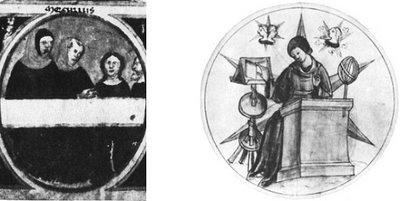
Next is the “schoolboy,” with his “satchel” and “shining morning face” (II.vii.145f). During the Middle Ages, Mercury was often depicted as the planet of scholars, speakers, and scribes. To a degree this is because Mercury, as messenger of the gods, governed communication. But medieval illustrations were often based on those in Arab astrological manuscripts, which used images derived from Babylonian mythology rather than Graeco-Roman. The Babylonian god Nebo was the gods’ scribe. Examples are Slides 7a and 7b, both showing showing Mercury as a scribe. In 7a ("Mercurius," detail of European manuscript illustrating the planets), others look on; in 7b ( illustration to an astronomical-astrological treatise by Michael Scott, composed 1250) he is alone.
Third is the lover, “sighing like a furnace, with a woeful ballad/ Made to his mistress’s eyebrow” (II.vii.148f). His planet is Venus. As the Babylonian deity was similar; there is no need for illustrations yet.
Fourth is the soldier, “quick in quarrel,/ Seeking the bubble reputation even in the cannon’s mouth” (II.vii.151ff) This, of course, is Mars. Again, the Babylonian equivalent was similar. This order, Mars before the Sun, is different from the Ptolemaic one and derives from Plato’s Timaeus.
Fifth is the “justice,” or magistrate, of “round belly,” full of “wise saws and modern instances” (II.vii.153ff). This corresponds to Sol, the Sun, often depicted as a king. This is not the Graeco-Roman Apollo, with customary lyre, but rather the sun-god proper, Helios or Sol. This god in medieval times also held political office. In Slide 8a, from the same series as Slide 7a, Sol is a king holding the sun in one hand and a and a scepter in the other. Slide 8b, from a 14th century manuscript, shows a similar figure, except that the spheroid looks more like an Easter egg.

Compare these images with that attached to a real monarch, e.g. Holy Roman Emperor Charles V (Slide 8c; Detail of engraving by Martin van Heemskerck):

Charles's loyal subject, blond like the sun, bows at right, his captive, a Lutheran heretic, glowers at left. The eagle is the bird of Jupiter, who of course in Graeco-Roman times was head of the gods.
Exactly how Helios got promoted to King in medieval manuscripts is unclear. But several possible explanations come to mind. The metal corresponding to the Sun was gold, which was also the most precious. Jupiter’s metal, by contrast, was tin. There was a natural symmetry between King and Queen, Sun and Moon, and gold and silver. The sun’s animal was the lion, king of beasts, who dominated over much bigger animals than Jupiter’s eagle. The sun provided warmth, more important in Western Europe than the thunder-god’s rain. Moreover, European astrology and alchemy derived from Arab sources, for which the sun was king, following ancient traditions of the eastern part of the Roman Empire, such as that of Mithras and Serapis/Osiris. Even the Christian day of worship was the day of the Sun, symbolizing Christ as the sun of resurrection.
The sixth age in Jaques' poem is the early retiree or elder statesman of:
First comes the infant, “muling and puking” (II.vii.144). This stage is that of Luna, who as the goddess Diana governs childbirth.
Next is the “schoolboy,” with his “satchel” and “shining morning face” (II.vii.145f). During the Middle Ages, Mercury was often depicted as the planet of scholars, speakers, and scribes. To a degree this is because Mercury, as messenger of the gods, governed communication. But medieval illustrations were often based on those in Arab astrological manuscripts, which used images derived from Babylonian mythology rather than Graeco-Roman. The Babylonian god Nebo was the gods’ scribe. Examples are Slides 7a and 7b, both showing showing Mercury as a scribe. In 7a ("Mercurius," detail of European manuscript illustrating the planets), others look on; in 7b ( illustration to an astronomical-astrological treatise by Michael Scott, composed 1250) he is alone.

Third is the lover, “sighing like a furnace, with a woeful ballad/ Made to his mistress’s eyebrow” (II.vii.148f). His planet is Venus. As the Babylonian deity was similar; there is no need for illustrations yet.
Fourth is the soldier, “quick in quarrel,/ Seeking the bubble reputation even in the cannon’s mouth” (II.vii.151ff) This, of course, is Mars. Again, the Babylonian equivalent was similar. This order, Mars before the Sun, is different from the Ptolemaic one and derives from Plato’s Timaeus.
Fifth is the “justice,” or magistrate, of “round belly,” full of “wise saws and modern instances” (II.vii.153ff). This corresponds to Sol, the Sun, often depicted as a king. This is not the Graeco-Roman Apollo, with customary lyre, but rather the sun-god proper, Helios or Sol. This god in medieval times also held political office. In Slide 8a, from the same series as Slide 7a, Sol is a king holding the sun in one hand and a and a scepter in the other. Slide 8b, from a 14th century manuscript, shows a similar figure, except that the spheroid looks more like an Easter egg.

Compare these images with that attached to a real monarch, e.g. Holy Roman Emperor Charles V (Slide 8c; Detail of engraving by Martin van Heemskerck):

Charles's loyal subject, blond like the sun, bows at right, his captive, a Lutheran heretic, glowers at left. The eagle is the bird of Jupiter, who of course in Graeco-Roman times was head of the gods.
Exactly how Helios got promoted to King in medieval manuscripts is unclear. But several possible explanations come to mind. The metal corresponding to the Sun was gold, which was also the most precious. Jupiter’s metal, by contrast, was tin. There was a natural symmetry between King and Queen, Sun and Moon, and gold and silver. The sun’s animal was the lion, king of beasts, who dominated over much bigger animals than Jupiter’s eagle. The sun provided warmth, more important in Western Europe than the thunder-god’s rain. Moreover, European astrology and alchemy derived from Arab sources, for which the sun was king, following ancient traditions of the eastern part of the Roman Empire, such as that of Mithras and Serapis/Osiris. Even the Christian day of worship was the day of the Sun, symbolizing Christ as the sun of resurrection.
The sixth age in Jaques' poem is the early retiree or elder statesman of:
…the lean and slipper’d pantaloon,
With spectacles on nose and pouch on side,
His youthful hose, well sav’d, a world too wide
For his shrunk shank; and his big manly voice,
Turning again toward childish treble, pipes
And whistles in his sound. (II.vii.158ff)
The
identification here depends on the fact that Jupiter is a generation
older the other planetary gods, all except Saturn, who is a generation
older still.
This last planet, dimmest and furthest out, governs the seventh stage, described by Shakespeare with the French word “sans,” meaning “without”: “sans teeth, sans eyes, sans taste, sans every thing” (VII.ii.166), Saturnian dimness, awaiting death.
It is my thesis that the play Hamlet is structured around such a sequence, in its case conforming closely to the one enunciated in the Poimandres, one to be done not after death but during life, confronting each vice, as in the medieval romances. The planets are represented by the seven major characters in the play, corresponding to the descriptions in the Poimandres. We will look at each characterization as we look at Hamlet's confrontation with each character in the play.
In fact, Hamlet himself points us toward taking a planetary perspective toward the characters, in his comments to the acting troupe that arrives at Elsinore to cheer him up. This speech is generally cut from performances. But notice the six stock characters Hamlet describes:
This last planet, dimmest and furthest out, governs the seventh stage, described by Shakespeare with the French word “sans,” meaning “without”: “sans teeth, sans eyes, sans taste, sans every thing” (VII.ii.166), Saturnian dimness, awaiting death.
It is my thesis that the play Hamlet is structured around such a sequence, in its case conforming closely to the one enunciated in the Poimandres, one to be done not after death but during life, confronting each vice, as in the medieval romances. The planets are represented by the seven major characters in the play, corresponding to the descriptions in the Poimandres. We will look at each characterization as we look at Hamlet's confrontation with each character in the play.
In fact, Hamlet himself points us toward taking a planetary perspective toward the characters, in his comments to the acting troupe that arrives at Elsinore to cheer him up. This speech is generally cut from performances. But notice the six stock characters Hamlet describes:
HAMLET. He that plays the King shall be welcome—his Majesty shall have tribute on me. The adventurous knight shall use his foil and target, the lover shall not sigh gratis, the humorous man shall end his part in peace, the clown shall make those laugh whose lungs are tickle a th’s ear, and the lady shall say her mind freely—or the blank verse shall halt for’t. (II.ii.318-324)Deriving from the medieval morality plays and the Italian commedia dell’arte, all of these characters, we shall see, make an appearance in the play itself, and in just the way Hamlet describes. Four are straightforward; the King is the Sun, the knight to Mars; the lover is Venus, and the Lady is the Moon. Hamlet’s “humorous man” is the one who is at the mercy of his humors, or moods, someone, in other words, who is mercurial, who goes up and down like a thermometer.
As for the clown, two gravediggers near the end are given this designation. But one of the major characters also is quite a bit the clown. In comedia dell’arte, a stock comic character was an older gentleman, affecting much wisdom, named Pantalone. Shakespeare’s reference to the “pantaloon” in the sixth of the “Ages of Man” suggests that Jupiter might be the planet of such a clown, in the play corresponding to the king’s chief advisor, a self-styled expert on many things. He is a clown without knowing it. The only planet left out is Saturn.
THE PLAN OF THIS ESSAY
The first tractate of the Corpus Hermeticum ends, we have seen, with the soul after death mounting the spheres until it has
passed all of them and is in the super-celestial place. The Corpus has
13 tractates more. How is the rest of it going to top what is in
the first essay? In fact, Tractate XIII does top it. This time there
are 12 evil powers,along with 10 good powers that oppose them. At the end,
when evil is defeated, the pupil Tat has a kind of epiphany of sorts,
an experience of the divine while still in the flesh. He says to Hermes
Trismegistus:
Since God has made me tranquil, father, I no longer picture things with the sight of my eyes but with the mental energy that comes through the powers. I am in heaven, in earth, in water, in air; I am in animals and in plants; in the womb, before the womb, after the womb; everywhere. (Copenhaver, Hermetica, p. 51)I submit that what Tat is describing is an experience of the immanent divine, a divinity that exists in all things.
Later in the same tractate the pupil Tat has another experience. This one he describes more briefly.
Father, I see the Universe and I see myself in Mind.He is now above everything that he experienced the divine as in before. It is an experience of being part of the transcendent divine.
(Copenhaver, Hermetica, p. 52)
Henry Vaughan latches onto that part of Tat's experience in describing what he expeiences when he has given to each of the seven spheres its vice, and he has entered the spheres above the seven planets. He says:
Get up, my disentangled soul, thy fireWhat does all this have to do with Hamlet? I hope to show that Hamlet's progress is toward both of these experiences of the divine.I will go through the play twice.
Is now refined, and nothing left to tire
Or clog thy wings. Now my auspicious flight
Hath brought me to the empyrean light,
I am a sep’rate essence, and can see
The emanations of the Deity...
With angels now and spirits I do dwell,
And here it is my nature to do well.
Thus, though my body you confined see,
My boundless thoughts have their ubiquity.
(Poems of Henry Vaughan, ed. Beeching, pp. 202-203. Accessible on web at Google Books. Search "Henry Vaughan ubiquity.")
The first time, we will see his confrontations with Jupiter, Venus, and Luna. After them, you will see, Hamlet experiences matter in a new way, as a manifestation of the sacred. The principal confrontations here have to do with the feminine energies of Venus and Luna. He himself is represented by the planet Mercury, which has both a feminine and masculine aspect.
The second time, I will deal with his confrontations with Saturn, Sol, and Mars. After these confrontations Hamlet experiences what I would call the transcendent divine, that is, participation in a divinity that is beyond this world altogether.
In
this second set of confrontations Shakespeare is also anticipating some
of the most profound thoughts of modern philosophy. In the 19th
century, his experiences were articulated by both Kierkegaard, and
Nietzsche. Their insights are still very much with us, as is of course
Hamlet himself.
Image sources, Planetary perspective:
1. Santi, B. (1982). The Marble Pavement of the Cathedral of Siena. Florence: Scala.Group22.
2a and b. Fabricius, Alchemy, 15.
3. Page, Sophie (2002). Astrology in Medieval Manuscripts. Toronto: University of Toronto Press, 36.
4 &5. Author’s photos, 1988.
6. German language brochure, details lost.
7. (a) Seznec, Survival of the Pagan Gods, 165; (b) Seznec, 159.
8. (a) Seznec, 165; (b) Page, 18. (c). Puttfarken, Thomas, Titian and Tragic Painting.: Aristotle’s Poetics and the Rise of the Modern Artist, 95.

0 Comments:
Post a Comment
<< Home