I-C: Venus; I-D: the Moon
PART I, SECTION C: VENUS
Ophelia says she wants to return some gifts he had given her. His response convinces Ophelia, if not those listening in, of Hamlet’s madness. He denies he ever gave them to her. She insists, saying that when the giver becomes unkind, gifts lose their sweetness with which they were given.
At this Hamlet says "Ha, Ha!" (3.1.103) and unleashes a tirade that Ophelia cannot even understand. (I will deal with it shortly.) As though sensing Ophelia's distress. he says, “I did love you once” (3.1.115). This mood is beautifully expressed in a still from Olivier’s version, Slide 27 (1948, with Jean Simmons as Ophelia).

Ophelia responds with, “Indeed, my lord, you made me believe so” (3.1.116). These are her father’s words, from her mouth.
At this Hamlet is desperate, a mood aptly captured by Branagh and Winslet in 1996 (Slide 28a). To add a little humor, one internet site has added captions to this still (Slide 28b,by Kate Sullivan, 2003); it does help bring out Hamlet’s feeling of desperation and betrayal, at how she follows her father's dictates rather than her own heart.

Hamlet explodes at her. "You should not have believed me... I loved you not” (3.1.117-119; Slide 29, Derek Jacobi and Lalla Ward, 1980).

He's lying of course, as a defensive reaction to her betrayal. As further defense, he explodes at her further. "Get thee to a nunnery. Why, wouldst thou be a breeder of sinners?...We are arrant knaves all, believe none of us. Go thy ways to a nunnery" (3.1.121-122, 129-130). There may be a double meaning to "nunnery," the second one being Elizabethan slang for a brothel. If so, Hamlet is adding insult to injury.
I have omitted a key interchange leading up to this display, because it needs extended treatment that will lead us out of the play altogether and into the wide world of Renaissance iconography. I think can only be understood properly from a planetary perspective. Let us start with Ophelia's insistence that Hamlet did indeed give her the gifts she is returning:
Exactly what Hamlet means has, I believe, eluded interpreters. It requires a planetary perspective. Honesty is a masculine god, Beauty a feminine one. And contrary to Ophelia, Castiglione, and Keats, here they do not get along. Seen this way, the abstractions mirror the two quarreling.
Renaissance emblems portrayed Venus in different ways. Some saw her as the epitome of grace and virtue (Slide 30, c. 1470), as in this illustration to De Sphaera:

Here are the words that accompany this illustration:
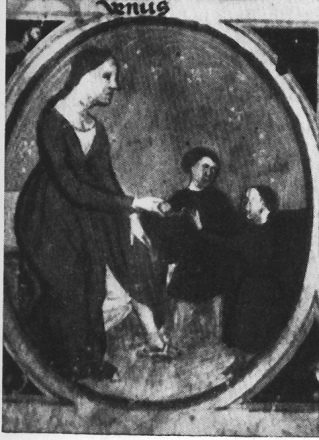
(Slide 31, from a medieval European manuscript):

She is even associated with deception. “Venus deceives and is deceived,” declares the motto to an Elizabethan engraving (Slide 32 below, 1593 engraving by Theodor de Bry, patriarch of the family that did the engravings for Robert Fludd and many of the alchemists, including Michael Maier and John Mylius). Both the female and the male are infected by this vice.

Thus she is the opposite of truth-telling.
As the Poimandres says, the sphere of Venus is that of “the lust by which men are deceived.” By her tempting and her deceptiveness, then, Beauty, i.e. Venus, would corrupt Honesty. But who personifies honesty, the one who can’t make Beauty like himself? Honesty is taking after his role-model Mercury. De Sphaera characterizes Mercury as “the enemy of. every vain affair.” As such, Mercury looks warily on Beauty’s flirtations.
Ficino, in his well known book on applying the planets in one’s life (I have already quoted its views on Saturn), imagines first Venus and then Mercury giving a speech to a group of older people who want to know how to live a long life. Mercury tells his audience that Venus should not even have been speaking, because “speeches belong to me,” as well as to them, older people with some wisdom. He warns that Venus “comes before your face as a friend, secretly as your enemy.” Besides being “embellished like a prostitute with rouge and ornaments,” and slowly killing you her glorification of sexual intercourse, she fashions those “wonderful allurements of taste by which daily you, secretly miserable, lose your life like people caught on a hook” (Ficino 211).
The paradox is that while we would think that Mercury’s presence would induce Beauty to be honest, in both senses, the real danger is that she will induce Mercury to become dishonest, in a broad sense. “Transformedinto a bawd,” means becoming not only a pimp, but anyone engaged in the business of counterfeit love, trafficking in whatever one’s desire is. To avoid being like her, and her father, Hamlet denies he ever loved her. That in itself, of course, is a blatant lie. Mercury, as god of communication, governs both lying and truth-telling.
A Renaissance pictorial example of Mercury’s attitude toward Venus, famous already in Shakespeare’s time, is Botticelli’s La Primavera (Slide 33, 1482).
 Venus stands in the middle of this love-fest, blessing a springtime scene of longing and dancing. On the opposite side form Mercury is the evil-looking Zephyr, chasing after the nymph Chloris. He has a purely physical love in mind, In nature what the wind does is to fertilize the plants and spread their seeds. The identity of the other lover is the one toward which Cupid’s arrow, above Venus, is pointing. Cupid’s victim is the middle of the Three Graces, dancing just to the left of
center. Scholars have identified her as Chastity. She looks longingly to her left at Mercury.
Venus stands in the middle of this love-fest, blessing a springtime scene of longing and dancing. On the opposite side form Mercury is the evil-looking Zephyr, chasing after the nymph Chloris. He has a purely physical love in mind, In nature what the wind does is to fertilize the plants and spread their seeds. The identity of the other lover is the one toward which Cupid’s arrow, above Venus, is pointing. Cupid’s victim is the middle of the Three Graces, dancing just to the left of
center. Scholars have identified her as Chastity. She looks longingly to her left at Mercury.
Mercury, however, is not looking at her. Likely repelled by the Claudius-like Zephyr, and disapproving of the Graces’ flimsy attire, he is looking upwards toward the sun, pointing his staff through Jupiter’s clouds. In the context of our play, Chastity would be Ophelia, longing for Hamlet’s love, while Hamlet trying to stay focused on the task given him by the Ghost.
Botticelli’s painting was so famous that there likely were tapestries done in imitation of it. “Arras,” the play’s word for what the spies are standing behind, in French means “tapestry.” Perhaps Hamlet is looking at this very scene as he lectures Ophelia.
At first Hamlet’s charge of dishonesty is of a general nature, reflecting his earlier conversation with Polonius and applying to any representative of Venus. But then he has a more specific issue. Hamlet asks Ophelia, “Where’s your father?” (3.1.130f). By now he has probably guessed that Ophelia is a decoy and that Polonius is spying. Ophelia answers, unconvincingly, “At home, my lord” (3.1.132). Hamlet, of course, gets even angrier, not saying she is a liar but rather something for Polonius’s benefit. “Let the doors be shut upon him, that he may play the fool nowhere else but in’s own house” (3.1.133f).
Yet everything that Hamlet hates in Ophelia he has in himself. He, too, is a deceiver, in pretending to be mad and to have never loved Ophelia. He, too, is a seducer, in that by his pretended madness and later his little play, he hopes to seduce Claudius into revealing his guilt. He, too, cowers in front of his father. Knowing this, Hamlet can only rage in all directions at once.
Titian did a painting that captures a similar male to female attitude, at least as far as the male's distancing himself and the female's expressing her longing (Slide 34). Titian used the myth of Venus and Adonis.

The story’s most familiar version was Ovid’s, where Venus gets a scratch from Cupid’s arrow and as a result falls in love with the beautiful young man Adonis. Since Adonis likes to hunt, Venus hunts with him and, as Ovid tells it, wins his love. After a while Adonis wants to hunt more than just the deer and rabbits that Venus insists on; he wants to hunt boars, wolves, bears, or lions. Venus pleads that to do so would likely mean his death. He does it anyway, when Venus is away, and of course is killed by a boar.
But Titian departs from Ovid in that for him Adonis does not wait until Venus has gone before going on his hunt. She grabs at him and he resists. To the left, her son Cupid, who might have helped her with an arrow, instead sleeps or weeps. The implication of the scene as Titian stages it is that Adonis is not just resisting her hunting advice, but her body as well. Just as Hamlet resists settling down with Ophelia, preferring to hunt for truth and justice, so Adonis goes boar hunting with his hounds. Dogs, as we shall see later in Titian’s Allegory of Prudence, can symbolize sniffing out the course ahead. Adonis, like Hamlet, is the questor after truth who will not be satisfied with creature comforts.
Shakespeare also had a Venus and Adonis, in his case a long narrative poem. Interestingly enough, it departs from Ovid in the same way as Titian’s painting, Adonis resisting Venus’s sexual advances. The famous art historian Irwin Panofsky, among others, speculated that Shakespeare or someone he knew saw a copy of Titian’s painting, because his words fit the scene so well: “With this he breaketh from the sweet embrace/ Of those fair arms which bound him to her breast” and “Leaves love upon her back, deeply distress’d” (l. 811ff)
For Shakespeare to have used Titian’s innovation, that would not have been strictly necessary, as the painting could have been seen in Madrid by someone else and described to Shakespeare, or remembered from 1554 when Philip II of Spain, Queen Mary’s husband, had the original delivered to him in London. Another version was in Prague, where English Court Astrologer John Dee could have seen it. And the painting was well-known for its backside view of Venus. Moreover, Shakespeare might have heard of a published attack on Titian’s painting. In his Il Riposo of 1584, Raffello Borghini criticized Titian for showing Adonis “fleeing from Venus, who is shown in the act of embracing him, whereas he very much desired her embraces” (Panofsky, 151)
One curious detail does support Panofsky’s specific claim. In Shakespeare’s poem, Adonis wears a “bonnet” to protect himself from the sun when he hunts, a bonnet that Venus later remembers fondly (l. 1087ff). This detail is not in Ovid, or other versions in art and verse, or even in most versions of the painting itself, including the ones that were in Madrid and Prague.

Yet one version of the painting (Slide 35, above), probably not by Titian himself, did feature just such a hunting cap. Art historians date the painting to the late 16th century, but can trace ownership for certain only as far back as 18th century Rome (although a few claim that it was in Prague). Logically it probably would have been in Venice at least long enough for copies to be made, as we know they were, for the cap appears again in an early 17th century version. A copy with the cap could easily have been brought back to England by a visiting noble, or seen and then described to Shakespeare—and if such a noble also knew the Madrid original, he might have noticed the cap, and perhaps had a good laugh.
Another feature makes this version closer to Shakespeare than the Madrid original. Adonis is noticeably younger and more delicate looking. We like to think that a boy would like nothing better than to be initiated into sex by an older, experienced woman. But that is not necessarily true, especially for one insecure in his budding manhood. Shakespeare’s Adonis gives his youth as one reason for not succumbing to Venus.
In any case, the widely recognized correspondence between the poem and the painting is another example of Shakespeare’s affinity with Titian’s sensibility.
Botticelli, if I may go back to the earlier Florentine painter, did another painting to show the effects of Venus’s charms. His “Mars and Venus” (Slide 36, below, 1485) shows a very un-martial Mars, Venus’s lover, after making love with her. His guard is down, and cherubs play with his armor. This is another danger of Venus: to lull one into complacency. In the soldiers’ view, Claudius is more concerned with his new wife than he is with the defense of the state, in contrast to their former king. Claudius relies on diplomacy; but diplomacy without a strong defense to back it up is self-deception, as the outcome of the play will demonstrate.
Hamlet is quite aware of Venus’s disarming nature; hence his own over-reaction to Ophelia. But it would be false to think that in railing at Ophelia he was really thinking about his mother, as the one who was the unfaithful and seductive one. Ophelia isn’t just someone who happened to be there when Hamlet was angry at his mother. She is guilty in her own right, of being dishonest to Hamlet and too faithful to her father. At the same time, to be sure, they have similarities; both, in Hamlet’s view, hope to seduce Hamlet into forgetting how unfaithful they were, the Queen to Old Hamlet and Ophelia to him.
For Hamlet they not only have different crimes, they correspond to two different conceptions of Venus, a distinction which the Renaissance carried over from ancient Greece.
As related in Plato’s Symposium, one was “Aphrodite Pandemos,” or “popular Aphrodite” (from “pan,” all, and “demos,” people), daughter of Zeus by the Titan Dione. She enacts or fails to enact the social roles men expect of their daughters and wives, in producing children, being gentle and dutiful, but also being deceptive and seductive.
Besides that Venus, there was another, born when Kronos, the Greek Saturn, cut off the testicles of his father Uranus, god of the heavens, and threw them into the sea. Out of the foam that gathered around them, and long before Jupiter or any of the other Olympian gods, was born “Uranian Aphrodite,” in Plato’s words, celestial or heavenly Venus. Botticelli captures her birth from the sea in his famous painting The Birth of Venus (Slide 37, c. 1485, below).

This Venus is beyond social roles. The Church attempted to co-opt her in its cult of the Virgin Mary. Plato characterizes her as purely spiritual, as opposed to the purely physical other Venus.
In The Renaissance, Titian did a famous painting generally regarded as showing both together; in the 18th century it acquired the name “Sacred and Profane Love” (Slide 38, 1514, below).

Here “Profane” means worldly, and corresponds to the figure on the left, holding a jewel box tightly. The “sacred” one is on the right, holding a torch.
Whether she is purely spiritual is not clear. Apart from her sensuously displayed body, another reason for questioning this designation is that the scene to her right includes an amorous couple lying in the field, almost at the edge of the painting, while a shepherd and his flock nearby seem to be minding their own business (Slide 39 below, detail of 38, right-hand edge, half-way down). I am not entirely sure where the lady’s right hand is positioned; it might be at his crotch.)

There are other scenes of animal vitality. On the left side, two rabbits stare at us, while a knight gallops homeward to his castle (Slide 40a and b, below). On the right side, in the same meadow as the lovers and the shepherd, a hound chases a rabbit while two riders watch (Slide 40b).
Art historians take the two rabbits on the left as signs that the female on the left represents physical love. Rabbits are traditional images of fertility. But I do not think that is quite right. This woman is demure, thoughtful, practical-looking, even a bit apprehensive (Slide 38 above).
Rather than using the Platonic/Christian distinction between physical and spirituial here, I would define the contrast as conscious calculation versus surrender to an unknown.. The woman on the left has conscious ego-concerns such as household, children, prestige, and so on. And there are penalties for failing to fulfill expectations, as illustrated on the sarcophagus by the figure being whipped, and behind him or her a woman standing beside a tree, suggesting the tree of knowledge (Slide 41a). The tail on the other figure at the tree suggests the devil (Slide 41b, a computer enhancement using a different photo of the painting).

Similarly, the castle behind her can be either protective or punitive (Slide 38 again, repeated below). A negative in the woman’s calculations is that the husband may die or be unfaithful, in either case a source of great pain. As I have said, the lady looks apprehensive. The box she holds may be that of her own sexuality. It is said that the painting was a wedding-present to a young widow who had been fearful of marrying again.
Against such calculations, the figure on the right seems to be urging their abandonment and giving oneself to love, both the uncalculated erotic and uncalculated spiritual aspect of a person’s longings. In contrast to the castle, symbolic of the ego’s defenses, the right side has a church and the open sea, symbolic of the spiritual and immeasurable. The two women are virtual twins: they are two aspects of one person. Cupid, the God of Love, stands between them, stirring the waters, waters that may be of death or life, sarcophagus or fountain. Later we shall see what the alchemists did with this antithetical image. At the bottom of this tomb or bath, water pours out to nourish the plant, the wild rose sacred to the elemental Venus.
The prospective bride must balance the two sides of her nature. Ophelia may have been listening to this Celestial Venus, with her sensuality, before her father intervened. But Celestial Venus cannot simply be invited and then dismissed. She is an energy in her own right, apart from a person’s will. Dismissing her as Ophelia does is to invite consequences. In contrast to Ophelia, Hamlet’s mother, who is not shown as anyone’s daughter, never seems to be without that energy, both for Hamlet and for Claudius. She wears it not as clothing but as part of her very skin. We shall hear more from this goddess later.
Image Sources: Venus.
27. www.oscars.org/press/pressreleases/2002/02.09.17.html.
28. (a) www.aboutfilm.com/features/eternalsunshine/hamlet.jpeg. (b) www.sullivanet.com/misc/hamlet/bran1.jpg.
29. http://arlenestage.homestead.com/JacobiHamlet.html.
30. Walther, Ingo F., & Wolf, Norbert, Codices Illustres: The world’s most famous illuminated manuscripts. 316.
31. Seznec, Survival of the Pagan Gods, 165.
32. de Rola, The Golden Game, 15.
33. http://www.andriaroberto.com/Botticelli%20-%20Primavera.jpg.
34. www.wga.hu/art/t/tiziano/mytholo2/venus_ac.jpg.
35. http://www.terminartors.com/museumdetailed?ID=628.
36. www.artchive.com/artchive/b/botticelli/venus_mars.jpg.
37. www.mezzo-mondo.com/arts/mm/botticelli/BOS001_L.jpg.
38. www.colorado.edu/FRIT/cravenp/Ital3030/sacredandprofane.gif.
39, 40. Joannides, P., Titian to 1518: The assumption of genius, 191.
41. Joannides, 191, 189.
PART I, SECTION D: THE MOON
Where I want us to pick up the action is as Hamlet answers his mother's summons to meet with her in her so-called "closet," a kind of anteroom to her bedroom. Convinced as he is of Claudius's guilt, he relishes the opportunity. He must expose the villain to her, however painful it is to her. He must "be cruel to be kind," he tells himself. Yet he is aware that he is very much keyed up; thus he must “speak daggers only, not use them” (Slide 42, Derek Jacobi, 1980).

The tapestry behind Jacobi, an "Assumption of the Virgin" expresses one aspect of the Queen's mythic dimensions well. Hamlet is entering the lair of the mother-dragon, the planetary sphere of Luna.
Luna is often represented simply as a woman holding the moon (Slide 43a, medieval European manuscript, below).

The Poimandres characterizes hers as the sphere of “the power of increase and decrease.” I take this to mean either the vagaries of fortune, giving a person more at one time and less at another, or that which makes us grow as a child and shrink in old age.
If the former, she merges with the goddess Fortuna, with her Wheel of Fortune (Slide 43b, “Wheel of Fortune” card, “Bembo” Tarocchi, mid-15th century). A man who has everything may well, in the next turn of the wheel, lose it all. One’s fortunes wax and wane like the phases of the moon, or the tides that go in and out in time with her motion. She is the "inconstant moon," as Romeo tells Juliet in another play. When our fortune is bad, moreover, we commit the deadly sin of envy, associated with the Moon.
The play occasionally compares Queen Gertrude to Fortuna. When Hamlet’s school friends Rosenkranz and Guildenstern joke about not being in Fortune’s favor, Hamlet characterizes her as a “strumpet.” He has his mother in mind. Later she is “outrageous fortune” who sends “slings and arrows." The Queen is the “imperial jointress,” as Claudius calls her; by her favors, she in effect chooses her king and consort.
Lilly characterizes the positive side of Luna as follows:
As the Roman goddess Diana, Luna governs childbirth and childrearing, part of the other sense of “increase and decrease.” Ficino sees her as governing the growth of all living things, as well as their strength or weakness. She is thus one manifestation of the Great Mother goddess, as illustrated by multi-breasted Diana of Ephesus in the Hellenistic city that later became sacred to the Virgin Mary.
The shrine, if not the statue itself, appears in Shakespeare’s play Pericles Prince of Tyre. But the statue was well-known (Slide 44a, Hellenistic sculpture). One alchemist after Shakespeare’s time incorporated it his engravings (Slide 44b, frontispiece to Actorum Chymicorum Holmiensium, 1712). Here she is not only Diana and feminine Mercury, but also Celestial Venus to masculine Mercury’s Cupid

The figures below the goddess’s bust represent the animal, vegatble and mineral forms of Mercury. Cupid is dwarfed by her immense presence even as he stands in the clothes and other attributes of his dead King, in a heap along with his own quiver (Slide 45 below, detail of 44b).

Since Cupid is here, we may infer that this Diana is also Venus--the celestial Venus, of course, the great goddess.
Diana the Moon-goddess is also the Luna of lunacy. Slide 46 shows Luna as Diana, wounding her victims’ minds with her arrows (“Luna and her Children,” c. 1410, 1415, Harley MS 4431, f. 102).

Slide 47 shows their faces more clearly (especially if you click on it):

In Hamlet’s case, a major cause of his particular form of madness, melancholia that shoots outward one minute and inward at another, is his fury at his mother’s remarriage and his envy of Claudius, combined with an equally strong desire to be closer to her, to replace Claudius as her intimate companion. Torn both ways, his ego is unstable. It is the unresolved Oedipus Complex, just as Freud said, although at this point in our analysis it is the desire for intimacy rather than sex. Luna is the Mother-goddess who tears him apart.
.
Entering his mother’s closet, a kind of drawing room adjoining her bedroom, Hamlet is ready to set his mother straight. After Claudius’s display, he can justifiably lecture her for her faithlessness and bad judgment in marrying Claudius. At the same time Gertrude has her own agenda. She is angry at Hamlet for upsetting Claudius.
What ensues is a contest of wills between the two, a favorite subject in alchemical illustrations, for example Slide 48, of a wolf and a dog fighting (Emblem 6 of De Lapide Philosophico, 1625. “Lambsprinck,” author, Lucas Jennis, engraver).

Of the animals, the accompanying epigram says, “The Sages tell us that they are descended from the same stock, but the wolf came from the east and the dog from the west. They are full of jealousy, fury, rage, and madness.” We have already met the wolf as Antimony, Hamlet’s caustic rage at his mother’s new marriage. The dog, also called “the Armenian bitch,” is of course Mercury in feminine form.
Gertrude starts by saying, “You have your father much offended,” referring to Claudius and the playlet. Hamlet replies with “You have my father much offended,” referring to Old Hamlet and her marriage (3.4.8ff) “You answer with an idle tongue,” she says. “You question with a wicked tongue,” he retorts. She gets up to leave. He orders her to sit down. In the Quarto version of the play, she later says, describing the scene to her husband, “Then he throws and tosses me about.” Evidently he forcibly prevents her from going (Jenkins 3190. In some productions, such as Zefferelli’s with Mel Gibson and Glenn Close, he even throws her on a bed (Slide 49)—the better to emphasize the sexual tension, ignoring the play’s specification that they are in an anteroom.

Gertrude is so alarmed that she instinctively calls for help. Polonius, from behind the curtain, says, “What ho? Help!” (3.4.21). Hamlet shouts, "How now? A rat. Dead for a ducat, dead", and thrusts his rapier into the arras, or tapestry (Slide 50a, A.H. Brown, engraving, c. 1838).

“Is it the King?” Hamlet asks. Lifting the arras, he finds a dead Polonius instead (Slide 50b above, Delacroix, lithograph, 1843).
This was the second trap set by his enemies: the spy in the Queen’s bedroom, to see if Hamlet would drop his madness with her. As in the sources, Hamlet foils the trap by killing the spy. But he hadn’t expected it to be Polonius. “I took thee for thy better,” he says (3.4.32). He had assumed it was the King. To kill him in the act of spying would have been to catch him in a guilty act, keeping him out of Heaven and also raising suspicions in the eyes of the court.
This scene, too, has its alchemical equivalent (Slide 51, Emblem 4, Viatorium (The Wayfarer’s Guide, 1618. Michael Maier, author, Johann Theodor de Bry, engraver).

In the alchemical fable told by Meier, Mucius Scaevola stabs the secretary of King Lars Porsenna, whom he mistakes for the King. According to de Rola, at this moment of the work, the alchemist quite deliberately dissolves a substance other than gold, which nonetheless has all the appearance of gold. In the emblem, the assassin heating his sword in the background is a nice parallel to Hamlet’s worked-up state, when, as he says, “I could drink hot blood” (III.ii.381). The full title of Meier’s book is of interest: The Wayfarer’s Guide, that is, Of the Mountains of the Seven Planets or Metals. The sojourner in life, like Hamlet as I am presenting him, has seven mountains to climb.
Hamlet ignores Polonius’s body and continues his tirade against his mother. He shows her his locket with Old Hamlet’s portrait, and compares it to the locket his mother wears around her neck of Claudius (Slide 52, Derek Jacobi and Claire Bloom, 1980):


He lectures Hamlet not to spend his time attacking his mother, which he considers a side-track.
An alchemical illustration captures this moment, too. In Slide 55 a ghostly male figure on the right points downward, away from Luna, to the vessel below her, filled with solvent.

Slide 55. Solutio, Emblem 6, Philosohia Reformata, 1st series, 1622. Johann Daniel Mylius, author, Lucas Jennis, engraver.
Inside is probably a powerful poison, such as “oil of vitriol,” which the alchemists also called “the blood of the Green Lion”; it is the fire Hamlet feels when he thinks of his father’s fate. With his mother in this scene, Hamlet, fixated on his father’s glory like the Green Lion in the picture, is rebuked by the Ghost for berating his mother (Slide 56, Kenneth Branagh and Julie Christie).

Then the Ghost disappears, never to return. He is no longer a source of compulsion within Hamlet’s soul.
Hamlet ignores the ghost’s warning and continues on. Another illustration shows what is happening to Hamlet and his mother as they fight. Their enmity is dissolving in the Mercury common to both (Slide 57, below).

Slide 57, Solutio, Emblem 4 of Philosophia Reformata, 2nd series, 1622, Johann Daniel Mylius, author, Lucas Jennis, engraver.
Gertrude has melted a little under the onslaught, and he as well. She says, “Thou turnest my eyes into my very soul /And there I see such black and grained spots/ As will not leave their tinct” (3.4.91ff). Shakespeare’s image suggests a chemical process known to the alchemists: lunar silver nitrate turns black when exposed to light, a process later used in early photography. Similarly, the Queen sees her soul turn black when exposed to Hamlet’s illumination. An emotional shift is implied. She does not agree to Hamlet’s demand that she leave off making love to Claudius. But she does agree not to tell Claudius about their conversation. “Be thou assured,” she says, “if words be made of breath, /and breath of life, I have no life to breathe/ What thou has said to me” (3.4.199ff). Hamlet at least has an ally he can trust. He has established his longed-for connection with her, not on the terms he wanted, but he has something, a coniunctio of trust, of the soul rather than the body. And his madness slowly begins to lift.
The alchemical coniunctio that Hamlet is experiencing again has an incestuous quality (Slide 58, Coniunctio, or Coitus, Emblem 5 of the Rosarium Philosophorum, 1558).

Despite earlier being declared brother/sister incest, it is now something else. The commentary to a later emblem in the Rosarium series has Luna saying “Never did I become a mother, /Until the time I was born another…/Then it was I first knew my son, /And we two became as one” (Fabricius 131). The incest Hamlet labeled brother/sister, projected onto Claudius, is now revealed as between son and mother. However it is of a spiritual rather than physical nature.
As Plato said, there are two Venuses, with different origins. We saw the earthly one as Ophelia; the celestial, for Hamlet, is his mother. This celestial Venus is a primordial power, the universal force of attraction, for which the whole universe groans in yearning. For the alchemists her birth had symbolic significance. She came to be when Saturn cut off the testicles of his father Uranus, god of heaven, and threw them in the sea. Then she arose on the foam, as Botticelli pictured her in his unforgettable painting, The Birth of Venus (Slide 59, below).
The alchemists saw Saturn's act of throwing Uranus's testicles into the sea as symbolizing the introduction of spirit into matter. Thus this Venus was for them the Anima Mercury, the Mercurial Soul, whose womb radiates wherever it lies hidden in matter. (Slide 60, Anima Mercury, from the Quinta Essentia, 1579, Leonhard Thurneisser zum Thurn, author, Hans Steinman, engraver).

It is this Venus with which our play has now made contact. We will see this new way of being expressed more by Ophelia than by Hamlet.
Image Sources, Moon.
42. http://arlenestage.homestead.com/JacobiHamlet.html.
43. (a) Seznec, Survival of the Pagan Gods, 165. (b) Brian Innes, Tarot, 37.
44. www.keyway.ca/jpg/artemis.jpg. (b) Fabricius, Alchemy, 54.
45. Detail of 44b.
46. Page, Sophie (2002). Astrology in Medieval Manuscripts, 50.
47. Detail of 46.
48. Fabricius, Alchemy, 41
49. http://www.geocities.com/queeniemab/.
50. (a) www.leoyan.com/global-language.com/ENFOLDED/YOUNG/index.html.
(b) www.english.emory.edu/classes/Shakespeare_Illustrated/dh.html.
51. de Rola, The Golden Game, 130.
52. http://arlenestage.homestead.com/JacobiHamlet.html.
53. Zichy Mulhavy (on web, but I can no longer find it).
54. www.compusmart.ab.ca/hamlet/hamletimages/branagh.htm.
55. de Rola, Golden Game, 169.
56. www.compusmart.ab.ca/hamlet/hamletimages/branagh.htm.
57. de Rola, 174.
58. Fabricius, 80.
59. http://metalloarts.com/birth-of-fortuna/.
60. Fabricius, 36.
...to the third zone, the lust whereby men are deceived...Ophelia--even the name suggests love, "philia" being one word for love in Greek. Hamlet’s confrontation with this earthly Venus comes soon enough. Again, he is walking in a hallway. The occasion is a pretext concocted by her father, who along with Claudius is hiding behind a tapestry, called in the play an Arras, so as to spy on them. This is the first trap that Claudius has set for him, in the sources: by eavesdropping, to see whether he still acts crazy when presented with a beautiful girl.
(Corpus Hermeticum I, 2rd century)
Those fond Affections which made me a slave
To handsome Faces, Venus thou shalt have.
(Henry Vaughan, 17th century.)
Ophelia says she wants to return some gifts he had given her. His response convinces Ophelia, if not those listening in, of Hamlet’s madness. He denies he ever gave them to her. She insists, saying that when the giver becomes unkind, gifts lose their sweetness with which they were given.
At this Hamlet says "Ha, Ha!" (3.1.103) and unleashes a tirade that Ophelia cannot even understand. (I will deal with it shortly.) As though sensing Ophelia's distress. he says, “I did love you once” (3.1.115). This mood is beautifully expressed in a still from Olivier’s version, Slide 27 (1948, with Jean Simmons as Ophelia).

Ophelia responds with, “Indeed, my lord, you made me believe so” (3.1.116). These are her father’s words, from her mouth.
At this Hamlet is desperate, a mood aptly captured by Branagh and Winslet in 1996 (Slide 28a). To add a little humor, one internet site has added captions to this still (Slide 28b,by Kate Sullivan, 2003); it does help bring out Hamlet’s feeling of desperation and betrayal, at how she follows her father's dictates rather than her own heart.

Hamlet explodes at her. "You should not have believed me... I loved you not” (3.1.117-119; Slide 29, Derek Jacobi and Lalla Ward, 1980).

He's lying of course, as a defensive reaction to her betrayal. As further defense, he explodes at her further. "Get thee to a nunnery. Why, wouldst thou be a breeder of sinners?...We are arrant knaves all, believe none of us. Go thy ways to a nunnery" (3.1.121-122, 129-130). There may be a double meaning to "nunnery," the second one being Elizabethan slang for a brothel. If so, Hamlet is adding insult to injury.
I have omitted a key interchange leading up to this display, because it needs extended treatment that will lead us out of the play altogether and into the wide world of Renaissance iconography. I think can only be understood properly from a planetary perspective. Let us start with Ophelia's insistence that Hamlet did indeed give her the gifts she is returning:
HAMLET. ...I never gave you ought.Hamlet seems to be reacting to Ophelia's statement that Hamlet's attitude toward her has changed. To be sure, it has, but the change is more complex than Ophelia realizes. At first, his reaction was to women and sexuality in general, because of his mother's remarriage. Now his reaction is to Ophelia's distancing herself from him out of fear of her father. In reply he takes refuge in abstractions and paradox. But Ophelia has done some reading in philosophy herself:
OPHELIA. My honour'd lord, you know right well you did,
And with them words of so sweet breath compos'd
As made the things more rich. Their perfume lost,
Take these again; for to the noble mind
Rich gifts wax poor when givers prove unkind.
There, my lord.HAMLET. Ha, ha! Are you honest?
OPHELIA. My lord?
HAMLET. Are you fair?
OPHELIA. What means your lordship?
HAMLET. That if you be honest and fair, your honesty should admit no discourse to your beauty. (3.1.96-109)
OPHELIA. Could beauty, my lord, have better commerce than with honesty? (3.1.110)Ophelia's reply here is something that comes out of a book. Castiliogne’s Courtier was all the rage in Elizabethan England It presents the view that a beautiful face reflects a virtuous character, while ugliness reflects vice.To be more beautiful, be more truthful. Or as John Keats would say later, “Truth is beauty, beauty, truth.” Beauty and honesty not only went well together, they were two sides of the same coin, the same being. But Hamlet does not agree:
HAMLET. If you be honest and fair, your honesty should admit no discourse to your beauty. Ay, truly, for the power of beauty will sooner transform honesty from what it is to a bawd than the force of honesty can translate beauty into his likeness. This was sometime a paradox, but now the time gives it proof. I did love you once.Hamlet's speech is a mass of abstractions and quite difficult to deliver in a way that fits the meaning. The usual interpretation is that by honesty Hamlet means chastity. Beauty’s power is such that it does not remain chaste, i.e. faithful to one person. To say the speech dramatically with such an interpretation is not an easy thing to do. Moreover, it does not take into consideration how Hamlet refers to honesty with the masculine possessive “his.” Chastity is a feminine personification, known to the Renaissance as one of the Three Graces.
OPHELIA. I was the more deceived. (3.1.111-120)
Exactly what Hamlet means has, I believe, eluded interpreters. It requires a planetary perspective. Honesty is a masculine god, Beauty a feminine one. And contrary to Ophelia, Castiglione, and Keats, here they do not get along. Seen this way, the abstractions mirror the two quarreling.
Renaissance emblems portrayed Venus in different ways. Some saw her as the epitome of grace and virtue (Slide 30, c. 1470), as in this illustration to De Sphaera:

Here are the words that accompany this illustration:
Gracious Venus, by her ardour,William Lilly said similarly, in characterizing the influence of Venus, "when well favored":
Kindles gentle hearts, wherefore in singing,
And dancing and beautiful festivals for love,
She leads them on with her delightful glances.
(La graziosa Vener del suo ardore
I cuor gentili onde in cantare
Et danze et vaghe feste per amore
L’induce col suave vagheggiare.)
She signifies a quiet man, not given to Law, Quarrel or Wrangling, not Vitious, Pleasant, Neat and Spruce, Loving Mirth in his words and actions, cleanly in Apparel, rather Drinking much then Gluttonous, prone to Venery, oft entangles in Love-matters, Zealous in their affections, Musical, delighting in Baths, and all honest merry meetings, or Maskes and Stage-playes, easie of Belief, and not given to Labour, or take any Pains, a Company-keeper, Cheerful, nothing Mistrustful, a right vertuous man or Woman, oft had in some Jealousie, yet no cause for it.To this there was an opposing view. Beauty was the occasion for vice. Lilly again:
Then he is Riotous, Expensive, wholly given to Loosenesse and Lewd companies of Women, nothing regarding his Reputation, coveting unlawful Beds, Incestuous, an Adulterer; Fennatical, a meer Skip-jack, of no Faith, no Repute, no Credit; spending his Means in Ale-houses, Taverns, and amongst Scandalous, Loose people; a meen Lazy companion, nothing careful of the the things of this Life, or any thing Religious; a meer Atheist and natural man.(http://www.renaissanceastrology.com/venus.html)The medieval series from which I have already taken other images shows Venus displaying her ankle to a group of men
(Slide 31, from a medieval European manuscript):
She is even associated with deception. “Venus deceives and is deceived,” declares the motto to an Elizabethan engraving (Slide 32 below, 1593 engraving by Theodor de Bry, patriarch of the family that did the engravings for Robert Fludd and many of the alchemists, including Michael Maier and John Mylius). Both the female and the male are infected by this vice.

Thus she is the opposite of truth-telling.
As the Poimandres says, the sphere of Venus is that of “the lust by which men are deceived.” By her tempting and her deceptiveness, then, Beauty, i.e. Venus, would corrupt Honesty. But who personifies honesty, the one who can’t make Beauty like himself? Honesty is taking after his role-model Mercury. De Sphaera characterizes Mercury as “the enemy of. every vain affair.” As such, Mercury looks warily on Beauty’s flirtations.
Ficino, in his well known book on applying the planets in one’s life (I have already quoted its views on Saturn), imagines first Venus and then Mercury giving a speech to a group of older people who want to know how to live a long life. Mercury tells his audience that Venus should not even have been speaking, because “speeches belong to me,” as well as to them, older people with some wisdom. He warns that Venus “comes before your face as a friend, secretly as your enemy.” Besides being “embellished like a prostitute with rouge and ornaments,” and slowly killing you her glorification of sexual intercourse, she fashions those “wonderful allurements of taste by which daily you, secretly miserable, lose your life like people caught on a hook” (Ficino 211).
The paradox is that while we would think that Mercury’s presence would induce Beauty to be honest, in both senses, the real danger is that she will induce Mercury to become dishonest, in a broad sense. “Transformedinto a bawd,” means becoming not only a pimp, but anyone engaged in the business of counterfeit love, trafficking in whatever one’s desire is. To avoid being like her, and her father, Hamlet denies he ever loved her. That in itself, of course, is a blatant lie. Mercury, as god of communication, governs both lying and truth-telling.
A Renaissance pictorial example of Mercury’s attitude toward Venus, famous already in Shakespeare’s time, is Botticelli’s La Primavera (Slide 33, 1482).
 Venus stands in the middle of this love-fest, blessing a springtime scene of longing and dancing. On the opposite side form Mercury is the evil-looking Zephyr, chasing after the nymph Chloris. He has a purely physical love in mind, In nature what the wind does is to fertilize the plants and spread their seeds. The identity of the other lover is the one toward which Cupid’s arrow, above Venus, is pointing. Cupid’s victim is the middle of the Three Graces, dancing just to the left of
center. Scholars have identified her as Chastity. She looks longingly to her left at Mercury.
Venus stands in the middle of this love-fest, blessing a springtime scene of longing and dancing. On the opposite side form Mercury is the evil-looking Zephyr, chasing after the nymph Chloris. He has a purely physical love in mind, In nature what the wind does is to fertilize the plants and spread their seeds. The identity of the other lover is the one toward which Cupid’s arrow, above Venus, is pointing. Cupid’s victim is the middle of the Three Graces, dancing just to the left of
center. Scholars have identified her as Chastity. She looks longingly to her left at Mercury.Mercury, however, is not looking at her. Likely repelled by the Claudius-like Zephyr, and disapproving of the Graces’ flimsy attire, he is looking upwards toward the sun, pointing his staff through Jupiter’s clouds. In the context of our play, Chastity would be Ophelia, longing for Hamlet’s love, while Hamlet trying to stay focused on the task given him by the Ghost.
Botticelli’s painting was so famous that there likely were tapestries done in imitation of it. “Arras,” the play’s word for what the spies are standing behind, in French means “tapestry.” Perhaps Hamlet is looking at this very scene as he lectures Ophelia.
At first Hamlet’s charge of dishonesty is of a general nature, reflecting his earlier conversation with Polonius and applying to any representative of Venus. But then he has a more specific issue. Hamlet asks Ophelia, “Where’s your father?” (3.1.130f). By now he has probably guessed that Ophelia is a decoy and that Polonius is spying. Ophelia answers, unconvincingly, “At home, my lord” (3.1.132). Hamlet, of course, gets even angrier, not saying she is a liar but rather something for Polonius’s benefit. “Let the doors be shut upon him, that he may play the fool nowhere else but in’s own house” (3.1.133f).
Yet everything that Hamlet hates in Ophelia he has in himself. He, too, is a deceiver, in pretending to be mad and to have never loved Ophelia. He, too, is a seducer, in that by his pretended madness and later his little play, he hopes to seduce Claudius into revealing his guilt. He, too, cowers in front of his father. Knowing this, Hamlet can only rage in all directions at once.
Titian did a painting that captures a similar male to female attitude, at least as far as the male's distancing himself and the female's expressing her longing (Slide 34). Titian used the myth of Venus and Adonis.

The story’s most familiar version was Ovid’s, where Venus gets a scratch from Cupid’s arrow and as a result falls in love with the beautiful young man Adonis. Since Adonis likes to hunt, Venus hunts with him and, as Ovid tells it, wins his love. After a while Adonis wants to hunt more than just the deer and rabbits that Venus insists on; he wants to hunt boars, wolves, bears, or lions. Venus pleads that to do so would likely mean his death. He does it anyway, when Venus is away, and of course is killed by a boar.
But Titian departs from Ovid in that for him Adonis does not wait until Venus has gone before going on his hunt. She grabs at him and he resists. To the left, her son Cupid, who might have helped her with an arrow, instead sleeps or weeps. The implication of the scene as Titian stages it is that Adonis is not just resisting her hunting advice, but her body as well. Just as Hamlet resists settling down with Ophelia, preferring to hunt for truth and justice, so Adonis goes boar hunting with his hounds. Dogs, as we shall see later in Titian’s Allegory of Prudence, can symbolize sniffing out the course ahead. Adonis, like Hamlet, is the questor after truth who will not be satisfied with creature comforts.
Shakespeare also had a Venus and Adonis, in his case a long narrative poem. Interestingly enough, it departs from Ovid in the same way as Titian’s painting, Adonis resisting Venus’s sexual advances. The famous art historian Irwin Panofsky, among others, speculated that Shakespeare or someone he knew saw a copy of Titian’s painting, because his words fit the scene so well: “With this he breaketh from the sweet embrace/ Of those fair arms which bound him to her breast” and “Leaves love upon her back, deeply distress’d” (l. 811ff)
For Shakespeare to have used Titian’s innovation, that would not have been strictly necessary, as the painting could have been seen in Madrid by someone else and described to Shakespeare, or remembered from 1554 when Philip II of Spain, Queen Mary’s husband, had the original delivered to him in London. Another version was in Prague, where English Court Astrologer John Dee could have seen it. And the painting was well-known for its backside view of Venus. Moreover, Shakespeare might have heard of a published attack on Titian’s painting. In his Il Riposo of 1584, Raffello Borghini criticized Titian for showing Adonis “fleeing from Venus, who is shown in the act of embracing him, whereas he very much desired her embraces” (Panofsky, 151)
One curious detail does support Panofsky’s specific claim. In Shakespeare’s poem, Adonis wears a “bonnet” to protect himself from the sun when he hunts, a bonnet that Venus later remembers fondly (l. 1087ff). This detail is not in Ovid, or other versions in art and verse, or even in most versions of the painting itself, including the ones that were in Madrid and Prague.

Yet one version of the painting (Slide 35, above), probably not by Titian himself, did feature just such a hunting cap. Art historians date the painting to the late 16th century, but can trace ownership for certain only as far back as 18th century Rome (although a few claim that it was in Prague). Logically it probably would have been in Venice at least long enough for copies to be made, as we know they were, for the cap appears again in an early 17th century version. A copy with the cap could easily have been brought back to England by a visiting noble, or seen and then described to Shakespeare—and if such a noble also knew the Madrid original, he might have noticed the cap, and perhaps had a good laugh.
Another feature makes this version closer to Shakespeare than the Madrid original. Adonis is noticeably younger and more delicate looking. We like to think that a boy would like nothing better than to be initiated into sex by an older, experienced woman. But that is not necessarily true, especially for one insecure in his budding manhood. Shakespeare’s Adonis gives his youth as one reason for not succumbing to Venus.
In any case, the widely recognized correspondence between the poem and the painting is another example of Shakespeare’s affinity with Titian’s sensibility.
Botticelli, if I may go back to the earlier Florentine painter, did another painting to show the effects of Venus’s charms. His “Mars and Venus” (Slide 36, below, 1485) shows a very un-martial Mars, Venus’s lover, after making love with her. His guard is down, and cherubs play with his armor. This is another danger of Venus: to lull one into complacency. In the soldiers’ view, Claudius is more concerned with his new wife than he is with the defense of the state, in contrast to their former king. Claudius relies on diplomacy; but diplomacy without a strong defense to back it up is self-deception, as the outcome of the play will demonstrate.

Hamlet is quite aware of Venus’s disarming nature; hence his own over-reaction to Ophelia. But it would be false to think that in railing at Ophelia he was really thinking about his mother, as the one who was the unfaithful and seductive one. Ophelia isn’t just someone who happened to be there when Hamlet was angry at his mother. She is guilty in her own right, of being dishonest to Hamlet and too faithful to her father. At the same time, to be sure, they have similarities; both, in Hamlet’s view, hope to seduce Hamlet into forgetting how unfaithful they were, the Queen to Old Hamlet and Ophelia to him.
For Hamlet they not only have different crimes, they correspond to two different conceptions of Venus, a distinction which the Renaissance carried over from ancient Greece.
As related in Plato’s Symposium, one was “Aphrodite Pandemos,” or “popular Aphrodite” (from “pan,” all, and “demos,” people), daughter of Zeus by the Titan Dione. She enacts or fails to enact the social roles men expect of their daughters and wives, in producing children, being gentle and dutiful, but also being deceptive and seductive.
Besides that Venus, there was another, born when Kronos, the Greek Saturn, cut off the testicles of his father Uranus, god of the heavens, and threw them into the sea. Out of the foam that gathered around them, and long before Jupiter or any of the other Olympian gods, was born “Uranian Aphrodite,” in Plato’s words, celestial or heavenly Venus. Botticelli captures her birth from the sea in his famous painting The Birth of Venus (Slide 37, c. 1485, below).

This Venus is beyond social roles. The Church attempted to co-opt her in its cult of the Virgin Mary. Plato characterizes her as purely spiritual, as opposed to the purely physical other Venus.
In The Renaissance, Titian did a famous painting generally regarded as showing both together; in the 18th century it acquired the name “Sacred and Profane Love” (Slide 38, 1514, below).

Here “Profane” means worldly, and corresponds to the figure on the left, holding a jewel box tightly. The “sacred” one is on the right, holding a torch.
Whether she is purely spiritual is not clear. Apart from her sensuously displayed body, another reason for questioning this designation is that the scene to her right includes an amorous couple lying in the field, almost at the edge of the painting, while a shepherd and his flock nearby seem to be minding their own business (Slide 39 below, detail of 38, right-hand edge, half-way down). I am not entirely sure where the lady’s right hand is positioned; it might be at his crotch.)

There are other scenes of animal vitality. On the left side, two rabbits stare at us, while a knight gallops homeward to his castle (Slide 40a and b, below). On the right side, in the same meadow as the lovers and the shepherd, a hound chases a rabbit while two riders watch (Slide 40b).

Art historians take the two rabbits on the left as signs that the female on the left represents physical love. Rabbits are traditional images of fertility. But I do not think that is quite right. This woman is demure, thoughtful, practical-looking, even a bit apprehensive (Slide 38 above).

Rather than using the Platonic/Christian distinction between physical and spirituial here, I would define the contrast as conscious calculation versus surrender to an unknown.. The woman on the left has conscious ego-concerns such as household, children, prestige, and so on. And there are penalties for failing to fulfill expectations, as illustrated on the sarcophagus by the figure being whipped, and behind him or her a woman standing beside a tree, suggesting the tree of knowledge (Slide 41a). The tail on the other figure at the tree suggests the devil (Slide 41b, a computer enhancement using a different photo of the painting).

Similarly, the castle behind her can be either protective or punitive (Slide 38 again, repeated below). A negative in the woman’s calculations is that the husband may die or be unfaithful, in either case a source of great pain. As I have said, the lady looks apprehensive. The box she holds may be that of her own sexuality. It is said that the painting was a wedding-present to a young widow who had been fearful of marrying again.
Against such calculations, the figure on the right seems to be urging their abandonment and giving oneself to love, both the uncalculated erotic and uncalculated spiritual aspect of a person’s longings. In contrast to the castle, symbolic of the ego’s defenses, the right side has a church and the open sea, symbolic of the spiritual and immeasurable. The two women are virtual twins: they are two aspects of one person. Cupid, the God of Love, stands between them, stirring the waters, waters that may be of death or life, sarcophagus or fountain. Later we shall see what the alchemists did with this antithetical image. At the bottom of this tomb or bath, water pours out to nourish the plant, the wild rose sacred to the elemental Venus.
The prospective bride must balance the two sides of her nature. Ophelia may have been listening to this Celestial Venus, with her sensuality, before her father intervened. But Celestial Venus cannot simply be invited and then dismissed. She is an energy in her own right, apart from a person’s will. Dismissing her as Ophelia does is to invite consequences. In contrast to Ophelia, Hamlet’s mother, who is not shown as anyone’s daughter, never seems to be without that energy, both for Hamlet and for Claudius. She wears it not as clothing but as part of her very skin. We shall hear more from this goddess later.
Image Sources: Venus.
27. www.oscars.org/press/pressreleases/2002/02.09.17.html.
28. (a) www.aboutfilm.com/features/eternalsunshine/hamlet.jpeg. (b) www.sullivanet.com/misc/hamlet/bran1.jpg.
29. http://arlenestage.homestead.com/JacobiHamlet.html.
30. Walther, Ingo F., & Wolf, Norbert, Codices Illustres: The world’s most famous illuminated manuscripts. 316.
31. Seznec, Survival of the Pagan Gods, 165.
32. de Rola, The Golden Game, 15.
33. http://www.andriaroberto.com/Botticelli%20-%20Primavera.jpg.
34. www.wga.hu/art/t/tiziano/mytholo2/venus_ac.jpg.
35. http://www.terminartors.com/museumdetailed?ID=628.
36. www.artchive.com/artchive/b/botticelli/venus_mars.jpg.
37. www.mezzo-mondo.com/arts/mm/botticelli/BOS001_L.jpg.
38. www.colorado.edu/FRIT/cravenp/Ital3030/sacredandprofane.gif.
39, 40. Joannides, P., Titian to 1518: The assumption of genius, 191.
41. Joannides, 191, 189.
PART I, SECTION D: THE MOON
... And to the first zone of heaven he gives up the force which works increase and that which works decrease...Hamlet has passed his first test, by not betraying himself to Ophelia and the spies behind the arras. But things will get worse before they get better. He puts on a play enacting something quite similar to the murder of Old Hamlet. He will look at Claudius's face and hopefully be able to gather from this reaction whether Claudius is guilty or innocent. The result is that he discerns guilt in Claudius's face--although no one else does, not even his friend Horatio. Most people, including his mother, think that Claudius was simply insulted by Hamlet's insinuations.
(Poimandres, 3rd century.)
...My growing Faculties I send as soon
Whence first I took them, to the humid Moon...
(Henry Vaughan, 17th century)
Where I want us to pick up the action is as Hamlet answers his mother's summons to meet with her in her so-called "closet," a kind of anteroom to her bedroom. Convinced as he is of Claudius's guilt, he relishes the opportunity. He must expose the villain to her, however painful it is to her. He must "be cruel to be kind," he tells himself. Yet he is aware that he is very much keyed up; thus he must “speak daggers only, not use them” (Slide 42, Derek Jacobi, 1980).

The tapestry behind Jacobi, an "Assumption of the Virgin" expresses one aspect of the Queen's mythic dimensions well. Hamlet is entering the lair of the mother-dragon, the planetary sphere of Luna.
Luna is often represented simply as a woman holding the moon (Slide 43a, medieval European manuscript, below).

The Poimandres characterizes hers as the sphere of “the power of increase and decrease.” I take this to mean either the vagaries of fortune, giving a person more at one time and less at another, or that which makes us grow as a child and shrink in old age.
If the former, she merges with the goddess Fortuna, with her Wheel of Fortune (Slide 43b, “Wheel of Fortune” card, “Bembo” Tarocchi, mid-15th century). A man who has everything may well, in the next turn of the wheel, lose it all. One’s fortunes wax and wane like the phases of the moon, or the tides that go in and out in time with her motion. She is the "inconstant moon," as Romeo tells Juliet in another play. When our fortune is bad, moreover, we commit the deadly sin of envy, associated with the Moon.
The play occasionally compares Queen Gertrude to Fortuna. When Hamlet’s school friends Rosenkranz and Guildenstern joke about not being in Fortune’s favor, Hamlet characterizes her as a “strumpet.” He has his mother in mind. Later she is “outrageous fortune” who sends “slings and arrows." The Queen is the “imperial jointress,” as Claudius calls her; by her favors, she in effect chooses her king and consort.
Lilly characterizes the positive side of Luna as follows:
She signifieth one of composed Manners, a soft, tender creature, a Lover of all honest and ingenuous Sciences, a Searcher of, and Delighter in Novelties, naturally propense to frit and shift his Habitation, unstedfast, wholly caring for the present Times, Timorous, Prodigal, and easily Frighted, however loving Peace, and to live free from the cares of this Life, if a Mechannick, the man learnes many Occupations, and frequently wil be tampering with many wayes to trade in.This characterization of her people as "unsteadfast," preferring new things, peace, freedom from care, avoidance of strife, and living in the present, is not exactly positive, from Hamlet's perspective. It is one who lives for the moment without loyalty to anything or anyone else, an unprincipled life. It is the traditional vice of inconstancy, to which the opposing virtue is faithfulness. It is hardly necessary to cite Lilly's list of Luna's negative qualities
A meer Vagabond, idleperson, hating Labour, a Drunkard, a Sot, one of no Spirit or Forecast, delighting to live beggarly and carefly, one content in no condition of Life, either good or il. (http://www.renaissanceastrology.com/moon.htm)At least the Queen is not that bad, although perhaps Claudius will take her to such depths.
As the Roman goddess Diana, Luna governs childbirth and childrearing, part of the other sense of “increase and decrease.” Ficino sees her as governing the growth of all living things, as well as their strength or weakness. She is thus one manifestation of the Great Mother goddess, as illustrated by multi-breasted Diana of Ephesus in the Hellenistic city that later became sacred to the Virgin Mary.
The shrine, if not the statue itself, appears in Shakespeare’s play Pericles Prince of Tyre. But the statue was well-known (Slide 44a, Hellenistic sculpture). One alchemist after Shakespeare’s time incorporated it his engravings (Slide 44b, frontispiece to Actorum Chymicorum Holmiensium, 1712). Here she is not only Diana and feminine Mercury, but also Celestial Venus to masculine Mercury’s Cupid

The figures below the goddess’s bust represent the animal, vegatble and mineral forms of Mercury. Cupid is dwarfed by her immense presence even as he stands in the clothes and other attributes of his dead King, in a heap along with his own quiver (Slide 45 below, detail of 44b).

Since Cupid is here, we may infer that this Diana is also Venus--the celestial Venus, of course, the great goddess.
Diana the Moon-goddess is also the Luna of lunacy. Slide 46 shows Luna as Diana, wounding her victims’ minds with her arrows (“Luna and her Children,” c. 1410, 1415, Harley MS 4431, f. 102).

Slide 47 shows their faces more clearly (especially if you click on it):

In Hamlet’s case, a major cause of his particular form of madness, melancholia that shoots outward one minute and inward at another, is his fury at his mother’s remarriage and his envy of Claudius, combined with an equally strong desire to be closer to her, to replace Claudius as her intimate companion. Torn both ways, his ego is unstable. It is the unresolved Oedipus Complex, just as Freud said, although at this point in our analysis it is the desire for intimacy rather than sex. Luna is the Mother-goddess who tears him apart.
.
Entering his mother’s closet, a kind of drawing room adjoining her bedroom, Hamlet is ready to set his mother straight. After Claudius’s display, he can justifiably lecture her for her faithlessness and bad judgment in marrying Claudius. At the same time Gertrude has her own agenda. She is angry at Hamlet for upsetting Claudius.
What ensues is a contest of wills between the two, a favorite subject in alchemical illustrations, for example Slide 48, of a wolf and a dog fighting (Emblem 6 of De Lapide Philosophico, 1625. “Lambsprinck,” author, Lucas Jennis, engraver).

Of the animals, the accompanying epigram says, “The Sages tell us that they are descended from the same stock, but the wolf came from the east and the dog from the west. They are full of jealousy, fury, rage, and madness.” We have already met the wolf as Antimony, Hamlet’s caustic rage at his mother’s new marriage. The dog, also called “the Armenian bitch,” is of course Mercury in feminine form.
Gertrude starts by saying, “You have your father much offended,” referring to Claudius and the playlet. Hamlet replies with “You have my father much offended,” referring to Old Hamlet and her marriage (3.4.8ff) “You answer with an idle tongue,” she says. “You question with a wicked tongue,” he retorts. She gets up to leave. He orders her to sit down. In the Quarto version of the play, she later says, describing the scene to her husband, “Then he throws and tosses me about.” Evidently he forcibly prevents her from going (Jenkins 3190. In some productions, such as Zefferelli’s with Mel Gibson and Glenn Close, he even throws her on a bed (Slide 49)—the better to emphasize the sexual tension, ignoring the play’s specification that they are in an anteroom.

Gertrude is so alarmed that she instinctively calls for help. Polonius, from behind the curtain, says, “What ho? Help!” (3.4.21). Hamlet shouts, "How now? A rat. Dead for a ducat, dead", and thrusts his rapier into the arras, or tapestry (Slide 50a, A.H. Brown, engraving, c. 1838).

“Is it the King?” Hamlet asks. Lifting the arras, he finds a dead Polonius instead (Slide 50b above, Delacroix, lithograph, 1843).
This was the second trap set by his enemies: the spy in the Queen’s bedroom, to see if Hamlet would drop his madness with her. As in the sources, Hamlet foils the trap by killing the spy. But he hadn’t expected it to be Polonius. “I took thee for thy better,” he says (3.4.32). He had assumed it was the King. To kill him in the act of spying would have been to catch him in a guilty act, keeping him out of Heaven and also raising suspicions in the eyes of the court.
This scene, too, has its alchemical equivalent (Slide 51, Emblem 4, Viatorium (The Wayfarer’s Guide, 1618. Michael Maier, author, Johann Theodor de Bry, engraver).

In the alchemical fable told by Meier, Mucius Scaevola stabs the secretary of King Lars Porsenna, whom he mistakes for the King. According to de Rola, at this moment of the work, the alchemist quite deliberately dissolves a substance other than gold, which nonetheless has all the appearance of gold. In the emblem, the assassin heating his sword in the background is a nice parallel to Hamlet’s worked-up state, when, as he says, “I could drink hot blood” (III.ii.381). The full title of Meier’s book is of interest: The Wayfarer’s Guide, that is, Of the Mountains of the Seven Planets or Metals. The sojourner in life, like Hamlet as I am presenting him, has seven mountains to climb.
Hamlet ignores Polonius’s body and continues his tirade against his mother. He shows her his locket with Old Hamlet’s portrait, and compares it to the locket his mother wears around her neck of Claudius (Slide 52, Derek Jacobi and Claire Bloom, 1980):

HAMLET. See what a grace was seated on this brow,Old Hamlet is not only Hyperion, the sun-god, but Jupiter, Mars, and Mercury as well, in their idealized forms. Then comes the tirade against her new husband. It is the same as in Hamlet’s opening soliloquy, except that he is saying it to his mother’s face. Suddenly, as if there had not been enough excitement already, the Ghost appears in his night-dress, but only to Hamlet (Slides 53 and 54).
Hyperion’s curls, the front of Jove himself,
An eye like Mars to threaten and command,
A station like the herald Mercury
New-lighted on a heaven-kissing hill…
A combination and a form indeed
Where every god did seem to set his seal
To give the world assurance of a man. (3.4.55ff)


He lectures Hamlet not to spend his time attacking his mother, which he considers a side-track.
An alchemical illustration captures this moment, too. In Slide 55 a ghostly male figure on the right points downward, away from Luna, to the vessel below her, filled with solvent.

Slide 55. Solutio, Emblem 6, Philosohia Reformata, 1st series, 1622. Johann Daniel Mylius, author, Lucas Jennis, engraver.
Inside is probably a powerful poison, such as “oil of vitriol,” which the alchemists also called “the blood of the Green Lion”; it is the fire Hamlet feels when he thinks of his father’s fate. With his mother in this scene, Hamlet, fixated on his father’s glory like the Green Lion in the picture, is rebuked by the Ghost for berating his mother (Slide 56, Kenneth Branagh and Julie Christie).

Then the Ghost disappears, never to return. He is no longer a source of compulsion within Hamlet’s soul.
Hamlet ignores the ghost’s warning and continues on. Another illustration shows what is happening to Hamlet and his mother as they fight. Their enmity is dissolving in the Mercury common to both (Slide 57, below).

Slide 57, Solutio, Emblem 4 of Philosophia Reformata, 2nd series, 1622, Johann Daniel Mylius, author, Lucas Jennis, engraver.
Gertrude has melted a little under the onslaught, and he as well. She says, “Thou turnest my eyes into my very soul /And there I see such black and grained spots/ As will not leave their tinct” (3.4.91ff). Shakespeare’s image suggests a chemical process known to the alchemists: lunar silver nitrate turns black when exposed to light, a process later used in early photography. Similarly, the Queen sees her soul turn black when exposed to Hamlet’s illumination. An emotional shift is implied. She does not agree to Hamlet’s demand that she leave off making love to Claudius. But she does agree not to tell Claudius about their conversation. “Be thou assured,” she says, “if words be made of breath, /and breath of life, I have no life to breathe/ What thou has said to me” (3.4.199ff). Hamlet at least has an ally he can trust. He has established his longed-for connection with her, not on the terms he wanted, but he has something, a coniunctio of trust, of the soul rather than the body. And his madness slowly begins to lift.
The alchemical coniunctio that Hamlet is experiencing again has an incestuous quality (Slide 58, Coniunctio, or Coitus, Emblem 5 of the Rosarium Philosophorum, 1558).

Despite earlier being declared brother/sister incest, it is now something else. The commentary to a later emblem in the Rosarium series has Luna saying “Never did I become a mother, /Until the time I was born another…/Then it was I first knew my son, /And we two became as one” (Fabricius 131). The incest Hamlet labeled brother/sister, projected onto Claudius, is now revealed as between son and mother. However it is of a spiritual rather than physical nature.
As Plato said, there are two Venuses, with different origins. We saw the earthly one as Ophelia; the celestial, for Hamlet, is his mother. This celestial Venus is a primordial power, the universal force of attraction, for which the whole universe groans in yearning. For the alchemists her birth had symbolic significance. She came to be when Saturn cut off the testicles of his father Uranus, god of heaven, and threw them in the sea. Then she arose on the foam, as Botticelli pictured her in his unforgettable painting, The Birth of Venus (Slide 59, below).
The alchemists saw Saturn's act of throwing Uranus's testicles into the sea as symbolizing the introduction of spirit into matter. Thus this Venus was for them the Anima Mercury, the Mercurial Soul, whose womb radiates wherever it lies hidden in matter. (Slide 60, Anima Mercury, from the Quinta Essentia, 1579, Leonhard Thurneisser zum Thurn, author, Hans Steinman, engraver).

It is this Venus with which our play has now made contact. We will see this new way of being expressed more by Ophelia than by Hamlet.
Image Sources, Moon.
42. http://arlenestage.homestead.com/JacobiHamlet.html.
43. (a) Seznec, Survival of the Pagan Gods, 165. (b) Brian Innes, Tarot, 37.
44. www.keyway.ca/jpg/artemis.jpg. (b) Fabricius, Alchemy, 54.
45. Detail of 44b.
46. Page, Sophie (2002). Astrology in Medieval Manuscripts, 50.
47. Detail of 46.
48. Fabricius, Alchemy, 41
49. http://www.geocities.com/queeniemab/.
50. (a) www.leoyan.com/global-language.com/ENFOLDED/YOUNG/index.html.
(b) www.english.emory.edu/classes/Shakespeare_Illustrated/dh.html.
51. de Rola, The Golden Game, 130.
52. http://arlenestage.homestead.com/JacobiHamlet.html.
53. Zichy Mulhavy (on web, but I can no longer find it).
54. www.compusmart.ab.ca/hamlet/hamletimages/branagh.htm.
55. de Rola, Golden Game, 169.
56. www.compusmart.ab.ca/hamlet/hamletimages/branagh.htm.
57. de Rola, 174.
58. Fabricius, 80.
59. http://metalloarts.com/birth-of-fortuna/.
60. Fabricius, 36.


0 Comments:
Post a Comment
<< Home