II - A: Saturn and Sol
Corpus Hermeticum Tractate I:... to the fourth zone, domineering arrogance; ... and in the seventh zone, the falsehood which lies in wait to work harm.
Henry Vaughan:...And saucy Pride (If there was aught in me) So I return it to thy Royalty. ... And my false Magic, which I did believe All mystic Lyes, to Saturn do I give. My dark imaginations rest you there, This is your grave and Superstitious Sphaere.
Now we will go back to the beginning of the play, this time focusing on a different group of characters, a different group of planets, all masculine in nature.
When we first meet Hamlet, he has just come home from Wittenburg, the Protestant university founded in 1503. There as a student he had been in Mercury’s natural sphere. Now he is dressed in black mourning, for his father’s untimely death (Slide 83, a still from the film Shakespeare’s Hamlet, 1996, Kenneth Branagh as Hamlet).

Hamlet is in the sphere of Saturn, corresponding the black metal lead, heavy and dark.. Others, such as his mother and his new stepfather, see his black mood as going on too long. (Slide 18, lithograph by Eugene Delacroix, 1843). Hamlet tells us it has only been a month or two, but Ophelia later says it has been "twice two months." At any rate it continues through half the play.

Meanwhile everyone else is celebrating his mother’s new marriage and her husband's coronation as king (Slide 18, from the same film; Hamlet’s mother is the central background, the left of three figures walking out as confetti showers them from above)

Hamlet is suffering from melancholy, an affliction that fascinated the Renaissance as much as it did Freud. Hamlet is Mercury in a Saturnian mood.
In art, there was the famous engraving by the 16th century German artist Albrecht Durer of an angel in its grips (Slide 87a, Melancholia I, 1514). The symbolism in this picture may serve as an introduction to the sphere of Saturn.

The dog, an animal associated with Saturn, sleeps through the day, afflicted with the Saturnian vice of sloth. The angel, too, is unproductive. Her posture and bulk suggest leaden Saturn. The polyhedron and the sphere suggest geometry. It was thought that mathematics properly applied could give one insight into basic laws of the universe, a level of reality beyond sensory appearances. Ficino considered this devotion to hidden truth the vocation of those governed by Mercury and Saturn. The compasses in the angel’s lap suggest not only geometry but its application in engineering or drawing. She could be Durer's own alter ego. The angel’s compasses dangle uselessly, and her eyes are elsewhere.
On the lover left, a plane and a saw lie idle (Slide 87b):

Nails spill from her pouch and a plumb-line lies useless (Slide 87c)

The hourglass (87d) shows time’s unstoppable Saturnian march.

The bell rings each hour mercilessly. The number square on the wall is another exercise in mathematics. All the rows, up, down and diagonally, add up to the same number, the diagonals in the middle four do the same, and the year the engraving was done, 1514, appears in the middle of the lower row. On the upper left (87e), the creature holding the banner is a kind of cross between a bat and a snake or dragon.

All are animals associated with Saturn. A rainbow displays the seven colors (87e), corresponding to the seven rungs on the ladder (87a), suggestive of the seven planetary spheres.
Melancholics under the planets Mercury and Saturn can end up either above or below, in truth and wisdom or ignorance and wickedness, depending on their strength of character. The putti (87f), like a fresh way of seeing things, is busy writing even as the angel languishes. In fact, the angel seems to have a weak sort of smile; within her stirs new energy.

Medical treatises of the time found the cause of melancholia in what they called “black bile.” But that was only part of the problem--there was also the world. In Ficino’s account of melancholia, highly influential in England (and the basis for the 16th century English studies by Bright and Burton), it is an affliction of Mercury as well as of Saturn, caused by the refusal of both types to accept reassuring conventional views of reality.
Macchiavelli, who lived just after Ficino, was a child of Saturn in that he saw not philosopher-kings ruling through Christian virtue and wisdom, but power-and money-hungry tyrants. In this spirit Durer wrote that he saw a tapestry done a century before his time and sketched it, since what it showed was still true. On its far left is a wheel of fortune turned by the goddess Fortuna, here called Time, and slyness, the Fox (Slide 88a).
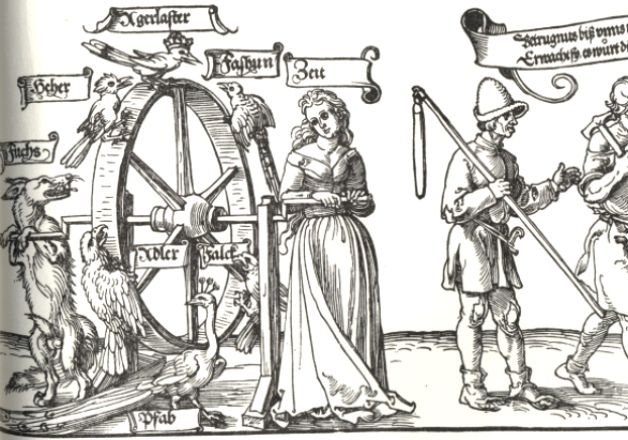
On the bottom are the noble eagle, peacock, and falcon; on top are the ignoble jay, magpie, and pheasant. To our right are representatives of various professions (I have reproduced only the first two). To the right of them are Truth, Teason, and Uprightness, who are in the stocks. Truth has a lock on her mouth (Slide 88b).

But the tradesmen look past the three in the stocks, in awe of Fraud siting on the throne (Slide 88c).

Below him Piety lies bound in its cradle. In the section just to the right of Fraud, which I have left out, a scholar and a cleric hope for favors from Fraud. At the right-hand edge Christ stands forlorn and ignored.
A youth, then as now, might have found himself or herself caught between the nobility of his dreams and the sordidness of the world. Here is the beginning of Hamlet's opening soliloquy:
HAMLET. O that this too too sullied flesh would melt,I could not find anything exactly suiting this attitude in Durer, but I did in Titian. Around 1520, he did several paintings of melancholy youths, any one of which would fit Hamlet at some point in the play. One example is the so-called Man with a Glove (Slide 89, c. 1522).
Thaw and resolve itself into a dew,
Or that the Everlasting had not fix’d
His canon ‘gainst self-slaughter. O God!
God! How weary, stale, flat and unprofitable
Seem to me all the uses of this world.
Fie on’t, ah fie, ‘tis an unweeded garden
That grows to seed; things rank and gross in nature
Possess it merely… (I.ii.129ff)

A melancholy, dreamy youth dressed in black stands with a torn glove. Gloves in portraits normally set off the elegance of their wearer. If, as in this one, they did not, then there was something unstable about their wearer; either that or the sitter was purposefully flaunting tradition and embarrassing his family. The young man’s attitude precisely expresses Hamlet at the beginning of the play.
Titian's Man with a Glove and Durer's Melancholia were part of a veritable fad for melancholia By Shakespeare's time, both artists were well enough known that prints would have circulated widely. Philip II of Spain had brought some Titians with him in 1533 when he became Queen Mary's husband. Then there is Titian's Young Englishman, of about 1545, which I shall discuss later. Even if its sitter wasn't English, the title it has been given suggests he well could have been. Venice received many English visitors. One of them, in the 1570's, was the Earl of Oxford, an English lord active in theatre circles and a popular candidate for author of Shakespeare's plays.
Man with a Glove in fact was in England, for how long nobody knows. During the turmoil of the English Revolution of 1640, when nobles needed ready cash, it was purchased in London by a foreign banker, who was the first to document it. He sold it almost immediately to the King of France.
I detect a resemblance between Man with a Glove and portraits done in London by Anthony van Dyck. One (below) is of the Princes Palatine, who visited London in 1635 (Slide 90a, 1635, details). They were Protestant German princes in exile during the thirty years’ war, waiting it out with little hope of return. They in fact did return, but they had no way of believing that then. Their situation was like Hamlet’s.

Another example (above) is “Two Young Englishmen,” done about the same time (Slide 90b, c. 1637, detail). The sitters are unidentified except by nationality. To me they look like the Princes Palatine, but I am no art historian. In any case, these are all examples of the melancholy young aristocrat.
That Hamlet begins in Saturn departs from the traditional order of the spheres, in which Saturn comes last. But it does fit the order in alchemy, which has the black nigredo of Saturn near the beginning, progresses through the white albedo of the Moon, and ends in the red rubedo, the rising sun, often associated with Christ. Red is also the color of Mars, the red planet that is also the god of war and bloodshed. Perhaps with this color progression in mind, Branagh dresses the principal characters of the play in these three colors (Slide 91).

Some alchemists used all seven planets to describe the "great work," as it was called. For the English alchemist Philalethes (whom some think was the pseudonymous Henry Vaughan), Mercury was the beginning of the work, then Saturn, the Sun, Jupiter, the Moon, Venus, and Mars. Hamlet’s progress is more or less the same.
As a planetary god, Saturn was not simply the withdrawn intellectual. The other response to the world seen by Machiavelli was to be like everyone else: pretend to moral uprightness, but secretly do the opposite. Saturn was often depicted with a sickle (Slide 92a, from a European astrological treatise, c. 1400) or a scythe (Slides 92b, Philosophia Reformata, Emblem 18, 1622, detail; and 92c, Saturn card from the “Tarocchi of Mantegna,” c. 1470).

These implements derive from his role as the early Roman harvest god. In the Roman Empire and the Renaissance, they symbolized the end of life, just as the festival of the Sarturnalia celebrated the end of the year and its rebirth in the year to come.Saturn was associated with time: in Greek, the god is Kronos, while the word for time is Chronos. As such, he carries the uroboros serpent, biting its tale to symbolize time devouring itself (Slide 92c; it is on top of the scythe’s handle).
Saturn was also the head of the pre-Olympian gods, but so fearful that his children would overthrow him that he swallowed them up (Slides 92b, 92c). The children at the bottom of 92c correspond to the other children of Saturn, but here also represent people not yet consumed by time, who play innocently as though nothing will happen. In one sense, Saturn here is time devouring its victims. In another sense, it is the restriction felt by those under Saturn's domination. In that sense, Hamlet feels swallowed up by his new stepfather, King Claudius, and Denmark is to him a “prison,” he tells his visiting school-friends, Rosenkranz and Guildenstern.
Da Sphaere, the 15th century planetary poem from which I have already quoted, says this about Saturn:
Saturn produces sluggish and wicked men,Hamlet’s view of Claudius comes more and more to fit this poem. In his first soliloquy he sees Claudius as a “satyr,” one way of saying he is a peasant boor. Later, to his friend Horatio, Hamlet describes Claudius as a lazy drunkard, the “sluggish” man of Da Sphaere; it is the Saturnian vice of sloth. His lameness accounts for his being the slowest of the planets. Mercury, with his quick wit, is the fastest. Claudius engages in secret poisonings, the "falsehood lying in wait to do harm" of the Poimandres.
Robbers, liars, and assassins,
Peasant boors with no light,
Shepherds, limpers, and wretches of that sort. .
(Saturno huonmini tardi et reiproduce
Rubbaduri et buxiardi et assasini
Villani et vili et senza alcuna luce
Pastori et zopp; I simili meschini)
Lilly, of course, is more balanced. His characterization of Saturn "when ill favored" is similar to Da Sphaere's:
Then he is envious, covetous, jealous and mistrustful, timorus, sordid, outwardly dissembling, sluggish, suspicious, stubborn, a contemner of women, a close lyar, malicious, murmuring, never contented, ever repining. (http://www.renaissanceastrology.com/saturn.html)
This
characterization does not fit Claudius quite as well as the other one,
as he certainly seems contented and not fearful ("timorus") or a
condemner of women. However if he is good at dissembling, we perhaps
just have not seen this side of him.
Old Hamlet enters the play on the night following the openng scene. Young
Hamlet goes to the castle walls, drawn there by reports that the ghost
of his father has been seen there walking at night (Slide 93 below:
Hamlet, Horatio, Marcellus, and the Ghost, engraving by Robert Thew,
1796, after Henry Fuseli, oil on canvas, 1789, now lost). It beckons to
Hamlet and speaks to him alone. In the engraving, his friends restrain
him in fear that it is an evil demon.

The Ghost charges that Claudius murdered him in his garden as he slept, pouring poison into his ear. In this garden setting, Claudius is like the serpent in the Garden of Eden, who put poisonous words into Eve’s ear. From a planetary perspective this act fits Saturn, not only his raised sickle of death and poisonous serpent, but in other ways. He is the “assassin” of De Sphaera. His metal, lead, was known to be poisonous.
In the Poimandres, Saturn’s sphere is that pertaining to “falsehood which lies in wait to work harm.” Saturn is the evil-doer who plots in secret. Later in the play Claudius does other things secretly, spying on Hamlet, arranging for him to be executed in England, and when all else fails using poison again.
In this vein, we need only look at the poster to the Disney movie, "The Lion King": King Mufasa, father of the Hamlet character Simba, is shown in yellow majesty, while Scar, Simba's uncle, is dark and brooding (Slide 94, below).
 T
TThe Ghost, for Hamlet, is still Hamlet’s King, no matter who may wear the crown. In the Renaissance, the king was often associated with the planet Sol, the sun, rather than with Jupiter. Similarly, in these opening scenes Hamlet tells us that his father, compared to Claudius, is like “Hyperion to a satyr” (1.2.140). Hyperion technically was one of the Titans, of the same generation as Saturn and father of the sun god Helios. But in the Odyssey Helios was also called Helios Hyperion; probably Hamlet means the same god. Then again, when Claudius asks why “the clouds still hang on you,” Hamlet says, “I am too much in the sun” (1.2.66f). Although 43 meanings have been proposed for Hamlet’s ambiguous reply, the one that relates to our planetary perspective is that he is too much the dutiful son of the sun.
For his part, Hamlet laps up the Ghosts words; they are just what he wanted to hear:
GHOST. …List, list, O list!And when the Ghost has told his story, he exclaims "O my prophetic soul! My uncle!", and finally, as he writes the Ghosts instruction in his notebook:
If thou didst ever thy dear father love—
HAMLET. O God!
GHOST. Revenge his foul and most unnatural murder.
HAMLET. Murder!
GHOST. Murder most foul, as in the best it is,
But this most foul, strange and unnatural.
HAMLET. Haste me to know’t, that I with wings as swift
As meditation or the thoughts of love
May sweep to my revenge... (1.5.22)
The artist in Slide 24 has given a sun-like shine to the Ghost’s head, as though to say that Hamlet is seeing the sun even though it is midnight. Such a vision characteristically occurs in ascent initiations, for example Lucius in his initiation into the cult of Osiris in Apuleius’s 3rd century romance The Golden Ass. In Shakespeare’s day, this work had recently been translated into English and so would be familiar even to audience members not fluent in Latin.HAMLET. O most pernicious woman! O villain, villain, smiling damned villain! My tables. Meet it is I set it down That one may smile, and smile, and be a villain— At least I am sure it may be so in Denmark. [Writes.] So, uncle, there you are. Now to my word. It is “Adieu, adieu, remember me.” I have sworn’t. (1.5.22ff)
Another association to the Ghost as the Sun is from alchemy. A text attributed to Hermes Trismegistus, the so-called Emerald Tablet, declared Mercury to be the child of the Sun and the Moon. In Slide 95 (Emblem 2 of Anatomia auri, 1628), King Sol exclaims “Come, my beloved, let us embrace and generate a new son who will not resemble his parents.”

Queen Luna replies “Here I come to you, most eager to conceive a son who shall have no equal in the world.” They point to a vessel, marked with the sign of Mercury, where a youth rests in the lap of a sun-headed lady. (Slide 96a, detail of 25). The seven flowers at the top of the vessel are probably the seven colors of the so-called “peacock’s tail,” emitted when heat is applied.

Da Sphaere, from which I have already quoted, has a beautiful depiction of the Sun and those in his sphere (Slide 96b, by Chrostoforo de Predis, c. 1470). As in the depictions of the Sun we saw earlier, he wears a crown and holds a scepter. We also see his associated animal, the lion, The accompanying stanza describes the Sun in mostly noble terms.
The Sun spurs man on to honor and glory,Perhaps to avoid a delicate issue, the poem does say that Sol wears a crown, but does not say in so many words that either Sol or Jupiter is king. Jupiter is not given a crown and is described simply as “a great power.” Here Sol’s only negative aspect is that he “produces sects in religion.” My hypothesis is that in the Church’s eyes, sects were the result of human pride, individuals putting themselves above the sanctified institution of the Church. And pride is the sin associated with the sun.
And delights in all comeliness,
Wears the crown of wisdom,
And produces sects in religion.
(Il Sole ad honor l’uhomo et gloria sprona
Et d’orgni leggiadria si dilecta
Di saptienza porta la corona
Et di religion produca secta.)
Yet these planetary attributions are ambiguous. Saturn in some respects fits Hamlet's father himself, Old Hamlet. He is a creature of the dark, who cannot be seen in even the faintest morning light. He is the deposed king, like Saturn. He is the immediate cause of Hamlet's melancholia. And as we shall see, he calls for Hamlet to kill Claudius.
Renaissance astrology in fact had a two-sided depiction of people who embodied the energy of Saturn. Lilly, writing in 1647, showed another, more positive side to Saturn:
Manners & Actions, when well dignified. Then he is profound in Imagination, in his Acts severe, in words reserved, in speaking and giving very spare, in labour patient, in arguing or disputing grave, in obtaining the goods of this life studious and solicitous, in all manner of actions austere. (http://www.renaissanceastrology.com/saturn.html)This characterization fits the Ghost. As King, he was military rather than diplomatic, and austere with his son. in his scene with Hamlet he goes quickly to the point, and speaks gravely.
In this set of correspondences, Claudius would be Sol, the alchemical representative of the King. Renaissance astrology also had a two-sided appraisal of his influence, and added a negative characterization of Sol to the positive one of Da Sphaere:
When ill dignified. Then the Solar man is Arrogant and Proud, disdaining all men, cracking of his Pedegree, he is Pur-blind in Sight and Judgment, restlesse, troublesome, domineerning; a meer vapour, expensive, foolish, endued with no gravity in words, or sobernesse in Actions, a Spend-thrift, wasting his Patrimony, and hanging after an other mens charity, yet thinks all men are bound to him, because a Gentleman born. (http://www.renaissanceastrology.com/sun.html)Much of this characterization fits Claudius. Hamlet observes that he spends his time in drunkenness and extravagance. The soldiers fear that without someone as militarily competent as the former king, the kingdom is in danger. For Hamlet his qualities are inferior to those of his brother, and the idea that he is king and husband to Gertrude fills him with disgust. And he is over-confident in matters of state: he puts trust in his skill in diplomacy and does not see the trap that Fortinbras of Norway has set for him, to avenge his own father's death and loss of lands at Denmark's hand, regardless of written agreements it may make.
Even Lilly's positive characterization of Sol, when applied to Claudius, has negative aspects:
Manners & Actions, when well dignified. Very faithfull, keeping their promises with all Punctuality, a kind of iteching desire to Rule and Sway where he comes: Prudent, and of incomparable Judgment, of great Majesty and Stateliness... (http://www.renaissanceastrology.com/sun.html)Claudius's "itching desire to Rule" is what led to his murder of Old Hamlet. Hamlet also has this "itch," part of his antipathy to Claudius's pre-emptive strike. The rest of Lilly's description characterizes how Claudius wishes to appear.
If Sol is the father of Mercury, then Hamlet's father, according to alchemy, must be Sol. That was one of the considerations for identifying Old Hamlet as Sol. But who is Hamlet's father? We learn later that Old Hamlet was in Norway fighting its King in single combat at the time Hamlet was born. Perhaps he was dallying with the Norwegian king, while his wife was busy with Claudius at home. In character, Norway's prince, Fortinbras, as a man of action, is more similar to Old Hamlet, while Hamlet is more similar to Claudius. Claudius goes out of his way to address Hamlet as "son," and his mother speaks of "your father" meaning Hamlet, even though they know it irritates Hamlet; perhaps they are only doing what they have longed to do since he was born. Sol as father of Mercury could be either one of the brothers.
The Poimandres spells out that side of the story, Sol’s downside. The sun represents “domineering arrogance,” the occupational disease of kings, “saucy pride,” as Vaughan’s poem put it. A Renaissance pictorial illustration of Sol at his most negative is an unfinished painting by the Venetian artist Titian, in time very close to Shakespeare’s play (Slide 97; left, The Flaying of Marsyas, 1570-1576. Right: detail of Apollo.).

The story is from Ovid’s Metamorphoses. The satyr Marsyas, renowned for his playing of the double flute, had challenged Apollo in a music-playing contest and lost, according to the Muses, who were assigned to judge the contest. Some might say that the judges were not impartial, since Apollo was their leader. In Titian’s painting Apollo is taking his reward from the unfortunate satyr, who hangs upside down screaming, "I concede, you've won." Here the golden-haired man with the knife is either Apollo or one of his servants, skinning Marsyas alive. In back, playing the stringed instrument, is either Apollo or Orpheus. The crowned man on the right, looking pensively on, is King Midas, a friend to the satyrs, before the time when he is granted his wish to have everything he touches turn to gold.
Titian seems to be implying an allegory: earthly kings, who identify with the god of light, be he Apollo or Jesus, also take after his dark side. In Titian’s day, and Shakespeare’s, those who refused to acknowledge the supremacy of whatever Church the monarch supported were burned at the stake, disemboweled alive, or merely beheaded.. There was even the same rigged trial, at the hands of those anxious not to be seen in the same light.
It is hardly likely that Shakespeare would have seen this painting, but others active in the theatre might have. The Earl of Oxford, who sponsored acting troupes (and some say wrote the plays attributed to Shakespeare), visited Venice at the time that it was in the artist’s studio. It is not likely to have inspired many copies, owing both to the content and the style. But Shakespeare, or whoever wrote the plays, would have known the story in Ovid and might have been directed to it by someone who had seen the painting, or another on the same theme. In any case, the work shows to what degree the dark side of royalty was conceived at that time.
So even if Claudius is an evil character, his planet still might be the Sun. To the court he appears a gracious and wise king, adored by all. It is he who rules, and seems to do so with warmth, while the Ghost is a creature of darkness and plotting. Claudius speaks warmly to Hamlet and invites him to stay in court instead of returning to Wittenberg. At the same time, Claudius is guilty of domineering arrogance, killing Old Hamlet for the sake of his crown and his wife, even if he appears gracious and considerate in public.
By the same token, the Ghost, we have seen, has his Saturnian aspects. As king, he was Sol, Hamlet’s “Hyperion.” But as former king, he is Saturnian—helpless, melancholy, shadowy, and scheming. He may be an evil spirit trying to deceive Hamlet, as Horatio suggests. The Ghost, if his story is false, may be the one lying in wait to do harm by secret means, i.e. plotting with his son. From this perspective it is the Ghost who fits the role of Saturn, and Claudius of Sol. But it is the wise Saturn, who penetrates to the heart of things, and the dark Sol, who appears warm and full of light when he is at his darkest.
Yet the Ghost also partakes of the negative qualities of Sol. He also suffers from wounded pride. Claudius caught him off guard and humiliated him. His desire for revenge is a matter of pride and of honor. he displays domineering arrogance toward his son, caring not a whit for Hamlet’s own feelings, needs, or even his life. And Claudius has some of the Ghost's positive side, sharing with him the hidden truth of Claudius's deeds.
Bearing
in mind this double view, let us take an alchemical perspective again.
Let us look at the opening scene of the play in alchemical terms, by
comparing it with the opening scenes in alchemical illustrations.
Raised
up from the main floor are the new King, played by Patrick Stewart, not
at the helm of the Starship Enterprise here but just as confident, and
his new Queen. Hamlet, lower down, broods (Slide 98, from BBC film, 1980; Derek Jacoby as Hamlet, Claire Bloom as Gertrude.).
The scene corresponds closely to those portrayed in alchemical illustrations. In Slide 99 (from the Golden Tripod, 1618), the first in its series, the happy couple corresponds to Claudius and Gertrude. On the lower right is old Saturn with his scythe. On the left is a wolf, eager to devour them.

The wolf, like the dog in Durer’s Melancholia, is an animal associated with Saturn. This figure corresponds to Hamlet himself. In alchemy the wolf is Antimony, which the alchemists used to make a powerful solvent that would dissolve metals.
With the Ghost as Saturn, a Biblical undercurrent comes into view, the story of Abraham and Isaac. Abraham, like Hamlet, heard a voice from the other world telling him to kill someone. My favorite image of the scene is Brunelleschi's, of 15th century Florence (Slide 100, below).
 The
beloved Isaac is not the emotional equivalent of the hated Claudius,
but if Claudius is innocent it is still the slaughter of an innocent.
Is one justified in suspending the requirement of evidence just because
a voice tells you a story, even if you identify it as one you credit
with immense authority? Kierkegaard famously described Abraham's dilemma
as between the religious and the ethical:
The
beloved Isaac is not the emotional equivalent of the hated Claudius,
but if Claudius is innocent it is still the slaughter of an innocent.
Is one justified in suspending the requirement of evidence just because
a voice tells you a story, even if you identify it as one you credit
with immense authority? Kierkegaard famously described Abraham's dilemma
as between the religious and the ethical:The ethical expression of what Abraham did is that he was willing to murder Isaac; the religious expression is that he was willing to sacrifice Isaac; but in this contradiction lies the very anguish that can indeed make one sleepless; and yet without that anguish Abraham is not the one that he is.(Fear and Trembling, Anchor ed., p. 60)There is something of that anguish in Hamlet. The Ghost demands belief and action without evidence, on faith. Hamlet's moral sense says otherwise. There is also Hamlet's own fate. Abraham's slaughter of Isaac is a prefiguring of God the Father's sacrifice of his own son. Hamlet is similarly the innocent whom the Ghost would sacrifice, as the likely consequence of regicide.
In another emblem a wolf is shown devouring the impure king and then being consumed itself by fire, an action which serves to release the king in purified form (Slide 101, emblem 14 of the Atalanta Fugiens, 1618).

This wolf’s self-sacrificial role, as we shall see, is not unlike that of Hamlet in our play. However the dead King is not Claudius per se. It is Denmark itself, the "body politic," as it was called, that is need of purifying, by restoring legitimacy.
In another alchemical opening scene (Slide 102, Emblem 2, 2nd series, of the Philosophia Reformata of 1622), however, Saturn does not appear. The king and the queen courteously face each other, and under them are two lions with one head, pouring out a molten substance.

The lion is the animal associated with Sol; what comes out of his mouth is either molten metal, red sulphur, or, based on descriptions of other similar engravings, green Vitriol, i.e. sulphurous acid. Iinterpreters say the two lions are the king and queen before purification, spewing out the poison that will first destroy and then purify them. What flows out of them is sulphur, which becomes sulphuric acid in the chemical process.
This sulphur, considered by the alchemists to be the sun's power in the earth, is also the caustic substance of the Ghost's realm, and Hamlet's own destructiveness, as son of the sun.
Then what about the bird swooping down between them, as though to separate the King and Queen from each other? Winged creatures in alchemy tend to represent the volatile (see de Rola's comments on Emblems 7 and 45 of the Atalanta Fugiens, pp. 98f of his Golden Game); that he is headed downward suggests the "fixation of the volatile." That would seem to fit the Ghost, coming from the world beyond wanting to enter material life again by way of young Hamlet. A 16th century alchemical illustration reveals another aspect of the king and queen that fits the scene as Hamlet and the Ghost see it (Slide 103, Emblem 2 of the Rosarium Philosophorum, 1558).

Here there is nothing below the couple except their identifying symbols. But as other woodcuts before and after reveal (Slides 104a and b, emblems 1 and 4 of the same work), they will soon be sitting on a basin into which pour animal, vegetable, and mineral forms of alchemical Mercury.

So now what is below is Mercurial, as in the earlier engravings (which are derivative from these woodcuts).
In Slide 104b, the bird swooping down is a dove. In Renaissance depictions, a descending dove usually represented the Holy Ghost. From this perspective the Ghost is the play's equivelent, holy or unholy. However he is no dove. He swoops down on the scene like the bird of prey depicted in the other series (Slide 102).
In Slide 104b the couple is shown holding each other’s left hands. The left hand was considered sinister, in fact the word sinistras means “left” in Latin. In alchemy there is a specific reason for this sinisterness, namely, the pair being conjoined is incestuous, brother with sister, mother with son, or father with daughter. (As we shall see, there is more than enough incest in our play to go around.)
Similarly, Hamlet considers the marriage between Claudius and Gertrude incestuous, following the medieval Church’s view that marriage with a brother’s wife constituted brother-sister incest. The Ghost has the same view, although no one else seems to notice.
In both these examples there is clearly something unstable about the King and Queen. They are in for a confrontation with the Mercury that will eat at them from below, stimulated by a Saturn from beyond, who is also the Sol from above of Hamlet's remembered idealization.
Image sources, Saturn and Sol.
83. www.compusmart.ab.ca/hamlet/hamletimages/branagh.
85. www.english.emory.edu/classes/Shakespeare_Illustrated/dh.html.
86. www.filmski.net/slike/slike/news02/10/zasto02.done.jpg.
87a-f. Durer, Albrecht (1965). The Complete Engravings, Etchings, and Drypoints (K.-A. Knappe, ed.), 74.
88. (a) Durer Complete, 374. (b) Durer Complete, 375. (c) Durer Complete, 375-376.
89. Joannides, P., Titian to 1518: The assumption of genius, 228.
90. (a) Van Puyvelde, Leo (1964). Van Dyck, 136. (b). www.nationalgallery.org.uk/.../mNG3605.jpg.
91. http://www.rlslog.net/hamlet-1996-internal-dvdrip-xvid-ils/.
92. (a) Seznec, Survival of the Pagan Gods, 165. (b) Fabricius, Alchemy, 169. (c) Brian Innes, The Tarot, 34.
93. www.tate.org.uk/britain/exhibitions/gothicnightmares/images/works/hamlethoratio_large.jpg.
94. http://www.factmonster.com/spot/disney-lion-king.html.
95. Fabricius, 45.
96. (a) Fabricius, 45.
(b) www.gnosis.art.pl/iluminatornia/omnibus/de_sphaera_manuskr_wloski01.htm.
97. Joannides.
98. http://arlenestage.homestead.com/JacobiHamlet.html.
99. de Rola, Golden Game, 120.
100. http://www3.telus.net/Quattrocento_Florence/brunelleschi1.html.
101. de Rola, 83.
102. de Rola, 173.
103. Fabricius, 24.
104. Fabricius, 18 and 64.


0 Comments:
Post a Comment
<< Home