II - C: Mars and Transcendence
Corpus Hermeticum, Tractate I: ...to the fifth zone, unholy daring and rash audacity...
Henry Vaughan: ...My daring Rashness and Presumption/ To Mars himself an equal Legacy...he sea-voyage contains Hamlet’s third trap, after the spy in the shape of a pretty girl and the one hiding in the bedroom. Along with him are his two school friends, Rosenkranz and Guildenstern. That Claudius had brought to spy on him Hamlet instantly got them to admit at their first meeting (Slide 122).
I see them now simply as extensions of Claudius, not as planets in themselves. They come with Hamlet to keep an eye on him. They also carry a sealed letter from Claudius. Although they don't know it, it asks the King of England to execute Hamlet. In such a situation, Hamlet acts in a way that indicates that his feminine side, of care and nurturance (Slide 123), has clearly left him.

Mars’ is the sphere of “unholy daring,” in the Poimandres, or “rashness” in Thomas Vaughan, a spirit Laertes exemplifies well. The poem Da Sphaere is particularly harsh on Mars:

Once Laertes is with the king, Laertes is easily persuaded that his true enemy is Hamlet, who after all did kill Polonius. Hamlet's mother is in the room when Claudius informs Laertes of this fact. Her authority adds wait to her husband's. It is with this knowledge that Laertes later attacks Hamlet in Ophelia’s grave, as Hamlet later recognizes. As he tells Horatio, “By the image of my cause I see/ The portraiture of his” (5.2..77f). However Claudius has secretly shown Laertes how to get his revenge (Slide 126).

They will arrange a fencing match between them and put poison on Laertes’ rapier. As a back-up, Claudius will give Hamlet a poisoned drink. This set-up is Hamlet’s fourth trap, in the traditional story.
In Laertes we see both the positive and negative side of Mars, as depicted by Lilly:

When Hamlet gets the invitation for the duel, Horatio and he immediately suspect a plot. “You will lose,” says Horatio. Hamlet protests that he is in fine form, but in the end does not disagree: “Thou wouldst not think how ill all’s here about my heart,” he says. "But it is no matter... It is but foolery, but such a kind of gainsgiving as would perhaps trouble a woman" (5.2.208ff; Slide 128, Derek Jacobi as Hamlet, 1980).

“I will say... you are not fit,” Horatio offers (5.2.213f). But Hamlet will not decline the match. It is not simply that he is resigned to take life as it comes, however cruel. He is a different Hamlet from the one who left for England, who merely embraced the absurd in the manner of a knight of infinite resignation. He now has a kind of faith. In describing his adventure rewriting Claudius's letter, he began by saying:
What follows is the transcendent moment of the play. In response to the worry that the fencing match is a trap to kill him, he says:
The gospel passage, I think, refers also to Jesus’s own fate. As a divine being, he descended into a man who had nothing, yet he fulfilled the Father’s deepest wish. So likewise Hamlet’s death, if it is to be, may serve to fulfill both his heavenly and his earthly father’s plan. He has only to be ready. God willing, justice will be done, and there will be no cycle of further vengeance-takings; the future will not be imperiled by his action.
But this does not necessarily mean that he thinks God and the Ghost are in accord, and that God will help him fulfill the Ghost’s demand. Hamlet also recognizes that he may accomplish none of this, whether he lives or dies. He has let go of his obsession with Claudius. True, he has just told Horatio, "And is it not to be damned, /To let this canker come to further evil?" (5.2.68f). That is his Mars speaking. But that side of him no longer has him firmly in its grip. Rosenkranz and Guildenstern, dying without time for last rites, just as he wanted for Claudius, serve as Claudius’s stand-ins and put a brake on his blood-lust.

In Shakespeare’s day, skulls were a common image for the transience of worldly ambition. Artists and performers often used the image when they wanted the viewer to ponder the meaning of life, usually in the context of a conventional message of salvation through Christ. One Frans Hals “Man with a Skull,” shows a man in middle age (Slide 130). In contrast to the proud young man holding a skull I showed earlier, this man seems to be saying: I have lived as well as I was able; I face death unafraid.

For his part, Durer usually put a skull at the foot of the cross in his crucifixion engravings. He also put one in another of his famous engravings, St. Jerome in his Study (Slide 131). The skull rests on Jerome’s window ledge to remind him, and us, of the transience of worldly ambitions. The dog, symbol of sniffing out the future, sleeps peacefully, and the lion, emblem of kingly might, sleeps next to him. In Jerome’s presence, they have no need to be active. Jerome, of course, is connected to a transcendent being; Hamlet also feels connected to a transcendence, a Providence. Yet his overcoming of the fear of death, it seems to me, is not dependent on religious belief.

Slide 131. Albrecht Durer, St. Jerome in His Study, 1514.
What is different about Hamlet in the "If it be now...Let be" speech is that it does not depend on religion. He is giving a secular argument, from the assumption that what lies beyond the grave is "the undiscovered country" (3.1.78), as he had put it in his "to be or not to be" speech, unknown territory. One reason we fear death is that it cuts short our plans to leave a legacy for others after we are gone--financial, artistic, social, etc., something for which we can be remembered positively. In his case, Hamlet has been thinking more about Yorick than about his revenge. Hamlet’s answer is that we have no assurance that our plans will result in what we expected:
The Player King had recited, in the short play Hamlet had put on, about the Queen who says she will be true to her husband even after his death: “Our wills and fates do so contrary run/ That our devices still are o’erthrown:/ Our thoughts are ours, their ends be none of our own” (3.2.204ff). Even if we do nothing but good, those who follow us may turn it all around. Our perspective is too limited. So let go of your grandiose ambitions, trust in Providence, and you are also letting go of your fear of death. We are all instruments in a game beyond our understanding.
“No man, of aught he leaves, knows aught” (5.2.218f). Shakespeare did not actually write this apt turn of phrase, but he should have. Jenkins takes credit for it (Arden Hamlet, 1982, p. 565f), as clarifying what Shakespeare did write. In the 2nd Quarto the line reads "Since no man of ought he leaves, knows." The second "aught" gives a nice ring to an awkward sentence. The Folio version, "Since no man ha's ought of what he leaves," probably the work of an editor, is perhaps worse. We both know and possess nothing of our actions' outcomes, whether we live to see them or not. Hamlet did not intend for his theatrical piece to backfire on him, or to kill Polonius instead of Claudius. Similarly, Claudius did not intend that his messengers would get hanged instead of Hamlet. In all these cases, it is clearer to say that one does not know the outcome, than to say that one does not have or own the outcome.
This aspect of his personality that Hamlet has been fighting is his Sol, an exaggerated sense of his own importance. This struggle is what his snide remarks to Claudius come to, in his own psyche. What he has been fighting is his attitude, promoted by the Ghost, that his insights and will alone, will save the kingdom. Thus he also reflects on the emperors who thought that same way: Charles V thought he would erase Luther from history; all he did was erase countless lives in a fruitless effort against the feeble monk. He also reflects on mighty Alexander, who died at age 33. In the end we are all eaten by the same worms. At the end of the play, in fact, it will not be Hamlet that brings Claudius down, but rather his mother and Laertes, exposing him with their dying words. Hamlet's will is only part of the redemption of the kingdom. Much of it will most likely be done by others. Providence is the slow, halting enlightenment of humanity, proceeding by trial and error as a communal effort.
Hamlet is something like Kierkegaard's "knight of faith," the one who believes that in God all things are possible, but in a more agnostic sense. Anything can happen, God or no God. So let go of your schemes. If God allows him another opportunity to expose Claudius, so that killing him won’t seem like slaughtering an innocent victim, so be it. But if Claudius lives, so be that too. Hamlet is done scheming. "Let be" applies to it all.
But Hamlet's philosophy is more akin to the French philosopher Montaigne, who in an early essay says, "I want a man to act, and to prolong the functions of life as long as he can; and I want death to find me planting my cabbages, but careless of death, and still more of my unfinished garden" (Essays III.20, p. 62 of Complete Essays of Montaigne, trans. David Frame). He speaks of a man who found himself dying in the middle writing a history, and he had only gotten to the 15th or 16th French king. "We must rid ourselves of these vulgar and harmful humors" (p. 62) Against this fear, which he himself at that age must have felt, he cites Lucretius, among others: "Our lives we borrow from each other/...And men, like runners, pass along the torch of life" (p. 65) .
Shakespeare even echoes Florio's translation of Montaigne in the earlier line, "There's a divinity shapes our ends, Rough-hew them how we will." Montaigne says, in John Florio's translation of 1603, "My consultation doth somewhat roughly hew the matter, and by its first show, lightly consider the same: the main and chief point of the work, I am wont to resign to heaven." (Essays III.8, quoted in Jenkins, p. 557). A modern translation goes, "In my deliberations I outline the matter a little and consider it sketchily in its first aspects; the heart and core of the matter I am accustomed to entrust to heaven." Montaigne goes on to quote Horace: "The rest leave to the gods." His main point is like Hamlet's: "The outcome often justifies very inept management" (Montaigne, Complete Essays, Trans. Donald Frame, p. 715).
In King Lear, Shakespeare offered a variant on "the readiness is all" (5.2.218). There, near the end of the play, the old, recently blinded Earl of Gloucester is caught in the middle of a battle between Lear's forces and those of his own traitorous son. He assumes that his other son, Edgar, whom he had mistakenly identified as his enemy, is already dead. In fact Edgar is there beside him, disguised as a peasant, helping the old man find a safe place to hide. But Gloucester merely wants to end his life. Edgar, unwilling to reveal his identity just yet, tells his father to hold on: "Ripeness is all" (5.2.11). Gloucester needed to live a little longer for his life to be complete. The fruit should not be plucked until the apple is fully ripe. When Edgar finally does tell his father who he is, and his forgiveness of his father, Gloucester's heart, as Edgar later remembers, "burst smilingly" (5.3.198) and he died.
Hamlet's phrase "the readiness is all" is for someone who does not want to die, because he or she has more to do or experience. It is a reminder to let go of such thoughts in the face of possible death in one's near future. Yet it is also a reminder to be ready in the present, not just for death, but for seizing the present moment rather than always preparing for the future. Hamlet is ready now, for play, for war, or for death.
A portrait by Titian captures some of this mood--not the playfulness, but his serious side, (Slide 132, c. 1545).

Most art historians say it was done in the 1540’s, some twenty years after the one we saw earlier, of the melancholy and dreamy youth with the torn glove. The portrait shows a mixture of melancholy, courage, calmness, and openness to the future. Traditional titles given to the painting are “The Young Englishman,” “The Gray-Eyed Nobleman” and “The Man with the Blue-Green Eyes.” In the reproduction, the eyes appear a steely blue-grey (Slide 133).

The sitter is unidentified. Is this painting indeed of a young English aristocrat, biding his time in Venice, readying himself for his next showdown in England with circumstances beyond his ability to predict or control?

I have a speculation about who the sitter might have been. There is a tradition that it was Thomas Howard, Duke of Norfolk. This cannot be right: of the two dukes that lived during Titian's lifetime, the first was too old and the second too young, for a painting done sometime between 1535 and 1545. I think it more likely the first Duke's son, William Howard, born in 1510, who at the time was both a naval officer and a diplomat for Henvy VIII (Slide 134). He went on diplomatic missions to Scotland and France. I can find no record of his going to Venice, but it would have made sense for him to go there. Venice was Europe's foremost naval power, in a different part of the world than England but with common enemies, France and Spain. To avoid offending the Pope, Venice might have preferred that English visits be kept quiet.
William in this period, the late 1530's, was going through difficult times, with more to come. His family was in disgrace after his niece's Anne Boleyn's execution for adultery in 1536 (http://en.wikipedia.org/wiki/Anne_Boleyn). Moreover, he was raised Catholic in a country ruled by a king who had broken with the Pope and who was executing whoever seemed to be an annoyance. For William, things might get worse before they got better.
(Things in fact did get worse before they got better. In 1541 most of the Howard family, including William, was accused of complicity in covering up the sexual conduct of William's niece Catherine, whom Henry VIII, with the encouragement of the Howards, had married in 1540. Catherine was executed for adultery, while William and the other Howards were convicted of treason and sentenced to life imprisonment (http://en.wikipedia.org/wiki/Catherine_Howard). But his fortunes improved. He got a pardon and eventually became Lord High Admiral and the first Earl of Effingham. Such are the hazards of life.)
However art historians today are quite confident that the sitter was Italian. So I put no faith in my speculation about Titian's "Young Englishman." I will go on.
Hamlet, then, is simultaneously feeling divine grace, a sense of impending doom, a realization of his inability to control events, and a readiness for anything. He has come to terms with Mars and with all the planets, whom I will now show together as they appear in the manuscript I have been drawing from (Slide 135), from a 14th century manuscript..

At this point in the play, Hamlet is at one with Polonius and Ophelia, he has a friend and confidant in his mother, he is above jealousy at Claudius; he can joke about and ignore Old Hamlet, and he is ready for Laertes. He is at the stage now of the spirit who has ascended through all the spheres and can say, as Corpus Hermeticum XIII puts it, "Father, I see the Universe and I see myself in Mind." "Mind" is the Corpus Hermeticum's term for God. The word translated "Universe" is probably the Greek "Pan," meaning "All," a term which frequently refers to the divine world rather than the material one.
There is a passage in Montaigne's final essay that expresses this transcendence of the planetary vices. I quote Florio's translation (published 1603) supplemented with a modern translation of a few of the phrases:

Here is a close-up of just the face (Slide 136b).

Rembrandt at this point in his life, despite his early fame, was ignored by the public. Few people cared for his later work, and he had been forced to declare bankruptcy. He had also lost his wife. The only person close to him who was left was a young son, who died later on in Rembrandt's life. I think he has painted himself this way as his own meditation, to project the attitude he wants to feel, of a holy presence beyond all tragedy and a readiness both to do what he is able and to take whatever happens.
Let us return to our story. All that remains is the bitter end. In the duel Hamlet confronts his destiny in Martial form (Slide 137, a laser-sword version by Danaye Weber, 2003).

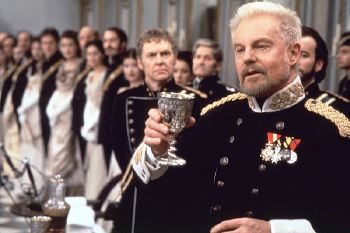
It goes without saying, knowing what happened to Old Hamlet, that Hamlet will not touch the drink (Slide 138, Derek Jacobi as Claudius, in Branagh's film, 1996).

Here is the relevant dialogue:
In the duel, Hamlet scores hits against Laertes and keeps him from scoring any himself. There is no anxiety for Hamlet here, just play. But there is for Laertes. Killing Hamlet is "almost against my conscience," Laertes says in an aside. During a break, Laertes finally just slashes Hamlet when he isn’t looking. Hamlet knows full well what has happened. In the next round, he manages to grab Laertes’ sword and slash him back (Slide 139, from Branagh film, 1996):

There is a similar sword-switching in the sources, except that instead of a poisoned rapier, one sword is nailed to its scabbard, and the task is to get the other one. The Queen collapses, gasping “The drink, the drink! I am poison’d” (5.2..316). Hamlet rushes to her (Slide 140, Derek Jacobi and Claire Bloom, 1980), and she dies.

The dying Laertes shouts, “The King--the King’s to blame” (5.2.326). Claudius has finally been exposed before everyone, in a way impossible to deny. Now is not only his last chance to act; it is finally the right time as well.
And a few lines later, just before dying, Laertes says for all to hear, making explicit what he said implicitly a short time earlier:
By then Hamlet Hamlet has stabbed Claudius (Slide 141, Eric Gill engraving, 1933).

And for good measure he has poured the rest of the drink down his throat (Slide 142, Branagh and Jacobi, 1996).
 Representations
of such bloody deeds are not that frequent among alchemical emblems,
and those that exist do not quite fit. However I found two that seem to
apply to what has just happened, Hamlet and Gertrude each bringing
about Claudius’s exposure and death by means of their own.
Representations
of such bloody deeds are not that frequent among alchemical emblems,
and those that exist do not quite fit. However I found two that seem to
apply to what has just happened, Hamlet and Gertrude each bringing
about Claudius’s exposure and death by means of their own.
First, there is the emblem we looked at earlier, of the wolf Antimony burning in the fire after consuming the king, for the sake of the king’s rebirth in purified form (Slide 143, Emblem 24 of the Atalanta Fugiens).

In Hamlet’s case, the purified king is not exactly Fortinbras, who has been physically and psychologically removed from the action, but rather the kingdom of Denmark itself, purified of its corruption, and the characters in the play who have sacrificed themselves toward this end, not only Hamlet but also, I think, at the last minute his mother.
The second emblem follows immediately after this one in Meier’s Atalanta series (Slide 144, Emblem 25, Atalanta Fugiens). It shows Sol and Luna killing the Saturnian dragon.

Behind these two are depictions of two other myths with the same point, Diana slaying the hunter Orion and Apollo slaying the dragon Python, the one that guarded the sacred spring of Delphi. The motto makes the theme clear: “The dragon does not die unless it is slain by a brother and sister, which are Sol and Luna” (http://www.levity.com/alchemy/atl21-5.html).
But what is victory in alchemy is irony in Shakespeare. While all the members of the Danish inner circle have been dying, the Norwegian army under Fortinbras has returned from its foray into Poland, having been granted safe passage through Denmark by Claudius. He now appears at the Danish court just as all its royalty has been slain.
The play does not indicate whether Fortinbras has arrived by stealthily taking the castle by force or whether he has been invited there as a guest. In any case, he ends up with the kingdom. The Ghost’s call for revenge has resulted in the loss of his heritage to his old enemy Norway. But hat probably would have happened anyway. Claudius had been trusting his negotiating skill, which amounts to nothing unless it is backed up with adequate watchfulness. He was lulled into inaction not only by his preoccupation with Hamlet, but also by his infatuation with his Queen and his whole way of life.
For his part, Hamlet gives his vote to Fortinbras as Denmark’s new king. He does not care whether Denmark is ruled by a Dane or a Norwegian. And probably Fortinbras is Old Hamlet's son anyway. After that, he asks Horatio to tell his story, and “the rest is silence” (5.2.363). Hamlet’s famous last words. (They are also, quite coincidentally, quite similar to the last words said by the soul in the ascent narrative of the Gospel of Mary, quoted in Chapter 1: “From this time on will I attain to the rest of the time, of the season, in silence.”)

Slide 145, Delacroix, pencil on paper, 1834-43.
Shakespeare has Hamlet die in triumph. Fortinbras commands four captains to lift him onto their shoulders (Slide 146a, Delacroix, lithograph, 1843). “For he was likely,” Fortinbras says, “had he been put on,/ To have prov’d most royal” (5.2.492f).

Slide 146a, lithograph by Eugene Delecroix.
Slide 146b, Emblem 10, Rosarium Philosophorum, 1550.
In the Rosarium there are two images of the soul rising up like Hamlet by the soldiers. One is is the albedo, the lunar rising of the resurrected soul, and the other is the rubedo, the solar rising of the resurre4cted spirit. Here it is subtitled "Enigma," because of its paradoxical composition, like that of Jesus and the Virgin Mary, due to the paradox of the Trinity: it is the son of its daughter and the mother of its father. For his part, Hamlet is now whole, for which the image is the hermaphrodite ascending. It is Hamlet’s spirit joined to his mother’s, a spiritual union that continues the image of their holding each other as she dies. Since both Ophelia and Laertes died repudiating their elders, I think we may also see them as ascending as well, also as a brother-sister pair.

Slide 147, Emblem 17, Rosarium Philosophorum, 1550. "Royal Enigma."
Even the kingdom of Denmark partakes of this ascent, for despite its physical bondage it has been spiritually cleansed.

Gertrude is the Empress, the mother figure of the cards (Slide 148 left). In her fatal flaw, she is the Queen of Coins, so dazzled by wealth that she cannot see anything else until it is too late (Slide 148 right).

Hamlet is the Lover who does not see his beloved as she is, but only in terms of the threat she poses. In the Lovers card (Slide 149, left), he chooses virtue over pleasure. In terms of his flaw, he is the Valet of Swords (Slide 149, center), so bogged down in scruples that he'd like to cut off his own head, yet acting too fast when he has what he thinks is the information he needs.
As for Ophelia, she is the frowning young woman of this Lover card, rejected by the young man who can see only the task he has put himself. But by the end she is the Knight of Cups (Slide 149 right), the Knight of service, offering love and wisdom. But with no protecting sword she can't last long. Hamlet also fits this description. In his case he has a sword but is not prepared for those who augment the sword with secret means.

Mars is the Charioteer, with his two horses. (Slide 150, left; I am using the original unrestored card here, as the restored version has the left horse too dark and the right horse too light, compared to the original.) If the chariot follows the lead of the dark horse on our right, the horse thirsting for vengeance at all costs, then Laertes is the Charioteer; we see him more clearly as the Knight of Batons, so caught up in looking at his own feelings and prowess that he does not see where he is going and whom he serves (Slide 150 center). If on the other hand the desire for revenge is controlled by his reasoning power, the light horse on our left, then he is Fortinbras, represented also in the young King of Swords (Slide 150 right). Well armed himself, with both sword and dagger, he lets others do the dying while he picks up the pieces. His faults are not seen in this play.

Polonius is the Pope, similar to the medieval representation of a Priest, taking young people under his wing at the same time as he has them watched (Slide 151 left, above). In terms of his flaw, he is the King of Batons (Slide 151 right), caught up in the pomp and prestige of the courtly life he so wishes to serve but failing to value people as people.

There are also two candidates for Emperor (Slide 152 left). Old Hamlet is an Emperor whose flaw is that he is so used to being obeyed that he is surprised when he isn't. He is represented specifically as the King of Coins (Slide 152 center); he is the one who has it all until Fortune turns its wheel. He seeks the rising sun of redemption in Young Hamlet, hoping that he will climb the aldder of the seven virtues to victory. The other candidate is Claudius. His flaw is hidden in the King of Cups (Slide 152 right), offering us his poisoned drink with a smile.
Let us turn now to the other questions I raised earlier. What has Hamlet done to deal with his own planetary demons, and what does it mean for us?First, he can accept whatever his own personal fortunes may be, whether they are up or down, as measured by money, love, power, or anything else, as fortune is always fickle. In asking his mother for constancy he has received it, at least to him if not to her dead husband. He also got her support at the end, in exposing her husband along the lines Hamlet had suggested to her.
Second, he feels no necessity to continue using cunning and cleverness to expose the truth. He has a kind of simplicity of spirit now.
Third, he has supplanted lust with love, of a kind that, once one has it, can never be extinguished in one's soul.
Fourth, he has stopped being proud of his own ability to right things by himself.
Fifth, he accepts rashness, because it is through action that we learn things about our lives, and we never know whether estimates of situations are realistic. He trusts in circumstances to right things. And he is able to forgive rash judgments in others.
Sixth, he is no longer possessive and greedy in his demands, but accepts each kind of love and position in its own place, in love with the whole universe. His is now a generous spirit.
Seventh, he recognizes that traps and plots can turn on their perpetrators' heads. So he takes life as it comes.
All of these planetary triumphs also serve toward defeating his fear of death, to put him into the mental space of transcendence. Death would be a definitive frustration of the desires represented by the planets; with death, there is no hope of ever achieving them. But Hamlet no longer depends upon these desires to give his life purpose. Hence there is nothing to fear.

Slide 153, Emblem 18, Rosarium Philosophorum, 1550.
In the Rosarium, the stage after the ascent is a lion eating the sun (Slide 154). It is the Green Lion. The epigram reads: "I am the true green and golden lion without cares; / In me all the secrets of the philosophers are hidden" (http://www.scribd.com/doc/2940413/Rosarium-Philosophorum). In relation to the play, it is the young Hamlet, now with his solar nature, overcoming the mature Claudius. Green is for the new life of the resurrection body. A colored version, by the modern alchemy researcher Adam McLean, is below. According to McLean it is analogous to Aqua Regia, the greenish-tinged acid that dissolves gold (http://www.levity.com/alchemy/roscom.html).
The text accompanying the illustration says it is of "Our Mercury which is devouring the sun." But is he trying to eat the sun, or just hold it? On the one hand, he might be holding it, because he already has all seven planets inside him. The lion is like a powerful acid that can dissolve gold. In that case, the Lion transforms itself by the heat of the Sun that it holds. It becomes the rising sun.On the other hand, other versions of this image, such as that of Slide 154, don't have the seven within him. His swallowing the sun will surely burn him up. And that is Hamlet's fate.

Someone might object, so what if he has learned all this, if at the end of the play he is dead? Well, he has at least died wisely. But more importantly, the play is not about some imaginary character named Hamlet. It is about humanity; and we who have watched the play and have empathized with its protagonist go on living, that we may live wiser and more fulfilling lives for having seen what we have seen, and having understood some of it as well, as another Rosarium emblem reminds us.

Slide 155, Emblem 11, Rosarium Philosophorum, 1550.
So now the play comes back to us. I can only speak for myself. Like Hamlet, I want to make the world a better place, and to make whatever my unique contribution may be. It is the idea that I’m here to do something. If I die before then, I’ll lose my chance, at least until the next time round. Against that, Hamlet says that our efforts to achieve our goals, especially obsessive ones where it seems like everything depends on our success, have unintended consequences: things can and do get twisted. We don’t know the results of what we have started (know aught of aught we leave). Moreover, we can attach too much importance to ourselves, as vain little Emperors, although, as Hamlet has told us, we are all eaten by the same worms. We’re not the only ones with ideals, goals, and inner lives; so whatever we manage is fine. In the play, for example, it is not Hamlet who exposes Claudius for who he is, his mother and Laertes, once they realize their mistakes. We owe it to ourselves still to do our part, and not be passive out of fear of life. Our Mars has a role, to help us overcome the fear of becoming who we are. But it needs to be balanced by our celestial Venus, through seeing ourselves in relationship with others, and living well, with virtue and pleasure, like Yorick helping others to enjoy life, without imposing our virtues.
Henry Vaughan: ...My daring Rashness and Presumption/ To Mars himself an equal Legacy...he sea-voyage contains Hamlet’s third trap, after the spy in the shape of a pretty girl and the one hiding in the bedroom. Along with him are his two school friends, Rosenkranz and Guildenstern. That Claudius had brought to spy on him Hamlet instantly got them to admit at their first meeting (Slide 122).
I see them now simply as extensions of Claudius, not as planets in themselves. They come with Hamlet to keep an eye on him. They also carry a sealed letter from Claudius. Although they don't know it, it asks the King of England to execute Hamlet. In such a situation, Hamlet acts in a way that indicates that his feminine side, of care and nurturance (Slide 123), has clearly left him.

Hamlet
quickly turns the tables. At night he opens the letter, writes another
one in the same hand (such is his skill as a scribe), and then seals it
with his copy of the Royal Seal, which his father once gave him. In the
new letter Hamlet orders the deaths of Rosenkranz and Guildenstern, “with no shriving time allowed”
(5.2.47), i.e. no last rites. Hamlet is giving them the death that Old
Hamlet had, and that he wishes to give Claudius. Since he cannot get to
Claudius, they are his surrogates.
We don't know whether Hamlet would have followed through on the plan, or instead showed the English that he was the true author, because the ship is attacked by pirates. It breaks free and escapes, and in the fighting Hamlet ends up on the pirates’ deck. Eventually they return him to Denmark, in return for some unspecified future boon. But we do know that Hamlet does not regret his action: " Why, man, they did make love to this employment. They are not on my conscience," he tells Horatio (5.2.56f).
Hamlet is acting within the sphere of his final planet, Mars, god of war (Side 112a, 14th century European manuscript). Laertes is his new opponent, embodying for Hamlet the warrior, as artists have well understood (Slide 124, Dante Gabriel Rossetti, pen and ink sketch, c. 1836).
We don't know whether Hamlet would have followed through on the plan, or instead showed the English that he was the true author, because the ship is attacked by pirates. It breaks free and escapes, and in the fighting Hamlet ends up on the pirates’ deck. Eventually they return him to Denmark, in return for some unspecified future boon. But we do know that Hamlet does not regret his action: " Why, man, they did make love to this employment. They are not on my conscience," he tells Horatio (5.2.56f).
Hamlet is acting within the sphere of his final planet, Mars, god of war (Side 112a, 14th century European manuscript). Laertes is his new opponent, embodying for Hamlet the warrior, as artists have well understood (Slide 124, Dante Gabriel Rossetti, pen and ink sketch, c. 1836).

Mars’ is the sphere of “unholy daring,” in the Poimandres, or “rashness” in Thomas Vaughan, a spirit Laertes exemplifies well. The poem Da Sphaere is particularly harsh on Mars:
He turns men to war and violenceLaertes tends to conform to this unflattering picture. Just beforet Hamlet returns to Denmark, Laertes comes back, too. He is shocked by the perfunctory funeral given his father Polonius and is sure that Claudius killed him. There is no hesitation here, waiting for evidence. Laertes organizes a rebellion and attacks the palace. One internet site depicts the confrontation between the two with Lego characters (Slide 125, left, Laertes, and b, right, Claudius; “Lego Hamlet” website).
Now to this, now to that,
and his raging is never satisfied,
When he gets something, he only wants more.
(Il bellicoso Marte sempre inflama
Li animi alteri ni guerregiare et sforza
Hor questo hor quello, ni satia sun brama
In l’acquistor, ma piu sempre rinforza.)

Once Laertes is with the king, Laertes is easily persuaded that his true enemy is Hamlet, who after all did kill Polonius. Hamlet's mother is in the room when Claudius informs Laertes of this fact. Her authority adds wait to her husband's. It is with this knowledge that Laertes later attacks Hamlet in Ophelia’s grave, as Hamlet later recognizes. As he tells Horatio, “By the image of my cause I see/ The portraiture of his” (5.2..77f). However Claudius has secretly shown Laertes how to get his revenge (Slide 126).

They will arrange a fencing match between them and put poison on Laertes’ rapier. As a back-up, Claudius will give Hamlet a poisoned drink. This set-up is Hamlet’s fourth trap, in the traditional story.
In Laertes we see both the positive and negative side of Mars, as depicted by Lilly:
Manners, Actions, when well dignified. In feats of Warre and Courage invincible, scourning any should exceed him, subject to no Reason, Bold, Confident, Immoveable, Contentious, challenging all Honour to themselves, Valiant, lovers of Warre and things pertaining thereunto, hazarding himself to all Perils..
When ill. Then he is Pratler without modesty or honesty, a lover of Slaughter and Quarrels, Murder, Theevery, a promoter of Sedition, Frayes and Commotions; and Highway-Theef, as wavering as the Wind, a Traytor, of turbulent Spirit, Perjurer, Obscene, Rash, Inhumane, neither fearing God or caring for man... (http://www.renaissanceastrology.com/mars.html)Laertes certainly hazards himself to all perils, dedicates himself to victory, and challenges all dishonor. But he also promotes sedition, frays and commotions, acts rashly, and changes sides as quickly as the wind. Hamlet, too, has acted rashly, and it is hard to say if he is wavering or not. He has clearly not changed his former opinion of Claudius:
He that hath killed my king and whored my mother,On Hamlet's return, he remains in the mode of Mars, the warrior. Yet the feminine has returned as well (Slide 127 below). We see this in his offer to meet with Claudius alone, probably for the sake of peace. It is also in his declaration of love for Ophelia at her grave, where Hamlet and Laertes fight. And although Ophelia is dead, the most powerful feminine spirit in Hamlet is still alive, his mother. And most importantly, he is not thinking of how he is to do the deed of killing his foe. He more interested in mending fences, not only with Claudius, in his request for a meeting, but with Laertes. "I'll court his favors," he tells Horatio (5.2.77).
Popped in between th'election and my hopes,
Thrown out his angle for my proper life.
And with such coinage--is't not perfect conscience
To quit him with this arm? And is't not to be damned
To let this canker of our nature come
In further evil? (5.2.64ff)

When Hamlet gets the invitation for the duel, Horatio and he immediately suspect a plot. “You will lose,” says Horatio. Hamlet protests that he is in fine form, but in the end does not disagree: “Thou wouldst not think how ill all’s here about my heart,” he says. "But it is no matter... It is but foolery, but such a kind of gainsgiving as would perhaps trouble a woman" (5.2.208ff; Slide 128, Derek Jacobi as Hamlet, 1980).

“I will say... you are not fit,” Horatio offers (5.2.213f). But Hamlet will not decline the match. It is not simply that he is resigned to take life as it comes, however cruel. He is a different Hamlet from the one who left for England, who merely embraced the absurd in the manner of a knight of infinite resignation. He now has a kind of faith. In describing his adventure rewriting Claudius's letter, he began by saying:
HAMLET. Sir, in my heart there was a kind of fightingThis is why he has given up plotting. When he plotted craftily, all he got was trouble. At sea, he didn't plot at all. Yet everything fell into place. He knew how to write in the king's hand, and he even happened to have the king's seal with him, so no one would be the wiser. And the pirates relieved him of the responsibility of seeing his plan come to fruition.
That would not let me sleep. Methought I lay
Worse than the mutines [mutineers] in the bilboes [shackles]. Rashly--
And prais’d be rashness for it: let us know
Our indiscretion sometime serves us well
When our deep plots do pale; and that should learn us
There’s a divinity that shapes our ends
Rough-hew them how we will—
HORATIO. That is most certain.
HAMLET. Up from my cabin,
My sea-gown scarf'd about me, in the dark
Groped I to find out them, had my desire...(5.2.9ff)
What follows is the transcendent moment of the play. In response to the worry that the fencing match is a trap to kill him, he says:
We defy augury. There is a special providence in the fall of a sparrow. If it be now, ‘tis not to come; if it be not to come, it will be now; if it be not now, yet it will come. The readiness is all. Since no man, of aught he leaves, knows aught, what is’t to leave betimes? Let be. (5.2.215ff)The sparrow reference is to Matthew 10:29, “Are not two sparrows sold for a farthing, and one of them shall not fall on the ground without your Father?” (The Geneva Bible translation that Shakespeare would have used is the same as King James; Luke 12:6 is similar.) Hamlet will trust in Providence, which oversees everything.
The gospel passage, I think, refers also to Jesus’s own fate. As a divine being, he descended into a man who had nothing, yet he fulfilled the Father’s deepest wish. So likewise Hamlet’s death, if it is to be, may serve to fulfill both his heavenly and his earthly father’s plan. He has only to be ready. God willing, justice will be done, and there will be no cycle of further vengeance-takings; the future will not be imperiled by his action.
But this does not necessarily mean that he thinks God and the Ghost are in accord, and that God will help him fulfill the Ghost’s demand. Hamlet also recognizes that he may accomplish none of this, whether he lives or dies. He has let go of his obsession with Claudius. True, he has just told Horatio, "And is it not to be damned, /To let this canker come to further evil?" (5.2.68f). That is his Mars speaking. But that side of him no longer has him firmly in its grip. Rosenkranz and Guildenstern, dying without time for last rites, just as he wanted for Claudius, serve as Claudius’s stand-ins and put a brake on his blood-lust.
Now
he has returned to Elsinore, where his Celestial Venus had begun to
activate. That side now has come forward, and it was that side which,
the day before, had wanted to meet alone with Claudius. It is that side
which played with Yorick's
skull and remembered the connection he had had with this warm and
clever man. It is that which declared his love for Ophelia. It is that
which now wants to reach out to Laertes, to "court his favors" (5.2.78) even in the fencing match that may be a trap to kill him. It is this side that begs of Laertes, before the match starts, "Give me your pardon, sir. I have done you wrong"
(5.2.222).The union of his Mars and his Celestial Venus, a union that
is his transcendence of the opposites, has given birth to a new Hamlet,
without the Mercurial cunning. No longer dependent on it, he will rely
on Providence. Providence has taken the place Hamlet formerly reserved
for Fortuna.
With plagues, wars, and the horrors of childbirth, people in the 16th century were all too familiar with the idea that death can happen at any time. The soldier was an especially apt image, because he was one who chose death, either his or his enemy’s. Images of the soldier with Death proliferated. Durer, for example, shows death talking to a foot-soldier (Slide 129, Lansquenet and Death, broadsheet, 1510). The words at the top of his woodcut read, “Nothing can prevent an early death.
With plagues, wars, and the horrors of childbirth, people in the 16th century were all too familiar with the idea that death can happen at any time. The soldier was an especially apt image, because he was one who chose death, either his or his enemy’s. Images of the soldier with Death proliferated. Durer, for example, shows death talking to a foot-soldier (Slide 129, Lansquenet and Death, broadsheet, 1510). The words at the top of his woodcut read, “Nothing can prevent an early death.
Therefore serve God from dawn to dusk.”

In Shakespeare’s day, skulls were a common image for the transience of worldly ambition. Artists and performers often used the image when they wanted the viewer to ponder the meaning of life, usually in the context of a conventional message of salvation through Christ. One Frans Hals “Man with a Skull,” shows a man in middle age (Slide 130). In contrast to the proud young man holding a skull I showed earlier, this man seems to be saying: I have lived as well as I was able; I face death unafraid.

For his part, Durer usually put a skull at the foot of the cross in his crucifixion engravings. He also put one in another of his famous engravings, St. Jerome in his Study (Slide 131). The skull rests on Jerome’s window ledge to remind him, and us, of the transience of worldly ambitions. The dog, symbol of sniffing out the future, sleeps peacefully, and the lion, emblem of kingly might, sleeps next to him. In Jerome’s presence, they have no need to be active. Jerome, of course, is connected to a transcendent being; Hamlet also feels connected to a transcendence, a Providence. Yet his overcoming of the fear of death, it seems to me, is not dependent on religious belief.

Slide 131. Albrecht Durer, St. Jerome in His Study, 1514.
What is different about Hamlet in the "If it be now...Let be" speech is that it does not depend on religion. He is giving a secular argument, from the assumption that what lies beyond the grave is "the undiscovered country" (3.1.78), as he had put it in his "to be or not to be" speech, unknown territory. One reason we fear death is that it cuts short our plans to leave a legacy for others after we are gone--financial, artistic, social, etc., something for which we can be remembered positively. In his case, Hamlet has been thinking more about Yorick than about his revenge. Hamlet’s answer is that we have no assurance that our plans will result in what we expected:
The Player King had recited, in the short play Hamlet had put on, about the Queen who says she will be true to her husband even after his death: “Our wills and fates do so contrary run/ That our devices still are o’erthrown:/ Our thoughts are ours, their ends be none of our own” (3.2.204ff). Even if we do nothing but good, those who follow us may turn it all around. Our perspective is too limited. So let go of your grandiose ambitions, trust in Providence, and you are also letting go of your fear of death. We are all instruments in a game beyond our understanding.
“No man, of aught he leaves, knows aught” (5.2.218f). Shakespeare did not actually write this apt turn of phrase, but he should have. Jenkins takes credit for it (Arden Hamlet, 1982, p. 565f), as clarifying what Shakespeare did write. In the 2nd Quarto the line reads "Since no man of ought he leaves, knows." The second "aught" gives a nice ring to an awkward sentence. The Folio version, "Since no man ha's ought of what he leaves," probably the work of an editor, is perhaps worse. We both know and possess nothing of our actions' outcomes, whether we live to see them or not. Hamlet did not intend for his theatrical piece to backfire on him, or to kill Polonius instead of Claudius. Similarly, Claudius did not intend that his messengers would get hanged instead of Hamlet. In all these cases, it is clearer to say that one does not know the outcome, than to say that one does not have or own the outcome.
This aspect of his personality that Hamlet has been fighting is his Sol, an exaggerated sense of his own importance. This struggle is what his snide remarks to Claudius come to, in his own psyche. What he has been fighting is his attitude, promoted by the Ghost, that his insights and will alone, will save the kingdom. Thus he also reflects on the emperors who thought that same way: Charles V thought he would erase Luther from history; all he did was erase countless lives in a fruitless effort against the feeble monk. He also reflects on mighty Alexander, who died at age 33. In the end we are all eaten by the same worms. At the end of the play, in fact, it will not be Hamlet that brings Claudius down, but rather his mother and Laertes, exposing him with their dying words. Hamlet's will is only part of the redemption of the kingdom. Much of it will most likely be done by others. Providence is the slow, halting enlightenment of humanity, proceeding by trial and error as a communal effort.
Hamlet is something like Kierkegaard's "knight of faith," the one who believes that in God all things are possible, but in a more agnostic sense. Anything can happen, God or no God. So let go of your schemes. If God allows him another opportunity to expose Claudius, so that killing him won’t seem like slaughtering an innocent victim, so be it. But if Claudius lives, so be that too. Hamlet is done scheming. "Let be" applies to it all.
But Hamlet's philosophy is more akin to the French philosopher Montaigne, who in an early essay says, "I want a man to act, and to prolong the functions of life as long as he can; and I want death to find me planting my cabbages, but careless of death, and still more of my unfinished garden" (Essays III.20, p. 62 of Complete Essays of Montaigne, trans. David Frame). He speaks of a man who found himself dying in the middle writing a history, and he had only gotten to the 15th or 16th French king. "We must rid ourselves of these vulgar and harmful humors" (p. 62) Against this fear, which he himself at that age must have felt, he cites Lucretius, among others: "Our lives we borrow from each other/...And men, like runners, pass along the torch of life" (p. 65) .
Shakespeare even echoes Florio's translation of Montaigne in the earlier line, "There's a divinity shapes our ends, Rough-hew them how we will." Montaigne says, in John Florio's translation of 1603, "My consultation doth somewhat roughly hew the matter, and by its first show, lightly consider the same: the main and chief point of the work, I am wont to resign to heaven." (Essays III.8, quoted in Jenkins, p. 557). A modern translation goes, "In my deliberations I outline the matter a little and consider it sketchily in its first aspects; the heart and core of the matter I am accustomed to entrust to heaven." Montaigne goes on to quote Horace: "The rest leave to the gods." His main point is like Hamlet's: "The outcome often justifies very inept management" (Montaigne, Complete Essays, Trans. Donald Frame, p. 715).
On
television I once saw the aged Sir John Gielgud, one of the stage's
more memorable Hamlets, being interviewed by the commentator David
Frost. Frost asked Gielgud for the line from Shakespeare that most
stuck with him, looking aback on his long career. Gielgud immediately
quoted the "If it be now...Let be" speech. It was his antidote
to the anxiety of knowing he would be dying soon. (What did Gielgud
have to be anxious about? There are always possibilities for new
experiences, new ideas--and new ways for people to misunderstand one.)
In King Lear, Shakespeare offered a variant on "the readiness is all" (5.2.218). There, near the end of the play, the old, recently blinded Earl of Gloucester is caught in the middle of a battle between Lear's forces and those of his own traitorous son. He assumes that his other son, Edgar, whom he had mistakenly identified as his enemy, is already dead. In fact Edgar is there beside him, disguised as a peasant, helping the old man find a safe place to hide. But Gloucester merely wants to end his life. Edgar, unwilling to reveal his identity just yet, tells his father to hold on: "Ripeness is all" (5.2.11). Gloucester needed to live a little longer for his life to be complete. The fruit should not be plucked until the apple is fully ripe. When Edgar finally does tell his father who he is, and his forgiveness of his father, Gloucester's heart, as Edgar later remembers, "burst smilingly" (5.3.198) and he died.
Hamlet's phrase "the readiness is all" is for someone who does not want to die, because he or she has more to do or experience. It is a reminder to let go of such thoughts in the face of possible death in one's near future. Yet it is also a reminder to be ready in the present, not just for death, but for seizing the present moment rather than always preparing for the future. Hamlet is ready now, for play, for war, or for death.
A portrait by Titian captures some of this mood--not the playfulness, but his serious side, (Slide 132, c. 1545).

Most art historians say it was done in the 1540’s, some twenty years after the one we saw earlier, of the melancholy and dreamy youth with the torn glove. The portrait shows a mixture of melancholy, courage, calmness, and openness to the future. Traditional titles given to the painting are “The Young Englishman,” “The Gray-Eyed Nobleman” and “The Man with the Blue-Green Eyes.” In the reproduction, the eyes appear a steely blue-grey (Slide 133).

The sitter is unidentified. Is this painting indeed of a young English aristocrat, biding his time in Venice, readying himself for his next showdown in England with circumstances beyond his ability to predict or control?

I have a speculation about who the sitter might have been. There is a tradition that it was Thomas Howard, Duke of Norfolk. This cannot be right: of the two dukes that lived during Titian's lifetime, the first was too old and the second too young, for a painting done sometime between 1535 and 1545. I think it more likely the first Duke's son, William Howard, born in 1510, who at the time was both a naval officer and a diplomat for Henvy VIII (Slide 134). He went on diplomatic missions to Scotland and France. I can find no record of his going to Venice, but it would have made sense for him to go there. Venice was Europe's foremost naval power, in a different part of the world than England but with common enemies, France and Spain. To avoid offending the Pope, Venice might have preferred that English visits be kept quiet.
William in this period, the late 1530's, was going through difficult times, with more to come. His family was in disgrace after his niece's Anne Boleyn's execution for adultery in 1536 (http://en.wikipedia.org/wiki/Anne_Boleyn). Moreover, he was raised Catholic in a country ruled by a king who had broken with the Pope and who was executing whoever seemed to be an annoyance. For William, things might get worse before they got better.
(Things in fact did get worse before they got better. In 1541 most of the Howard family, including William, was accused of complicity in covering up the sexual conduct of William's niece Catherine, whom Henry VIII, with the encouragement of the Howards, had married in 1540. Catherine was executed for adultery, while William and the other Howards were convicted of treason and sentenced to life imprisonment (http://en.wikipedia.org/wiki/Catherine_Howard). But his fortunes improved. He got a pardon and eventually became Lord High Admiral and the first Earl of Effingham. Such are the hazards of life.)
However art historians today are quite confident that the sitter was Italian. So I put no faith in my speculation about Titian's "Young Englishman." I will go on.
Hamlet, then, is simultaneously feeling divine grace, a sense of impending doom, a realization of his inability to control events, and a readiness for anything. He has come to terms with Mars and with all the planets, whom I will now show together as they appear in the manuscript I have been drawing from (Slide 135), from a 14th century manuscript..

At this point in the play, Hamlet is at one with Polonius and Ophelia, he has a friend and confidant in his mother, he is above jealousy at Claudius; he can joke about and ignore Old Hamlet, and he is ready for Laertes. He is at the stage now of the spirit who has ascended through all the spheres and can say, as Corpus Hermeticum XIII puts it, "Father, I see the Universe and I see myself in Mind." "Mind" is the Corpus Hermeticum's term for God. The word translated "Universe" is probably the Greek "Pan," meaning "All," a term which frequently refers to the divine world rather than the material one.
There is a passage in Montaigne's final essay that expresses this transcendence of the planetary vices. I quote Florio's translation (published 1603) supplemented with a modern translation of a few of the phrases:
What egregious fools are we? "Hee hath passed his life in idleness," say we; "alas! I have done nothing this day." What, have you not lived? It is not only the fundamentall, but the noblest of your occupation. "Had I beene placed or thought fit for the managing of great affaires, I would have shewed what I could have performed." Have you knowen how to meditate [modern translation: think out] and mannage your life? you have accomplished the greatest worke of all. For a man to shew and exploit himselfe nature hath no neede of fortune; she equally shewes herselfe upon all grounds, in all sutes, before and behinde, as it were without curteines, welt, or gard. Have you knowne how to compose your manners? [your character?] you have done more than he who hath composed bookes. Have you knowne how to take rest? [conduct yourself with order and tranquility?] you have done more than be who hath taken Empires and Citties. The glorious masterpiece of man is to live to the repulse [to live appropriately]. All other things - as to raigne, to governe, to board up treasure, to thrive, and to build - are for the most part but appendixes and supports therunto. (Essays III:13; http://www.uoregon.edu/%7Erbear/montaigne/3xiii.htm, with Donald Frame, ed. and trans., Complete Essays of Montaigne, p. 850f).A work of art that captures this all-aronnd transcendence of his personal situation is one of Rembrandt's self-portraits, of himself as the apostle Paul (Slide 136a, below).

Here is a close-up of just the face (Slide 136b).

Rembrandt at this point in his life, despite his early fame, was ignored by the public. Few people cared for his later work, and he had been forced to declare bankruptcy. He had also lost his wife. The only person close to him who was left was a young son, who died later on in Rembrandt's life. I think he has painted himself this way as his own meditation, to project the attitude he wants to feel, of a holy presence beyond all tragedy and a readiness both to do what he is able and to take whatever happens.
Let us return to our story. All that remains is the bitter end. In the duel Hamlet confronts his destiny in Martial form (Slide 137, a laser-sword version by Danaye Weber, 2003).

It goes without saying, knowing what happened to Old Hamlet, that Hamlet will not touch the drink (Slide 138, Derek Jacobi as Claudius, in Branagh's film, 1996).

Here is the relevant dialogue:
KING. .. give me drink. Hamlet this pearl is thine.Knowing Hamlet's theory about Claudius's poisoning of Old Hamlet, she suspects something. If it is poisoned, her death will warn her son. If not, there is no harm done.
Here’s to thy health. Give him the cup.
HAMLET. I’ll play this bout first. Set it by a while…
KING. Our son shall win.
QUEEN. He’s fat and scant of breath.
Here Hamlet, take my napkin, rub thy brows.
The Queen carouses to thy fortune, Hamlet.
KING. Gertrude, do not drink.
QUEEN. I will, my lord, I pray you pardon me. (5.2.284ff)
In the duel, Hamlet scores hits against Laertes and keeps him from scoring any himself. There is no anxiety for Hamlet here, just play. But there is for Laertes. Killing Hamlet is "almost against my conscience," Laertes says in an aside. During a break, Laertes finally just slashes Hamlet when he isn’t looking. Hamlet knows full well what has happened. In the next round, he manages to grab Laertes’ sword and slash him back (Slide 139, from Branagh film, 1996):

There is a similar sword-switching in the sources, except that instead of a poisoned rapier, one sword is nailed to its scabbard, and the task is to get the other one. The Queen collapses, gasping “The drink, the drink! I am poison’d” (5.2..316). Hamlet rushes to her (Slide 140, Derek Jacobi and Claire Bloom, 1980), and she dies.

The dying Laertes shouts, “The King--the King’s to blame” (5.2.326). Claudius has finally been exposed before everyone, in a way impossible to deny. Now is not only his last chance to act; it is finally the right time as well.
And a few lines later, just before dying, Laertes says for all to hear, making explicit what he said implicitly a short time earlier:
Exchange forgiveness with me, noble Hamlet.After Laertes’ dying words, everyone in the court knows that Claudius is responsible for at least three deaths, the Queen's, Laertes', Hamlet’s, Gertrude’s, and in some measure Polonius's, too, since Laertes is releasing Hamlet from blame.
Mine and my father's death come not upon thee,
Nor thine on me. (5.2.332ff)
By then Hamlet Hamlet has stabbed Claudius (Slide 141, Eric Gill engraving, 1933).

And for good measure he has poured the rest of the drink down his throat (Slide 142, Branagh and Jacobi, 1996).

First, there is the emblem we looked at earlier, of the wolf Antimony burning in the fire after consuming the king, for the sake of the king’s rebirth in purified form (Slide 143, Emblem 24 of the Atalanta Fugiens).

In Hamlet’s case, the purified king is not exactly Fortinbras, who has been physically and psychologically removed from the action, but rather the kingdom of Denmark itself, purified of its corruption, and the characters in the play who have sacrificed themselves toward this end, not only Hamlet but also, I think, at the last minute his mother.
The second emblem follows immediately after this one in Meier’s Atalanta series (Slide 144, Emblem 25, Atalanta Fugiens). It shows Sol and Luna killing the Saturnian dragon.

Behind these two are depictions of two other myths with the same point, Diana slaying the hunter Orion and Apollo slaying the dragon Python, the one that guarded the sacred spring of Delphi. The motto makes the theme clear: “The dragon does not die unless it is slain by a brother and sister, which are Sol and Luna” (http://www.levity.com/alchemy/atl21-5.html).
But what is victory in alchemy is irony in Shakespeare. While all the members of the Danish inner circle have been dying, the Norwegian army under Fortinbras has returned from its foray into Poland, having been granted safe passage through Denmark by Claudius. He now appears at the Danish court just as all its royalty has been slain.
The play does not indicate whether Fortinbras has arrived by stealthily taking the castle by force or whether he has been invited there as a guest. In any case, he ends up with the kingdom. The Ghost’s call for revenge has resulted in the loss of his heritage to his old enemy Norway. But hat probably would have happened anyway. Claudius had been trusting his negotiating skill, which amounts to nothing unless it is backed up with adequate watchfulness. He was lulled into inaction not only by his preoccupation with Hamlet, but also by his infatuation with his Queen and his whole way of life.
For his part, Hamlet gives his vote to Fortinbras as Denmark’s new king. He does not care whether Denmark is ruled by a Dane or a Norwegian. And probably Fortinbras is Old Hamlet's son anyway. After that, he asks Horatio to tell his story, and “the rest is silence” (5.2.363). Hamlet’s famous last words. (They are also, quite coincidentally, quite similar to the last words said by the soul in the ascent narrative of the Gospel of Mary, quoted in Chapter 1: “From this time on will I attain to the rest of the time, of the season, in silence.”)

Slide 145, Delacroix, pencil on paper, 1834-43.
Shakespeare has Hamlet die in triumph. Fortinbras commands four captains to lift him onto their shoulders (Slide 146a, Delacroix, lithograph, 1843). “For he was likely,” Fortinbras says, “had he been put on,/ To have prov’d most royal” (5.2.492f).

Slide 146a, lithograph by Eugene Delecroix.
Slide 146b, Emblem 10, Rosarium Philosophorum, 1550.
In the Rosarium there are two images of the soul rising up like Hamlet by the soldiers. One is is the albedo, the lunar rising of the resurrected soul, and the other is the rubedo, the solar rising of the resurre4cted spirit. Here it is subtitled "Enigma," because of its paradoxical composition, like that of Jesus and the Virgin Mary, due to the paradox of the Trinity: it is the son of its daughter and the mother of its father. For his part, Hamlet is now whole, for which the image is the hermaphrodite ascending. It is Hamlet’s spirit joined to his mother’s, a spiritual union that continues the image of their holding each other as she dies. Since both Ophelia and Laertes died repudiating their elders, I think we may also see them as ascending as well, also as a brother-sister pair.

Slide 147, Emblem 17, Rosarium Philosophorum, 1550. "Royal Enigma."
Even the kingdom of Denmark partakes of this ascent, for despite its physical bondage it has been spiritually cleansed.
To
sum up, I want first to review the moral lessons we get from the
characters, then go over how Hamlet himself has come to terms with his
planetary demons, and finally how we may relate his experience to
ourselves.
To review the major characters, I want to use the concept of the "fatal flaw" of Aristotle's theory of tragedy. Hamlet himself expounds this theory, when he tells Horatio:
To review the major characters, I want to use the concept of the "fatal flaw" of Aristotle's theory of tragedy. Hamlet himself expounds this theory, when he tells Horatio:
So, oft it chances that in particular menHere I can do no better visually than to make use of a set of tarot cards made sometime in the second half of the 17th century, by a Parisian cardmaker signing himself Jean Noblet.
That for some vicious mole of nature in them,
And in their birth, wherein they are not guilty,
(Since nature cannot choose its origin)
...--that these men,
Carrying, I say, the stamp of one defect,
Being Nature's livery of Fortune's star,
His virtues else, be they as pure as grace
As infinite as man may undergo,
Shall in the general censure take corruption
From that particular fault. The dram of evil
Doth all the noble substance often dout
To his own scandal. (1.4.24ff)

Gertrude is the Empress, the mother figure of the cards (Slide 148 left). In her fatal flaw, she is the Queen of Coins, so dazzled by wealth that she cannot see anything else until it is too late (Slide 148 right).

Hamlet is the Lover who does not see his beloved as she is, but only in terms of the threat she poses. In the Lovers card (Slide 149, left), he chooses virtue over pleasure. In terms of his flaw, he is the Valet of Swords (Slide 149, center), so bogged down in scruples that he'd like to cut off his own head, yet acting too fast when he has what he thinks is the information he needs.
As for Ophelia, she is the frowning young woman of this Lover card, rejected by the young man who can see only the task he has put himself. But by the end she is the Knight of Cups (Slide 149 right), the Knight of service, offering love and wisdom. But with no protecting sword she can't last long. Hamlet also fits this description. In his case he has a sword but is not prepared for those who augment the sword with secret means.

Mars is the Charioteer, with his two horses. (Slide 150, left; I am using the original unrestored card here, as the restored version has the left horse too dark and the right horse too light, compared to the original.) If the chariot follows the lead of the dark horse on our right, the horse thirsting for vengeance at all costs, then Laertes is the Charioteer; we see him more clearly as the Knight of Batons, so caught up in looking at his own feelings and prowess that he does not see where he is going and whom he serves (Slide 150 center). If on the other hand the desire for revenge is controlled by his reasoning power, the light horse on our left, then he is Fortinbras, represented also in the young King of Swords (Slide 150 right). Well armed himself, with both sword and dagger, he lets others do the dying while he picks up the pieces. His faults are not seen in this play.

Polonius is the Pope, similar to the medieval representation of a Priest, taking young people under his wing at the same time as he has them watched (Slide 151 left, above). In terms of his flaw, he is the King of Batons (Slide 151 right), caught up in the pomp and prestige of the courtly life he so wishes to serve but failing to value people as people.

There are also two candidates for Emperor (Slide 152 left). Old Hamlet is an Emperor whose flaw is that he is so used to being obeyed that he is surprised when he isn't. He is represented specifically as the King of Coins (Slide 152 center); he is the one who has it all until Fortune turns its wheel. He seeks the rising sun of redemption in Young Hamlet, hoping that he will climb the aldder of the seven virtues to victory. The other candidate is Claudius. His flaw is hidden in the King of Cups (Slide 152 right), offering us his poisoned drink with a smile.
Let us turn now to the other questions I raised earlier. What has Hamlet done to deal with his own planetary demons, and what does it mean for us?First, he can accept whatever his own personal fortunes may be, whether they are up or down, as measured by money, love, power, or anything else, as fortune is always fickle. In asking his mother for constancy he has received it, at least to him if not to her dead husband. He also got her support at the end, in exposing her husband along the lines Hamlet had suggested to her.
Second, he feels no necessity to continue using cunning and cleverness to expose the truth. He has a kind of simplicity of spirit now.
Third, he has supplanted lust with love, of a kind that, once one has it, can never be extinguished in one's soul.
Fourth, he has stopped being proud of his own ability to right things by himself.
Fifth, he accepts rashness, because it is through action that we learn things about our lives, and we never know whether estimates of situations are realistic. He trusts in circumstances to right things. And he is able to forgive rash judgments in others.
Sixth, he is no longer possessive and greedy in his demands, but accepts each kind of love and position in its own place, in love with the whole universe. His is now a generous spirit.
Seventh, he recognizes that traps and plots can turn on their perpetrators' heads. So he takes life as it comes.
All of these planetary triumphs also serve toward defeating his fear of death, to put him into the mental space of transcendence. Death would be a definitive frustration of the desires represented by the planets; with death, there is no hope of ever achieving them. But Hamlet no longer depends upon these desires to give his life purpose. Hence there is nothing to fear.

Slide 153, Emblem 18, Rosarium Philosophorum, 1550.
In the Rosarium, the stage after the ascent is a lion eating the sun (Slide 154). It is the Green Lion. The epigram reads: "I am the true green and golden lion without cares; / In me all the secrets of the philosophers are hidden" (http://www.scribd.com/doc/2940413/Rosarium-Philosophorum). In relation to the play, it is the young Hamlet, now with his solar nature, overcoming the mature Claudius. Green is for the new life of the resurrection body. A colored version, by the modern alchemy researcher Adam McLean, is below. According to McLean it is analogous to Aqua Regia, the greenish-tinged acid that dissolves gold (http://www.levity.com/alchemy/roscom.html).
The text accompanying the illustration says it is of "Our Mercury which is devouring the sun." But is he trying to eat the sun, or just hold it? On the one hand, he might be holding it, because he already has all seven planets inside him. The lion is like a powerful acid that can dissolve gold. In that case, the Lion transforms itself by the heat of the Sun that it holds. It becomes the rising sun.On the other hand, other versions of this image, such as that of Slide 154, don't have the seven within him. His swallowing the sun will surely burn him up. And that is Hamlet's fate.

Someone might object, so what if he has learned all this, if at the end of the play he is dead? Well, he has at least died wisely. But more importantly, the play is not about some imaginary character named Hamlet. It is about humanity; and we who have watched the play and have empathized with its protagonist go on living, that we may live wiser and more fulfilling lives for having seen what we have seen, and having understood some of it as well, as another Rosarium emblem reminds us.

Slide 155, Emblem 11, Rosarium Philosophorum, 1550.
So now the play comes back to us. I can only speak for myself. Like Hamlet, I want to make the world a better place, and to make whatever my unique contribution may be. It is the idea that I’m here to do something. If I die before then, I’ll lose my chance, at least until the next time round. Against that, Hamlet says that our efforts to achieve our goals, especially obsessive ones where it seems like everything depends on our success, have unintended consequences: things can and do get twisted. We don’t know the results of what we have started (know aught of aught we leave). Moreover, we can attach too much importance to ourselves, as vain little Emperors, although, as Hamlet has told us, we are all eaten by the same worms. We’re not the only ones with ideals, goals, and inner lives; so whatever we manage is fine. In the play, for example, it is not Hamlet who exposes Claudius for who he is, his mother and Laertes, once they realize their mistakes. We owe it to ourselves still to do our part, and not be passive out of fear of life. Our Mars has a role, to help us overcome the fear of becoming who we are. But it needs to be balanced by our celestial Venus, through seeing ourselves in relationship with others, and living well, with virtue and pleasure, like Yorick helping others to enjoy life, without imposing our virtues.
That’s
not all there is to the fear of death, but it is part of it. The play
serves as a concrete example to us. Other people have other hang-ups,
things that tie them too closely to life. Confronting one’s “planetary”
and other attachments mentally and practically is thus a way of dealing
with the fear of death and actualizing ourselves in life. For myself, I
still fear death, but I know what it is I have to work on. Like Hamlet,
I feel the allure of hidden truths and the desire to reveal these
truths through cleverness and dialectic, i.e. uniting opposites. The
virtues of acceptance and simplicity are not yet mine. Perhaps from the
vice I will obtain the virtue.
Image sources, Mars and transcendence.
122. http://arlenestage.homestead.com/JacobiHamlet.html.
123. Fabricius, Alchemy, 132.
124. 112. (a) Seznec, Survival of the Pagan Gods, 165. (b) www.rossettiarchive.org/img/f75a.jpg.
125. http://www.feliztechnique.com/LegoHamlet/legohamletVIII.html.
126. Lamb, Charles and Mary, Tales from Shakespeare, 1915 ed.
127. Fabricius, 138.
128. http://arlenestage.homestead.com/JacobiHamlet.html.129. Durer, Complete Engravings, Etchings, and Drypoints, 292.
130. http://commons.wikimedia.org/wiki/Image:Frans_Hals_-_Portrait_of_a_Man_Holding_a_Skull.JPG.
131. Durer, 73.132. Joannides, 230.
133. Detail of 121.
134. http://en.wikipedia.org/wiki/William_Howard,_1st_Baron_Howard_of_Effingham.
135. Seznec, 165.
136a-b. http://www.rijksmuseum.nl/aria/aria_assets/SK-A-4050?lang=en&context_space=aria_catalogs&context_id=Term_00026463_en.
137. http://www.elfwood.com/fanq/a/n/angelminx/hamlet_laertes.jpg.html.
138. www.metroactive.com/papers/metro/02.20.97/gifs/jacobi-9708.jpg.
139. www.whoosh.org/issue14/Z12_cthm.jpg .
140. http://arlenestage.homestead.com/JacobiHamlet.html.
141. www.library.wustl.edu/units/spec/exhibits/enchant/images/hamlet-gill2.jpg.
142. www.astor-theatre.com/images/hamlet/claudius4.gif.
143. de Rola, The Golden Game, 83.
144. de Rola, 83.
145. http://www.iub.edu/~iuam/provenance/view.php?id=52.
146. (a) http://www.barbarapaul.com/shake/hamlet5.html. (b) Fabricius, 130.
147. Fabricius, 162.
148-152. J.-C. Flornoy, Jean Noblet tarot, published by http://www.tarot-history.com/.
153. Fabricius, 170.
154. http://ninthwavedesigns.typepad.com/photos/alchemy_notebook/alchlion.jpg.
155. Fabricius, 145.
Image sources, Mars and transcendence.
122. http://arlenestage.homestead.com/JacobiHamlet.html.
123. Fabricius, Alchemy, 132.
124. 112. (a) Seznec, Survival of the Pagan Gods, 165. (b) www.rossettiarchive.org/img/f75a.jpg.
125. http://www.feliztechnique.com/LegoHamlet/legohamletVIII.html.
126. Lamb, Charles and Mary, Tales from Shakespeare, 1915 ed.
127. Fabricius, 138.
128. http://arlenestage.homestead.com/JacobiHamlet.html.129. Durer, Complete Engravings, Etchings, and Drypoints, 292.
130. http://commons.wikimedia.org/wiki/Image:Frans_Hals_-_Portrait_of_a_Man_Holding_a_Skull.JPG.
131. Durer, 73.132. Joannides, 230.
133. Detail of 121.
134. http://en.wikipedia.org/wiki/William_Howard,_1st_Baron_Howard_of_Effingham.
135. Seznec, 165.
136a-b. http://www.rijksmuseum.nl/aria/aria_assets/SK-A-4050?lang=en&context_space=aria_catalogs&context_id=Term_00026463_en.
137. http://www.elfwood.com/fanq/a/n/angelminx/hamlet_laertes.jpg.html.
138. www.metroactive.com/papers/metro/02.20.97/gifs/jacobi-9708.jpg.
139. www.whoosh.org/issue14/Z12_cthm.jpg .
140. http://arlenestage.homestead.com/JacobiHamlet.html.
141. www.library.wustl.edu/units/spec/exhibits/enchant/images/hamlet-gill2.jpg.
142. www.astor-theatre.com/images/hamlet/claudius4.gif.
143. de Rola, The Golden Game, 83.
144. de Rola, 83.
145. http://www.iub.edu/~iuam/provenance/view.php?id=52.
146. (a) http://www.barbarapaul.com/shake/hamlet5.html. (b) Fabricius, 130.
147. Fabricius, 162.
148-152. J.-C. Flornoy, Jean Noblet tarot, published by http://www.tarot-history.com/.
153. Fabricius, 170.
154. http://ninthwavedesigns.typepad.com/photos/alchemy_notebook/alchlion.jpg.
155. Fabricius, 145.




0 Comments:
Post a Comment
<< Home