I-E, Putrefactio and Immanence
What dissolves in the Queen’s room is not Hamlet himself, as
the cunning and eloquent Mercury, but rather the Solar sulphur within
him. Now, however, he has to account for himself. He is brought before
the King, an occasion for Hamlet to be infuriating.

Slide 61. “Politic worms.” BBC Hamlet, 1980.
What is of interest for us now is the beginning and end of this exchange:

Slide 61. “Politic worms.” BBC Hamlet, 1980.
What is of interest for us now is the beginning and end of this exchange:
KING. Where’s Polonius?
HAMLET. At supper.
KING. At supper! Where?
HAMLET. Not where he eats, but where he is eaten. A certain convocation of politic worms are e’en at him.
KING. What dost thou mean by this?
HAMLET. Nothing but to show you how a king may go a pregress through the guts of a beggar.KING. Where is Polonius?
HAMLET. In heaven. Send thither to see. If your messenger finds him not there, seek him i’th’other place yourself. But if indeed you do not find him within this month, You shall nose him as you go up the stairs into the lobby. (IV.iii.32ff)
In this scene with
Claudius, Hamlet is briefly in the sphere of Saturn again, but in a new
way. It is the stage the alchemists called the putrefacatio. Before,
Hamlet was nauseated at things other people did not find nauseating at
all: the Queen's marriage, the beautiful Ophelia, and sexuality in
general. Now he has before him that which most people would find
nauseating, and to Hamlet it is an occasion for humor. Matter is now
longer nauseating, it is ludicrous. Or more precisely, what is
ludicrous is people's pretensions, as though their material being had
no end. The worm, like a good court jester, is the equalizer of kings
and beggars. Only matter lasts, in continually changing forms. It would
be a small step to add that matter, not any divinity that "hedges,"
i.e. surrounds, kings, is the only divinity in this world.
Here I am reminded of an alchemical illustration in which a lame Saturn points at two bodies in a coffin (Slide 62, below; Emblem 6, Philosophia Reformata, 2nd series, 1622, Johann Daniel Mylius, author,Balthazar or Beltzer Schwann, engraver)

Later in the series, Mercury does the pointing, and the bodies, now joined, are reviving; that happens in our play, too, as we will see, but only metaphorically and not with Polonius (Slide 63. Emblem 13, same work and series).

In the alchemical illustrations, however, Saturn and Mercury are pointing to two bodies, not just one. In our play, the second body is Ophelia’s.. The cause of death is the same as in alchemy: death follows coitus. But first she transforms into a new Hamlet, only one even more in despair and madness than he (Slide 64, below Conception or Putrefaction. Rosarium Philosophorum, Emblem 6, 1558).

In the Rosarium woodcut corresponding to Slide 64, the body is already a hermaphrodite (Slide 64a, above). It is the same during this stage of our play. The incestuous father-daughter relationship has a doubly fatal outcome. In our play, what was first brother-sister incest, and became mother-son, is also father-daughter.
In the Mylius series (Slide 64), the male half looks distinctly older than the female In the Rosarium, the male half, at its rebirth, declares, “I bore the mother who gave me birth” (Fabricius 131). In Christianity this paradoxical statement applies to God. For the alchemists, it applies to the royal hermaphrodite. Ophelia, had she been stronger, might have resisted Polonius for the way he ignored his and Hamlet’s individuality and integrity. Thereby he, too, might have been reborn as an individual with integrity himself.
Among artists, Ophelia’s descent into madness and death is a favorite topic. She acts totally distracted (Slide 65, with her brother Laertes). In fact, her distracted speech holds an awareness of the rottenness in Denmark, just as Hamlet’s had.

Slide 65. Francis Legat, engraving, 1805, after Benjamin West, c. 1802.
"The owl was a baker's daughter," she says, in Hamlet's style of mad rambling. But she is alluding to the legend of a shop girl who followed too closely her baker father’s instructions not to give handouts. She is changed into an owl for refusing charity to a beggar who is really Jesus. Ophelia is like that daughter, acting on behalf of her father's greed instead by her heart, which counseled generosity. After reminding the King and Queen of this story, she looks at them and says, “Lord, we know what we are, but know not what we may be.” She is fearing for her fate after death, but also warning them about theirs.
Significantly, the hermophrodite in the Putrefactio is pregnant, as indicated by the motto of Slide 93, “purtrefaction or conception.” After death comes new birth, if one has confronted one’s demons. Ophelia, too, is thinking, well, if not conception, at least her lost virginity. We may infer this from what she does next, singing them a little ditty, in which a maid declares her love, enters her lover’s room, and “out a maid/ Never departed more” (4.5.54f).

Slide 66. Flashback in Branaugh’s Hamlet, 1996.
The implication is brought out in Branaugh’s version, through a couple of flashbacks that many critics found objectionable, as reading something into the play. Slide 95 is one of them. In the mad scene in Branaugh’s film she actually does look pregnant. Polonius’s lecture to Ophelia about chastity thus only succeeded in making it impossible for Ophelia to say her mind. Not being able to see
Hamlet, of course, made her situation even worse. She took Hamlet's departure personally. “It is the false steward, that stole his master’s daughter,” she says, in her mad-sounding despair. She has Hamlet in mind, as the “false steward” who not only stole the daughter but killed the father.

Slide 67, John William Waterhouse, Ophelia (?), 1908.
But then she hands Claudius and Gertrude fennel, symbolic of flattery, columbines, symbolic of thanklessness, and daisies, symbolic of dissembling. And Claudius gets rue, for regret, as well as herself. The pre-Raphaelite Waterhouse paints her proud stance. She holds them to blame, although it is not clear for what: her father’s death and her father’s unstately funeral, as her brother does, but also for Hamlet’s departure. As her father had warned her, Hamlet was too high-born to take her in marriage.

Slide 68. John William Waterhouse, Ophelia, 1894.
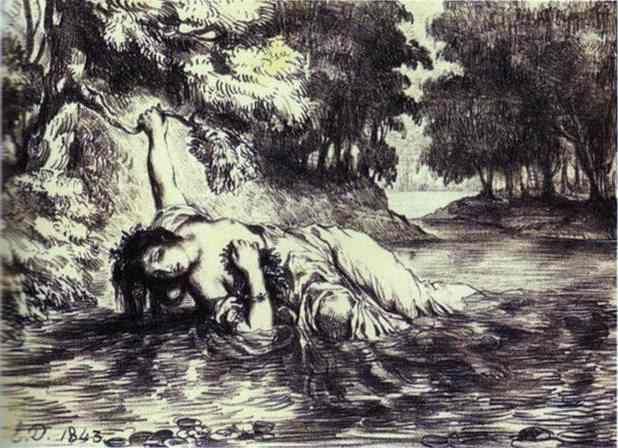
After making her last riddling or mad pronouncements, Ophelia drowns, by suicide or accident. She was gathering flowers by a brook (Slide 96), as another Waterhouse illustrates. she tried to reach a flower on a branch, Gertrude tactfully explains. But the branch hung over a stream, and she fell into the water below. Delacroix has her frantically clutching at the branch (Slide 97).

Slide 69. Delacroix, lithograph, 1838.
Whether it was an accident or a suicide is unknown. As Gertrude tells it, her skirts first kept her afloat, and then dragged her down. The pre-Raphaelite Millais captures this moment (Slide 70) most famously.
Slide 70. John Everett Millais, oil, 1852.

Noticethat in all these pre-Raphaelite paintings, but especially the last one, the points of light that glitter in the water and in the white flowers on the far bank. Flowers are for Ophelia the divine in the world, oases of beauty in a desert of ugliness. They are the "sparks of light" that the Gnostics and the Kabbalists declared were thrown in matter, They had in mind a divine kernel in human souls; but they exist in nature as well. The alchemists identified this substance as the "Anima Mercury," seeds of liquid silver, quicksilver, lying hidden in black matter, even feces, as its inner soul.
The other side of Ophelia's despair is captured by a contemporary American artist (Slide 71). This painting conveys very well how Ophelia has been thrown to the lions--or, since she is in water, the crocodiles.

Slide 71. Katherine Taylor, 1998.
During the putrefactio, in the Rosarium series, the soul is described as leaving the body (Slide 72). The same happens in our play; Claudius sends Hamlet to England on a boat that very night, with Hamlet kept well away from Ophelia. The male half leaves, the female half dies.

Slide 72. Left: Emblem 7, Rosarium, 1558. The Soul’s Extraction, or Impregnation. Right: Emblem 8, Rosarium, 1558. Cleansing, or purification.
There is an archetypal pattern here. In Jungian terms, it is the motif of the weak, helpless anima-woman suddenly alone. The ancient tale of Cupid and Psyche, in which Cupid flies away after being burned, literally, by Psyche, has the same motif. The female half of the pair, Psyche, then undergoes initiation, with much weeping and despairing, to gain her desire, while the male lies helpless in his bed.
Hamlet shows the process with the male as the active one. In Hamlet’s case, it is he who acts and lasts the course. And he gains his desire even though he does not gain Ophelia. In each case the initiation is a purification, one part of which is the washing of the that polluted instrument Hamlet called his “too, too sullied flesh,” which he would have “melt into a dew.” Ophelia’s tears, and Hamlet’s much extended sea voyage, are the watery part of putrefactio called the ablutio, the washing, by which the flesh is made ready (Slide 73, left side, below).

Slide 73. The Soul’s Jubilation, or Birth, or Sublimation. Emblem 9, Rosarium, 1558.
Eventually the spirit does return to the soul (Slide 104a), ready to rescue the soul, as we see with the two birds. But in this case the soul has already left, leaving only a dead body.
Our first encounter with the returned Hamlet is indirect, through a letter that Claudius gets while talking with Laertes.
Here I am reminded of an alchemical illustration in which a lame Saturn points at two bodies in a coffin (Slide 62, below; Emblem 6, Philosophia Reformata, 2nd series, 1622, Johann Daniel Mylius, author,Balthazar or Beltzer Schwann, engraver)

Later in the series, Mercury does the pointing, and the bodies, now joined, are reviving; that happens in our play, too, as we will see, but only metaphorically and not with Polonius (Slide 63. Emblem 13, same work and series).

In the alchemical illustrations, however, Saturn and Mercury are pointing to two bodies, not just one. In our play, the second body is Ophelia’s.. The cause of death is the same as in alchemy: death follows coitus. But first she transforms into a new Hamlet, only one even more in despair and madness than he (Slide 64, below Conception or Putrefaction. Rosarium Philosophorum, Emblem 6, 1558).

In the Rosarium woodcut corresponding to Slide 64, the body is already a hermaphrodite (Slide 64a, above). It is the same during this stage of our play. The incestuous father-daughter relationship has a doubly fatal outcome. In our play, what was first brother-sister incest, and became mother-son, is also father-daughter.
In the Mylius series (Slide 64), the male half looks distinctly older than the female In the Rosarium, the male half, at its rebirth, declares, “I bore the mother who gave me birth” (Fabricius 131). In Christianity this paradoxical statement applies to God. For the alchemists, it applies to the royal hermaphrodite. Ophelia, had she been stronger, might have resisted Polonius for the way he ignored his and Hamlet’s individuality and integrity. Thereby he, too, might have been reborn as an individual with integrity himself.
Among artists, Ophelia’s descent into madness and death is a favorite topic. She acts totally distracted (Slide 65, with her brother Laertes). In fact, her distracted speech holds an awareness of the rottenness in Denmark, just as Hamlet’s had.

Slide 65. Francis Legat, engraving, 1805, after Benjamin West, c. 1802.
"The owl was a baker's daughter," she says, in Hamlet's style of mad rambling. But she is alluding to the legend of a shop girl who followed too closely her baker father’s instructions not to give handouts. She is changed into an owl for refusing charity to a beggar who is really Jesus. Ophelia is like that daughter, acting on behalf of her father's greed instead by her heart, which counseled generosity. After reminding the King and Queen of this story, she looks at them and says, “Lord, we know what we are, but know not what we may be.” She is fearing for her fate after death, but also warning them about theirs.
Significantly, the hermophrodite in the Putrefactio is pregnant, as indicated by the motto of Slide 93, “purtrefaction or conception.” After death comes new birth, if one has confronted one’s demons. Ophelia, too, is thinking, well, if not conception, at least her lost virginity. We may infer this from what she does next, singing them a little ditty, in which a maid declares her love, enters her lover’s room, and “out a maid/ Never departed more” (4.5.54f).

Slide 66. Flashback in Branaugh’s Hamlet, 1996.
The implication is brought out in Branaugh’s version, through a couple of flashbacks that many critics found objectionable, as reading something into the play. Slide 95 is one of them. In the mad scene in Branaugh’s film she actually does look pregnant. Polonius’s lecture to Ophelia about chastity thus only succeeded in making it impossible for Ophelia to say her mind. Not being able to see
Hamlet, of course, made her situation even worse. She took Hamlet's departure personally. “It is the false steward, that stole his master’s daughter,” she says, in her mad-sounding despair. She has Hamlet in mind, as the “false steward” who not only stole the daughter but killed the father.

Slide 67, John William Waterhouse, Ophelia (?), 1908.
But then she hands Claudius and Gertrude fennel, symbolic of flattery, columbines, symbolic of thanklessness, and daisies, symbolic of dissembling. And Claudius gets rue, for regret, as well as herself. The pre-Raphaelite Waterhouse paints her proud stance. She holds them to blame, although it is not clear for what: her father’s death and her father’s unstately funeral, as her brother does, but also for Hamlet’s departure. As her father had warned her, Hamlet was too high-born to take her in marriage.

Slide 68. John William Waterhouse, Ophelia, 1894.
After making her last riddling or mad pronouncements, Ophelia drowns, by suicide or accident. She was gathering flowers by a brook (Slide 96), as another Waterhouse illustrates. she tried to reach a flower on a branch, Gertrude tactfully explains. But the branch hung over a stream, and she fell into the water below. Delacroix has her frantically clutching at the branch (Slide 97).

Slide 69. Delacroix, lithograph, 1838.
Whether it was an accident or a suicide is unknown. As Gertrude tells it, her skirts first kept her afloat, and then dragged her down. The pre-Raphaelite Millais captures this moment (Slide 70) most famously.
Slide 70. John Everett Millais, oil, 1852.

Noticethat in all these pre-Raphaelite paintings, but especially the last one, the points of light that glitter in the water and in the white flowers on the far bank. Flowers are for Ophelia the divine in the world, oases of beauty in a desert of ugliness. They are the "sparks of light" that the Gnostics and the Kabbalists declared were thrown in matter, They had in mind a divine kernel in human souls; but they exist in nature as well. The alchemists identified this substance as the "Anima Mercury," seeds of liquid silver, quicksilver, lying hidden in black matter, even feces, as its inner soul.
The other side of Ophelia's despair is captured by a contemporary American artist (Slide 71). This painting conveys very well how Ophelia has been thrown to the lions--or, since she is in water, the crocodiles.

Slide 71. Katherine Taylor, 1998.
During the putrefactio, in the Rosarium series, the soul is described as leaving the body (Slide 72). The same happens in our play; Claudius sends Hamlet to England on a boat that very night, with Hamlet kept well away from Ophelia. The male half leaves, the female half dies.

Slide 72. Left: Emblem 7, Rosarium, 1558. The Soul’s Extraction, or Impregnation. Right: Emblem 8, Rosarium, 1558. Cleansing, or purification.
There is an archetypal pattern here. In Jungian terms, it is the motif of the weak, helpless anima-woman suddenly alone. The ancient tale of Cupid and Psyche, in which Cupid flies away after being burned, literally, by Psyche, has the same motif. The female half of the pair, Psyche, then undergoes initiation, with much weeping and despairing, to gain her desire, while the male lies helpless in his bed.
Hamlet shows the process with the male as the active one. In Hamlet’s case, it is he who acts and lasts the course. And he gains his desire even though he does not gain Ophelia. In each case the initiation is a purification, one part of which is the washing of the that polluted instrument Hamlet called his “too, too sullied flesh,” which he would have “melt into a dew.” Ophelia’s tears, and Hamlet’s much extended sea voyage, are the watery part of putrefactio called the ablutio, the washing, by which the flesh is made ready (Slide 73, left side, below).

Slide 73. The Soul’s Jubilation, or Birth, or Sublimation. Emblem 9, Rosarium, 1558.
Eventually the spirit does return to the soul (Slide 104a), ready to rescue the soul, as we see with the two birds. But in this case the soul has already left, leaving only a dead body.
Our first encounter with the returned Hamlet is indirect, through a letter that Claudius gets while talking with Laertes.
KING. [Reads] High and mighty, you shall know I am set naked in your kingdom. Tomorrow shall I get leave to see your kingly eyes, when I shall, first asking your pardon, thereunto recount the occasion of my sudden and more strange return. Hamlet...'Tis Hamlet's character. "Naked." And in a poscript here he says "Alone." Can you advise me?
LAERTES. I am lost in it, my lord...(4.7.41ff)
The
ironic and perplexing tone of this letter is not surprising. What is
surprising is that Hamlet would want to meet with Claudius. What do
they have to say to each other? It seems to me that Hamlet is going to
apologize for his insinuations and say that even though he knows full
well what Claudius did, he is not going to make an issue of it if
Claudius won't. Hamlet has a certain incriminating letter by Claudius
to back him up, which could shed important light on events in England
if known. To be sure, Claudius will not go to Hamlet's meeting, and
Hamlet's anger at Claudius comes back. But why else would Hamlet ask to
see Claudius alone, except to call off their feud? As we will see,
Hamlet after his return no longer plots against Claudius. He is in a
more playful mood.
When we actually see Hamlet, he is on a walk with his friend Horatio through the castle cemetery, the very cemetery where Ophelia is about to be buried. But first we have to have Hamlet’s famous scene in which he waxes eloquently while holding a skull (Slide 74).

Slide 74. Cartoon in Aftonblat newspaper(Sweden) for January 6, 2006.
Hamlet’s last homage to the putrefactio is in this graveyard. The gravedigger and an assistant toss out bones and skulls as they dig, with a marvelous nonchalance. The gravedigger is as irreverent about dead bodies as Hamlet himself. “How absolute the knave!” he exclaims. He looks at various skulls and makes fun of the pretensions of their former owners.
Delacroix is the artist who milked the graveyard scene for its metaphysical angst. He did at least five versions, three in oils. One is from 1829, with the gravedigger thrusting the skull upwards toward Hamlet as if to say, “To be or not to be!” (Slide 75a and b, below).

In the second, 1835 (Slide 76a and b, below left and lower right), he is the delicate prince with the indelicate object. The extended foreleg suggests to me that Delacroix might have been trying to bring out Hamlet’s androgyny. There have been Hamlets played by women, most famously Sarah Bernhardt’s of 1899 London (Slide 76c, upper right below).

The gravediggers themselves, as I have said, are nowhere near as serious as in Delacroix. They are actually designated “First Clown” and “Second Clown” in the play (changed, however, to “Gravedigger” and “Other” in modern editions). Their mood is more along the lines of a captioned version of Delacroix’s painting that I found on the internet (Slide 77).

Slide 77. 70 with captions. Katie Sullivan, 2003.
Their irreverence rubs off on Hamlet. The gravedigger handing him the skull, like the initiator in some ancient mystery cult, gives him just enough information to move him forward. The skull is that of someone he knew, Yorick, the old king’s jester:
When we actually see Hamlet, he is on a walk with his friend Horatio through the castle cemetery, the very cemetery where Ophelia is about to be buried. But first we have to have Hamlet’s famous scene in which he waxes eloquently while holding a skull (Slide 74).

Slide 74. Cartoon in Aftonblat newspaper(Sweden) for January 6, 2006.
Hamlet’s last homage to the putrefactio is in this graveyard. The gravedigger and an assistant toss out bones and skulls as they dig, with a marvelous nonchalance. The gravedigger is as irreverent about dead bodies as Hamlet himself. “How absolute the knave!” he exclaims. He looks at various skulls and makes fun of the pretensions of their former owners.
Delacroix is the artist who milked the graveyard scene for its metaphysical angst. He did at least five versions, three in oils. One is from 1829, with the gravedigger thrusting the skull upwards toward Hamlet as if to say, “To be or not to be!” (Slide 75a and b, below).

In the second, 1835 (Slide 76a and b, below left and lower right), he is the delicate prince with the indelicate object. The extended foreleg suggests to me that Delacroix might have been trying to bring out Hamlet’s androgyny. There have been Hamlets played by women, most famously Sarah Bernhardt’s of 1899 London (Slide 76c, upper right below).

The gravediggers themselves, as I have said, are nowhere near as serious as in Delacroix. They are actually designated “First Clown” and “Second Clown” in the play (changed, however, to “Gravedigger” and “Other” in modern editions). Their mood is more along the lines of a captioned version of Delacroix’s painting that I found on the internet (Slide 77).

Slide 77. 70 with captions. Katie Sullivan, 2003.
Their irreverence rubs off on Hamlet. The gravedigger handing him the skull, like the initiator in some ancient mystery cult, gives him just enough information to move him forward. The skull is that of someone he knew, Yorick, the old king’s jester:
HAMLET. Alas, poor Yorick. I knew him, Horatio, a fellow of infinite jest, of most excellent fancy. He hath bore me on his back a thousand times, and now—how abhorred in my imagination it is. My gorge rises at it. Here hung those lips that I have kissed I know not how oft. Where be your gibes now, your gambols, your songs, your flashes of merriment, that were wont to set the table on a roar? Not one now to mock your own grinning? Quite chop-fallen? Now get you to my lady’s chamber and tell her, let her paint an inch think, to this favour she must come. Make her laugh at that. (V.i.178ff )

Slide 78. Derek Jacoby, still from BBC Hamlet, 1980.
I like very much Derek Jacobi’s affection and warmth toward the skull grinning up at him (Slide 78). Ah, if Hamlet could only be like Yorick! Notice how he plays with the skull in his speech. He imagines kissing it: "Here hung these lips that I have kissed I know not how oft." He pokes fun at at its "grinning." Then "Quite chop-fallen?" he asks. I imagine that he has just dropped the jawbone. He plays with the skull in the way that Yorick played with him.
Hamlet’s speech is not mere sentimentality; nor does it carry a sense that everything Yorick did was in vain. It is Hamlet’s first sign of real affection for someone other than Horatio. Hamlet’s tragedy, to my way of thinking, is that he never had a father in whose footsteps he could enthusiastically follow.
His father was a cold fish and a ruffian, his uncle a drunkard, their best friend a pretentious bully. But Yorick was a man who showed real affection for Hamlet, and who brought joy to others. Hamlet has before him, in that grinning skull, the model has been searching for.
Now life has meaning. And he is a long way from wanting to be king, or his mother’s intimate companion. He may still have grandiose ideas, but they are of a more literary sort. Perhaps he will become the world’s greatest playwright, with a flair for the comic side of life.

Slide 79. Delacroix, Horatio and Hamlet in the Graveyard, 1859.
As Hamlet finishes his thoughts about Yorick, a funeral procession heads toward them. In Delacroix’s 1859 version of the scene, it is in the background (Slide 79). Hamlet and Horatio back off and watch from a distance as Ophelia’s casket is lowered into the grave. Her brother Laertes, sick with grief, jumps into the grave after her.
At this Hamlet comes out of hiding and jumps in, too, saying "I loved Ophelia more than forty thousand brothers” (V.i.247).
Unaccountably for Hamlet, who seems to have forgotten who killed Laertes' father, Laertes starts physically attacking him, and they fight grotesquely (Slide 80), as the Queen begs them to stop.

Slide 80. Delacroix, Hamlet and Horatio fighting in Ophelia’s grave. Lithograph, 1843.
This image of the two young men fighting over who loves Ophelia most, while they trample on her body, is delicious macabre. However late and overblown, Hamlet now realizes that he did indeed love Ophelia. And for that we must be grateful.
For Hamlet now there is a reconciliation between Ophelia's pleasurable allure, of which he was so defensive before, and her Virtue--not ideal Virtue any longer, but virtue as it can be lived in this world. The Renaissance expressed this idea as the reconciliation of pleasure and virtue,
An early example in art is Durer's engraving Combat of Virtue and Pleasure in the Presence of Hercules (1498-1499), a deliberate variation on the familiar story in which Hercules has to choose between the difficult path of Virtue and the easy road of Pleasure. Ophelia early on in the play had invoked this image of the "steep and thorny way to heaven" versus the "primrose path of daliance"(1.3.48-50) in response to her brother's admonitions, as he goes off to Paris, that she preserve her virtue. Durer's take on the choice is below (Slide 81):

Instead of a choice between one and the other, what Durer has us and Hercules see is Virtue's impending assault on Pleasure, much in the style of Hamlet's on Ophelia and his mother in the play. All poor Pleasure is doing is minding her own business with a satyr. Hercules responds by blocking Virtue's blows. He wants Virtue to leave off her high-handed attacks. The two can live in peaceful co-existence.
In painting, a famous image was that of the middle Grace, now no longer seen as Chastity but rather as Beauty, bringing together Chastity and Pleasure. Raphael painted the scene. Chastity has on a covering, such as it is, and no jewelry. Pleasure is naked and with a large necklace and jewel. In the middle is a figure with less jewelry and her back to us (Slide 82):

Slide 82. Raphael, Three Graces, 1505.
Pleasure and Virtue can indeed coexist in one individual, the one whom Raphael put in the middle, Beauty as a Renaissance unity of opposites. In our world, of course, it is neither perfect Beauty nor perfect Virtue, only the best that can be expected. In like manner playwrights in Elizabethan England portrayed their Queen as the epitome of both Virtue and Beauty (Wind, Pagan Mysteries of the Renaissance, p82f). And in 1618, Ben Jonson, an admirer of Shakespeare, wrote a masque on the theme of "Pleasure reconciled to Virtue" for Elizabeth's successor James I (Wind, p. 85)
In this play, God is shown to be in this world, manifesting in figures like Ophelia. However our protagonist discovers Him too late; the immanent divine, we might say, is discovered in the shadow of death.
The Queen, the celestial Venus in whose mother-matter he first discovered spirit, still lives. However we suspect already that the play can't end until she, too, has breathed her last. The manner of her death will show her spirit. But that is a tale for a later section.
Image sources, Putrefactio and Immanence.
61. http://arlenestage.homestead.com/JacobiHamlet.html.
62. de Rola, Golden Game, 174.
63. de Rola, 175.
64. Fabricius, Alchemy, 102.
65. www.english.emory.edu/classes/Shakespeare_Illustrated/West.Ophelia.gif.
66. www.branaghcompendium.com/pattycake2.jpg.
67. http://commons.wikimedia.org/wiki/Image:John_William_Waterhouse_-_.
68. http://www.d.umn.edu/~kmaurer/hamlet/ophelia1894-s.jpg.
69. http://www.abcgallery.com/D/delacroix/delacroix17.JPG.
70. http://kunstiveeb.arhiiv.ee/pildid/millais/millaisophelia.JPG.
71. http://www.d.umn.edu/~kmaurer/hamlet/TaylorOphelia.jpg.
72. Fabricius, 104 and 112.
73. Fabricius, 124.
74. Aftonblatt newspaper, 1-6-2006. (On web, but I can't find it now.)
75 a and b. wikipedia.org, entry for “Hamlet.”
76. (a) and (c) Jobert, Barthelemy, Delacroix (T. Grabar and A. Bonfante-Warren, Trans.), 281; (b) www.filmski.net/.../news02/10/zasto01.done.jpg.
77. www.sullivanet.com/misc/hamlet/yorick1.jpg.
78. http://arlenestage.homestead.com/JacobiHamlet.html.
79. Jobert, 280.
80. www.english.emory.edu/classes/Shakespeare_Illustrated/dh.html.
81. Erwin Panofsky, Durer, fig 108.
82. http://en.wikipedia.org/wiki/Image:Three_Graces.jpg.
61. http://arlenestage.homestead.com/JacobiHamlet.html.
62. de Rola, Golden Game, 174.
63. de Rola, 175.
64. Fabricius, Alchemy, 102.
65. www.english.emory.edu/classes/Shakespeare_Illustrated/West.Ophelia.gif.
66. www.branaghcompendium.com/pattycake2.jpg.
67. http://commons.wikimedia.org/wiki/Image:John_William_Waterhouse_-_.
68. http://www.d.umn.edu/~kmaurer/hamlet/ophelia1894-s.jpg.
69. http://www.abcgallery.com/D/delacroix/delacroix17.JPG.
70. http://kunstiveeb.arhiiv.ee/pildid/millais/millaisophelia.JPG.
71. http://www.d.umn.edu/~kmaurer/hamlet/TaylorOphelia.jpg.
72. Fabricius, 104 and 112.
73. Fabricius, 124.
74. Aftonblatt newspaper, 1-6-2006. (On web, but I can't find it now.)
75 a and b. wikipedia.org, entry for “Hamlet.”
76. (a) and (c) Jobert, Barthelemy, Delacroix (T. Grabar and A. Bonfante-Warren, Trans.), 281; (b) www.filmski.net/.../news02/10/zasto01.done.jpg.
77. www.sullivanet.com/misc/hamlet/yorick1.jpg.
78. http://arlenestage.homestead.com/JacobiHamlet.html.
79. Jobert, 280.
80. www.english.emory.edu/classes/Shakespeare_Illustrated/dh.html.
81. Erwin Panofsky, Durer, fig 108.
82. http://en.wikipedia.org/wiki/Image:Three_Graces.jpg.




0 Comments:
Post a Comment
<< Home