I-A: Mercury; I-B: Jupiter.
PART I, SECTION A: MERCURY

For all these reasons the alchemists gave Mercury a central role, in both masculine and feminine forms and also as a hermaphrodite. Mercury affected all the planets, and vice versa, as shown below.
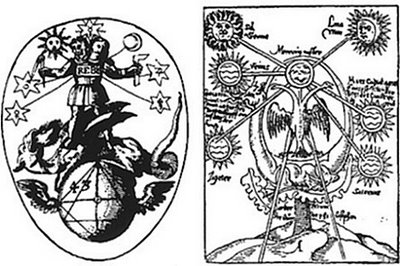
The illustration on the left (10a, “Hermaphrodite on the Winged Globe of Chaos,” from the Vintorum Spagyricum of 1625) shows Mercury as the central planet, and below its sign is a two-headed person, with the word “REBUS” on its front. Lines connect the figure with the other six planets. It is Mercury as conqueror of the chaos, drawing for this purpose from all the other planets and probably transforming them as well. “Rebus” is from Latin and means “two in one”; it is a term for the hermaphrodite. What the two parts of the hermaphrodite are, we will see later in this section.
The illustration on the right (10b, “Our Mercury,” from the Pandora of 1588, shows Mercury in the center with lines radiating out to the other planets. Below the circle for Mercury is a two-headed eagle, another image for the hermaphrodite. Again it is Mercury relating to all the other planets.
If the central figure in alchemy is Mercury, and our play follows an alchemical model, then we should expect to find Hamlet himself in the role of Mercury. And that, I sibmit, is what we have. Hamlet is the one who engages in the "machinations" attributed to Mercury by the Poimandres, the complex verbal contrivances designed to disarm his opposition and surprise his enemy.
With Mercury as with Hamlet, all is by no means sweetness and light. The Poimandres characterizes the vice of Mercury as that of “machinations of evil” i.e. clever schemes for evil ends. It is especially in communication that Mercury shows his skill. The poem De Sphaera (The Spheres), from the mid 15th century, for example, says that Mercury “produces a great fountain of eloquence.” I have not located a reproduction of the accompanying illustration, but one in another manuscript (below, Slide 10c, The Children of Mercury, c. 1410-1415, Harley MS 4431, f. 102) shows the “Children of Mercury” practicing their elocution.

A good orator can sway a crowd with bad logic or plausible lies, and Mercury comes with a reputation for deception. Ficino, in another work widely read in Elizabethan England, imagines Mercury giving a speech in which he says he speaks with a “double tongue.” What he means is that he is speaking for his sister Diana as well as himself; but he is also alluding to his reputation for speaking duplicitously. Yet on the positive side, with sound reasoning, good memory, and a passion for investigation, one can discriminate truth from falsehood, penetrate beneath superficial appearances, and even win others to a deeper understanding. Mercury is identified with both scrupulous honesty and skillful deception.
The astrologer William Lilly, writing in 1647, summed up the Renaissance conception of Mercury's qualities in the following set of contrasts. First, the planet as expressed positively in a person's character:
For the alchemists, Mercury had another characteristic, which we will see also in Hamlet. In his masculine aspect, he was the spirit of Sulphur (Slide 11, below), a poison dangerous to humans, but if properly used also a valuable medicine.

The figure on the left is labeled "Spirit of Sulphur," but he has the winged cap and heels of Mercury. The figure on the right is Sulphur's poisonous form, as a dangerous dragon called Vitriol, an old word for acid (both illustrations above are from the Quinta Essentia, 1579, by Therneisser zum Thurn). Even today that word survives to describe an acidic, or vitriolic, mood or way of speaking. In alchemy, the dragon Vitriol breathed sulphurous fumes, today we would label them sulphur dioxide, which could poison people’s lungs as sulphurous acid. Today we have acid rain, among other things.
To the alchemist, however, sulphur was a valuable solvent for the separation and purification of metals. In slide 14b, the words on one basin are Latin for Oil of Vitriol, i.e. sulphurous acid. The other says “drinkable gold.”
The metal mercury had similar characteristics and was a deadly poison in gaseous form. Yet sulphur and Mercury, in the right quantities, also had medicinal properties. Both sulphur and mercury compounds were put on the skin, for example, to cure infections. Words, too, can heal, even caustic ones if they are delivered in a way the recipient can understand. In alchemy the purifying of masculine Mercury is also that of Sulphur, from angry, self-defeating beginnings, or red sulphur, to beneficent endings, white sulphur. For Hamlet and for all of us, purifying our vitriol, that it may help rather than harm, is a life task.
The hermaphrodite in the images shown earlier ("Mercury as the Conqueror of the Chaos" and "Our Mercury") is, in the alchemists’ understanding, the fusion of Sulphur with Mercury. Mercury, in alchemy as opposed to astrology, was in itself represented as either feminine or androgynous, Sulphur as masculine. Sulphur is the “terrestrial sun,” the fiery, dry power of the sun within the earth. Mercury by itself, on the other hand, is naturally cold. It is liquid, and also silver like the feminine Moon. Yet its liquid nature is not that of water; Mercury does not cling to the skin. When Sulphur and Mercury are found together, alchemical Mercury can take on a masculine appearance, like his astrological counterpart, even while having much of the feminine in essence. Such also is Hamlet.
With his acidic wit, Hamlet is just the solvent to melt or burn away the impurities in the other planetary metals, as embodied in the other characters in the play. He will show them themselves and thereby confront them with their own possibility of salvation.
The six other planetary powers, moreover, are not only outside Hamlet, confronting him, but also character traits within him, his compulsive ways of thinking and acting. Hamlet says as much in a couple of places. One is to Claudius, the King, in one of his taunts to this man who has taken on the role he himself desired:
Another allusion to Hamlet's participation in all the planets is when he declares to Ophelia,
An English medallion of the period relates to Ophelia’s comments. One side (12a, below) shows the gods Mars and Mercury united in a single person (from The Mirror of Mercury, 1618; the words around the picture translate as “Perfect in each”).

The other side (12b, below) shows a scholar and a knight united in one person (here the words mean “virtue, unity, strength”).

Thus a well-rounded gentleman of the period was expected to embody both Mercury and Mars. He would have the other virtues as well, but to put them all in one’s emblem would have seemed vain.
Roland Frye, from whose book on Shakespeare I take these images, says that Hamlet’s friend and confidant Horatio is Mercury, because he is the one Hamlet calls “not passion’s slave.” The ideal scholar, Frye argues, is the one who follows the light of reason without being influenced by emotion. Indeed, Mercury is called the “star of reason” in such Renaissance texts as the 15th century astrological poem De Sphaera, famous for its illustrations.
Against this I say that Hamlet is the one in the play who does the most reasoning, with the most penetrating ideas. The trouble is that reason provides him no clear path, and het becomes overwhelmed by emotion. Even then he comes within the sphere of Mercury, for reason is what Mercury holds dear. For one squeezed in between the spheres of fickle Luna and lovely Venus, it offers the hope of delivering him from the ups and downs of mercurial passions.
I want to present one other way of expressing how all the planets are in Hamlet, in terms of Jungian psychology: They are all part of the organization of the typical male neurotic of our time, the so-called puer aeternis or eternal boy, who cannot seem to adjust to the world around him, and cannot feel at home in a career or family in the way that others can. He is overwhelmed by complexes, those contents of the unconscious that were identified in the Renaissance by the planets and in the play by the major characters in the Danish court.
Psychiatrists Donald Sandner and John Beebe, in an article published in the book Jungian Analysis in 1982, put the unconscious psyche of such a man in a diagram (Slide 13, below). I do not propose to psychoanalyze Hamlet: he is not a person, he is an artistic creation. But it is as such a creation that the diagram applies to him. The data for Sandner and Beebe's diagramt came from the dreams of their male patients in San Francisco of the 1970's. In our play, Shakespeare is dreaming the characters through his creation and alter ego Hamlet. They are the mirror in which Hamlet, the author, and many people may see the parts of themselves that are otherwise invisible.

In the play it is not hard to recognize the two aspects of the anima, the feminine-imaged unconscious figures in a man's dreams. There is the weak, crazed, damaged girl Ophelia, who is the "Wounded Anima." This is Hamlet's love-interest, but also his stymied ability to relate to others, except in crazy, self-defeating ways. The "Dominant Anma" is of course his mother the Queen, whom Hamlet conceives as a creature of sexual appetite and whose behavior and opinion affects him far more than one might wish.
Above these two in the diagram is the basic division in Hamlet's unconscious energy. On the one hand, he discerns is a reality behind appearances that is the opposite of what it seems. This reality is crystalized in the Ghost, a visitor from the spirit world who presents him with the imperative to remove the evil that dominates his world. He is the divine son and hero, however reluctantly he takes on the role. On the other hand, there are the forces against him, poiosonous and sexual. These phallically possessive men, King Claudius and Prime Minister Polonius, are what keeps him from being what he is. Instinctual energy is evil, the Spirit behind appearances is good.
The puer aeternus is not necessarily deluding himself. Hamlet's judgment of the situation is correct, as the murdering King Claudius reveals to us in an aside early on and a soliloquy later.What is inflated is his means of dealing with the situation, through words, exposing the guilty so eloquently that his guilt will be obvious to all, and even he will admit his guilt.
Words prove inadequate. What he needs is the same physical aggressiveness that he loathes in others. Therein lies his problem as he sees it, again not an unrealistic one: coming to terms with Mars, discovering how to act in an effective way, and with facts rather than imaginings.
I will put the issue in a more comprehensive planetary way. The people around Hamlet, as for the puer aeternis generally, seem happy with Polonius and Claudius, the powers that be, in planetary terms the educator and businessman Jupiter and the political, statesmanly, even priestly Sol. These planets were considered the "good" planets in medieval times. But for Hamlet these powers are evil. What is good is that which declares their evil and shows a reality hidden to others, as Saturn, and fights against it, Mars as a Holy Warrior. These very planets, Saturn and Mars, were considered generally evil in the Middle Ages, as disturbing a harmonious world with wild ideas and aggression. No wonder Hamlet has a hard time adjusting!
In the Renaissance, a more balanced view of all the planets was articulated by the humanists, based on classical thought and encapsulated in Renaissance Astrology, some of which remains with us today. That perspective is what Hamlet needs, as well as a mature style of relationship. For those of us who want to work on these issues in ourselves today, the play is an excellent place to exercise one's thoughts, feeling, and imagination.
Here, then, is Hamlet as he has been portrayed on stage (at left, 14a, a sketch by Dante Gabriel Rosetti, c. 1836; and 14b, a chromograph by Harold Copping, 1897).

As Mercury, he dazzles us with his wit, his non-stop cutting double-entrendres that to the other characters sound like mad ramblings but to the audience make perfect if unusual sense, if one is fast enough to pick up the meaning. He is a walking, talking Rebus, never with only one meaning. Moreover, in his soliloquies and asides, spoken to the audience to show what he is thinking, unheard by the other characters, he reveals another side of his character. His is a complex mind thinking itself out of the Middle Ages and into the modern age, again straddling points of view, and in the process raising questions that are with us even today.
Image sources, Mercury:
9. De Rola, Stanislaus (1988), p. 170..
10. (a) Jung, C. G. (1968). "Religious ideas in alchemy. "In R. F. C. Hull (Trans.), Psychology and alchemy (Vol. 12, 2nd ed., of Collected works of C. G. Jung, pp. 225-483), p. 372. He has it as from the Viatorum Spagyricum, 1625. Adam McLean, on his alchemy website, attributes the image to the Azoth, which was published in Paris, 1624, along with text attributed to Basil Valentine but translated into French.
(b) Jacobi, J. (Ed.). (1979). Paracelsus: Selected writings (N. Guterman, Trans.), p. 145; also Fabricius, 186. It is from the Pandora, 1582. Jacobi describes it as "Our Mercury." At http://www.levity.com/alchemy/s_pandor.html, Adam McLean describes it as Emblem 15, Fermentation.
10c. Page, Sophie (2002). Astrology in Medieval Manuscripts.
11.Johannes Fabricius (1989(, Alchemy, 37 .
12a and 12b. Frye, R. M. (1984). The Renaissance Hamlet: Issues and responses in 1600, 174.
13. D. Sandner and J. Beebe, ""Psychopathology and Analysis," in M. Stein, ed. (1982), Jungian Analysis, p. 308. From Donald Sandner and John Beebe, “Psychopathology in Analysis,” in Murray Stein, ed., DDonaldDSandSJungian Analysis 1982, pp. 294-293
14. (a) www.rossettiarchive.org/img/f75a.jpg. (b) www.leoyan.com/global-language.com/ENFOLDED/YOUNG/Illus/Copping-Hamlet.jpg.
PART I, SECTION B: JUPITER

The reason for such characterizations, according to Wind, is that astrological illustrations used Arab sources, in which Western Europe was represented as being ruled by religion. Hence Marduk, the head of the Babylonian gods, was seen in his role as judge of the dead. The people in his sphere were those whose profession prepared people for judgment after death. An 11th century Babylonian magical text, the Ghaya, says that when praying to Jupiter, “Be humble and modest, dressed in the manner of monks and Christians, for he is their patron.” By the time of the poem De Sphaera, the sphere had enlarged somewhat:

But we have already seen, in the “Seven Ages of Man” poem, how Shakespeare satirized the declining years, represented by Jupiter. Important and learned men still held power even as their bodies, and perhaps their minds, were slowly declining. In Hamlet, Polonius is his main example, and there are connections to Jupiter besides his age and position.
And in fact Renaissance astrology depicted the influence of Jupiter in both lights, positive and negative. On the positive side William Lilly wrote of Jupiter, when "well dignified":
Hamlet confronts Polonius in an early scene, walking in a hall brooding on his predicament and also reading a book (Slide 17, from Lawrence Olivier’s film, 1948).

Reading is a characteristic activity for Mercury, god of communication and scribes. A pillar in the Doge’s Palace in Venice shows Mercury in the same pose (Slide 18, from Seznec).

According to Ficino, it is characteristic of Jupiter to be the “helping father” (p. 269) as opposed to the sun, who is apt to do harm. But he is only helpful, Ficino adds, to “people leading ordinary lives” (p. 365) as opposed to melancholics like Hamlet. Jupiter’s field of expertise, according to Ficino, is “civic occupations, by those occupations which strive for honor, by natural philosophy, by the kind of philosophy which most people can understand, by civic religion, and by laws” (p. 253). Polonius, of course, is a civil servant, probably a lawyer, and certainly a dispenser of conventional wisdom to all and sundry.
In this mode of helpfulness, although also hoping to win points with Claudius, Polonius sees Hamlet walking up and down reading (Below, Slide 19, by Delacroix, 1843, and 20, Derek Jacobi, 1980). He strikes up a conversation, in the course of which he asks Hamlet, “What do you read, my lord?”


Here is the ensuing dialogue (In my slide presentation, people choose parts):
But what does the conversation have to do with Jupiter? It is the same idea as in the "Seven Ages of Man" poem: Jupiter is from the older generation. Moreover, as Gatti has pointed out, the passage Hamlet reads actually does correspond closely to a passage about Jupiter in a book published in London in the 1580’s, Giordiano Bruno’s The Expulsion of the Triumphant Beast. The aging Jupiter describes himself in just such terms:
A second consideration is Polonius’s name. In the early version of the play known as the Quarto, Polonius is named Carambis. This name is similar to the beginning of a motto in Latin, Crambe bis posita mors, meaning “Cabbage served up twice is death.” It is one of the adages in Erasmus’s Adagia as published in 1500 (English edition, 1982), the book which in 1508 included Festina lente. Erasmus explains that it was believed that cabbage when recooked produced nausea. Hence the phrase was applied to “something disagreeable repeated over and over again.” Thus the name is “eminently suitable for one who regales us with stale and tedious wisdom” (Jenkins 1982, 421). All the same, Shakespeare changed the name to Polonius. Why? Gatti observes that Bruno names one of his pedants Polinnio (1989, 131). Perhaps Shakespeare wished to credit Bruno, whom the Inquisition had just burned at the stake at the time Hamlet was being staged.
In the Poimandres, Jupiter’s sphere is that of “gaining wealth by evil means.” It is the sin of Avarice. I looked for a depiction of Jupiter as avaricious but could not find any. But once we recall that Jupiter’s equivalent in iconography was a monk, this problem is solved. There is a long-standing tradition in art and literature of portraying churchmen as greedy. A mid-15th century illumination to Dante’s Paradiso (Slide 21, by Giovanni di Paolo, detail) shows a devil showering gold into the open purse of the pope.

This devil sits on the towers of Florence, identifiable by the red fleur-de-lys on a white background, symbol of the Florentine Guelphs who had sentenced Dante to death in absentia. Florence and the Church had an arrangement that worked favorably for both, the illumination seems to tell us. Di Paolo, the artist, was based in Florence’s arch-rival Siena
But the most common example of churchly greed was the selling of indulgences: the Pope would get one’s time in Purgatory reduced in proportion to the generosity of one’s contribution. The engraving of Slide 22 (16th or 17th century) illustrates this practice in action, likely from a Protestant perspective.

On the left a priest reads from the pulpit. Only one person appears to be listening; the women at the lower left are talking among themselves. Below and to our right a monk explains the benefits of Indulgences to parisioners. A clerk collects the money (Slide 23, detail of 22):

It is characteristic of a king’s chief adviser to use his position to enrich himself materially. Shakespeare’s likely model for Polonius, Elizabeth’s chief adviser Lord Burleigh, was well-known for the practice. But Shakespeare never shows Polonius as hungry for money. There is one area where this characterization could apply, however: his attitude toward his daughter Ophelia. She of course is the protagonist’s love interest and the play’s main representative of Venus, goddess of Love and Beauty.
In an early scene, Polonius inquires about her relationship with Hamlet (again, people choose parts):
Stills of this scene capture Opelia’s emotions in a variety of ways. In one, she looks detached, even bored (Slide 24, Ubiquity State Productions, 2000). This is probably when Polonius is lecturing her.

In another, with Bill Murray playing Polonius as a corporation vice president, she looks angry (Slide 25, from film directed by Michael Almereyda, 2000). No doubt this is where she has just spoken up in defense of Hamlet’s decorum.

I would like to have found a still of Ophelia at the end of this scene, where she says she will obey. In Branagh’s film, she looks terrified. Polonius has achieved his goal.
For his part, Hamlet knows full well how Polonius has been ordering Ophelia to behave. We see this in the same scene that we l looked at earlier, with Hamlet reading but seeming not quite in his right mind.
In the ensuing dialogue, Hamlet becomes more specific. The moment is captured in Slide 26 (Derek Jacobi, 1980).

First Hamlet gives a rather nauseating image of sexual intercourse, spoken as though he were mad, of course, followed by a clear and direct question:
unwitting clown.
Image sources, Jupiter:15. (a) Seznec, Survival of the Pagan Gods, 165. (b) Seznec, 161.
16. http://www.nationmaster.com/encyclopedia/Polonius.
17.45. www.arabist.net/wp-content/uploads/2006/02/olivierhamlet-1-tm1.jpg.
18. Seznec, 72
19. www.english.emory.edu/classes/Shakespeare_Illustrated/dh.html.
20. http://arlenestage.homestead.com/JacobiHamlet.html.
21. Pope-Hennessy, Sir John Wyndham (1993). Paradiso: The illuminations to Dante's Divine Comedy by Giovanni di Paolo, p. 100.
22 and 23. www.augustana.edu/Religion/LutherProject/95THESES/church%20selling%20indulgences.gif.
24. www.ubiquitystage.com/images/hamlet/hamlet07.jpg.
25. www.kinoweb.de/film2000/Hamlet/pix/hm4.jpg.
26. http://arlenestage.homestead.com/JacobiHamlet.html.
And to the first zone of heaven he gives up the force which works increase and that which works decrease; to the second zone, the machinations of evil cunning... From Tractate I, Corpus Hermeticum, 2nd century.In the Ptolemaic system, the zone of Mercury was the second zone outward from the Earth, right after the Moon. Yet in many respects he plays a central role among the seven planets. In Latin countries, the middle of the week is Mercury’s day, for example Mercredi in French. Mercury, the Greek Hermes, as messenger of the gods, was in a position to come into frequent contact with all of them. He also brought people up to heaven from earth or even Hades, for example Psyche the bride of Cupid and Proserpine, or Persephone, wife of Pluto, god of the underworld.. Augustine saw Mercury, a savior of souls, as a kind of precursor to Christ. In metallurgy the metal Mercury had the particular virtue of being useful for separating other metals from their ore. Below is an alchemical illustration of this trait, the stage in the work they called the Separatio. Mercury, like Christ, was a purifying agent (Slide 9, Emblem 7 of Johann Daniel Mylius, author, Balthazar or Baltzer Schwann, engraver, Philosophia Reformata, 1st series, 1622).
All Subtleties and every cunning Art
To witty Mercury I do impart. Henry Vaughn, 17th century.

For all these reasons the alchemists gave Mercury a central role, in both masculine and feminine forms and also as a hermaphrodite. Mercury affected all the planets, and vice versa, as shown below.

The illustration on the left (10a, “Hermaphrodite on the Winged Globe of Chaos,” from the Vintorum Spagyricum of 1625) shows Mercury as the central planet, and below its sign is a two-headed person, with the word “REBUS” on its front. Lines connect the figure with the other six planets. It is Mercury as conqueror of the chaos, drawing for this purpose from all the other planets and probably transforming them as well. “Rebus” is from Latin and means “two in one”; it is a term for the hermaphrodite. What the two parts of the hermaphrodite are, we will see later in this section.
The illustration on the right (10b, “Our Mercury,” from the Pandora of 1588, shows Mercury in the center with lines radiating out to the other planets. Below the circle for Mercury is a two-headed eagle, another image for the hermaphrodite. Again it is Mercury relating to all the other planets.
If the central figure in alchemy is Mercury, and our play follows an alchemical model, then we should expect to find Hamlet himself in the role of Mercury. And that, I sibmit, is what we have. Hamlet is the one who engages in the "machinations" attributed to Mercury by the Poimandres, the complex verbal contrivances designed to disarm his opposition and surprise his enemy.
With Mercury as with Hamlet, all is by no means sweetness and light. The Poimandres characterizes the vice of Mercury as that of “machinations of evil” i.e. clever schemes for evil ends. It is especially in communication that Mercury shows his skill. The poem De Sphaera (The Spheres), from the mid 15th century, for example, says that Mercury “produces a great fountain of eloquence.” I have not located a reproduction of the accompanying illustration, but one in another manuscript (below, Slide 10c, The Children of Mercury, c. 1410-1415, Harley MS 4431, f. 102) shows the “Children of Mercury” practicing their elocution.

A good orator can sway a crowd with bad logic or plausible lies, and Mercury comes with a reputation for deception. Ficino, in another work widely read in Elizabethan England, imagines Mercury giving a speech in which he says he speaks with a “double tongue.” What he means is that he is speaking for his sister Diana as well as himself; but he is also alluding to his reputation for speaking duplicitously. Yet on the positive side, with sound reasoning, good memory, and a passion for investigation, one can discriminate truth from falsehood, penetrate beneath superficial appearances, and even win others to a deeper understanding. Mercury is identified with both scrupulous honesty and skillful deception.
The astrologer William Lilly, writing in 1647, summed up the Renaissance conception of Mercury's qualities in the following set of contrasts. First, the planet as expressed positively in a person's character:
Being well dignified, he represents a man of a subtil and politick brain, intellect, and cogitation; an excellent disputant or Logician, arguing with learning and discretion, and using much eloquence in his speech, a searcher into all kinds of Mysteries and Learning, sharp and witty, learning almost any thing without a Teacher.Then he gives a description of the negative side of Mercury:
A troublesome wit, a kind of Phrenetick man, his tongue and Pen against every man, wholly bent to spoil his estate and time in prating and trying nice conclusions to no purpose; a great lyar, boaster, pratler, busibody, false, a tale-carrier, given to wicked ARTS, as Necromancy, and such like ungodly knowledges; easie of beleef… (both from http://www.renaissanceastrology.com/mercury.htm).To those around him, Hamlet fits muc of this characterization, even that of "necromancy," i.e. summoning up the dead.
For the alchemists, Mercury had another characteristic, which we will see also in Hamlet. In his masculine aspect, he was the spirit of Sulphur (Slide 11, below), a poison dangerous to humans, but if properly used also a valuable medicine.

The figure on the left is labeled "Spirit of Sulphur," but he has the winged cap and heels of Mercury. The figure on the right is Sulphur's poisonous form, as a dangerous dragon called Vitriol, an old word for acid (both illustrations above are from the Quinta Essentia, 1579, by Therneisser zum Thurn). Even today that word survives to describe an acidic, or vitriolic, mood or way of speaking. In alchemy, the dragon Vitriol breathed sulphurous fumes, today we would label them sulphur dioxide, which could poison people’s lungs as sulphurous acid. Today we have acid rain, among other things.
To the alchemist, however, sulphur was a valuable solvent for the separation and purification of metals. In slide 14b, the words on one basin are Latin for Oil of Vitriol, i.e. sulphurous acid. The other says “drinkable gold.”
The metal mercury had similar characteristics and was a deadly poison in gaseous form. Yet sulphur and Mercury, in the right quantities, also had medicinal properties. Both sulphur and mercury compounds were put on the skin, for example, to cure infections. Words, too, can heal, even caustic ones if they are delivered in a way the recipient can understand. In alchemy the purifying of masculine Mercury is also that of Sulphur, from angry, self-defeating beginnings, or red sulphur, to beneficent endings, white sulphur. For Hamlet and for all of us, purifying our vitriol, that it may help rather than harm, is a life task.
The hermaphrodite in the images shown earlier ("Mercury as the Conqueror of the Chaos" and "Our Mercury") is, in the alchemists’ understanding, the fusion of Sulphur with Mercury. Mercury, in alchemy as opposed to astrology, was in itself represented as either feminine or androgynous, Sulphur as masculine. Sulphur is the “terrestrial sun,” the fiery, dry power of the sun within the earth. Mercury by itself, on the other hand, is naturally cold. It is liquid, and also silver like the feminine Moon. Yet its liquid nature is not that of water; Mercury does not cling to the skin. When Sulphur and Mercury are found together, alchemical Mercury can take on a masculine appearance, like his astrological counterpart, even while having much of the feminine in essence. Such also is Hamlet.
With his acidic wit, Hamlet is just the solvent to melt or burn away the impurities in the other planetary metals, as embodied in the other characters in the play. He will show them themselves and thereby confront them with their own possibility of salvation.
The six other planetary powers, moreover, are not only outside Hamlet, confronting him, but also character traits within him, his compulsive ways of thinking and acting. Hamlet says as much in a couple of places. One is to Claudius, the King, in one of his taunts to this man who has taken on the role he himself desired:
KING: How fares our cousin Hamlet?Claudius of course makes no sense of Hamlet's remark. Commentators point out that the chameleon was thought by some to live on air, just as Hamlet is expected to live on the King's promise that Hamlet will be king after Claudius dies. But another aspect of this metaphor is the more well-known property of the chameleon as an animal whose color changes with his location. It turns the color of whatever it is with, so as to camouflage itself. That is the alchemical property of Mercury, to be like with like; "with the good he is good, with the evil Planets ill," says Lilly of Mercury. His interactions with others are also confrontations with the same quality in himself.
HAMLET. Excellent, i'faith, of the chameleon's club.
I eat the air, promise-crammed. (3.2.92ff).
Another allusion to Hamlet's participation in all the planets is when he declares to Ophelia,
I am very proud, revengeful, ambitious, with more offences at my back than I have thoughts to put them in, imagination to give them shape, or time to act them in.” (3.1.122f)After that vague confession comes an apparently rambling train of invective. When he has left, Ophelia laments,
Oh what a noble mind is here o’erthrown! The courtier’s, soldier’s, scholar’s eye, tongue, sword…quite, quite down! (3.1.146f, 150)Renaissance men were supposed to excel in all these fields, and their emblems reflected this principle.
An English medallion of the period relates to Ophelia’s comments. One side (12a, below) shows the gods Mars and Mercury united in a single person (from The Mirror of Mercury, 1618; the words around the picture translate as “Perfect in each”).

The other side (12b, below) shows a scholar and a knight united in one person (here the words mean “virtue, unity, strength”).

Thus a well-rounded gentleman of the period was expected to embody both Mercury and Mars. He would have the other virtues as well, but to put them all in one’s emblem would have seemed vain.
Roland Frye, from whose book on Shakespeare I take these images, says that Hamlet’s friend and confidant Horatio is Mercury, because he is the one Hamlet calls “not passion’s slave.” The ideal scholar, Frye argues, is the one who follows the light of reason without being influenced by emotion. Indeed, Mercury is called the “star of reason” in such Renaissance texts as the 15th century astrological poem De Sphaera, famous for its illustrations.
Against this I say that Hamlet is the one in the play who does the most reasoning, with the most penetrating ideas. The trouble is that reason provides him no clear path, and het becomes overwhelmed by emotion. Even then he comes within the sphere of Mercury, for reason is what Mercury holds dear. For one squeezed in between the spheres of fickle Luna and lovely Venus, it offers the hope of delivering him from the ups and downs of mercurial passions.
I want to present one other way of expressing how all the planets are in Hamlet, in terms of Jungian psychology: They are all part of the organization of the typical male neurotic of our time, the so-called puer aeternis or eternal boy, who cannot seem to adjust to the world around him, and cannot feel at home in a career or family in the way that others can. He is overwhelmed by complexes, those contents of the unconscious that were identified in the Renaissance by the planets and in the play by the major characters in the Danish court.
Psychiatrists Donald Sandner and John Beebe, in an article published in the book Jungian Analysis in 1982, put the unconscious psyche of such a man in a diagram (Slide 13, below). I do not propose to psychoanalyze Hamlet: he is not a person, he is an artistic creation. But it is as such a creation that the diagram applies to him. The data for Sandner and Beebe's diagramt came from the dreams of their male patients in San Francisco of the 1970's. In our play, Shakespeare is dreaming the characters through his creation and alter ego Hamlet. They are the mirror in which Hamlet, the author, and many people may see the parts of themselves that are otherwise invisible.

In the play it is not hard to recognize the two aspects of the anima, the feminine-imaged unconscious figures in a man's dreams. There is the weak, crazed, damaged girl Ophelia, who is the "Wounded Anima." This is Hamlet's love-interest, but also his stymied ability to relate to others, except in crazy, self-defeating ways. The "Dominant Anma" is of course his mother the Queen, whom Hamlet conceives as a creature of sexual appetite and whose behavior and opinion affects him far more than one might wish.
Above these two in the diagram is the basic division in Hamlet's unconscious energy. On the one hand, he discerns is a reality behind appearances that is the opposite of what it seems. This reality is crystalized in the Ghost, a visitor from the spirit world who presents him with the imperative to remove the evil that dominates his world. He is the divine son and hero, however reluctantly he takes on the role. On the other hand, there are the forces against him, poiosonous and sexual. These phallically possessive men, King Claudius and Prime Minister Polonius, are what keeps him from being what he is. Instinctual energy is evil, the Spirit behind appearances is good.
The puer aeternus is not necessarily deluding himself. Hamlet's judgment of the situation is correct, as the murdering King Claudius reveals to us in an aside early on and a soliloquy later.What is inflated is his means of dealing with the situation, through words, exposing the guilty so eloquently that his guilt will be obvious to all, and even he will admit his guilt.
Words prove inadequate. What he needs is the same physical aggressiveness that he loathes in others. Therein lies his problem as he sees it, again not an unrealistic one: coming to terms with Mars, discovering how to act in an effective way, and with facts rather than imaginings.
I will put the issue in a more comprehensive planetary way. The people around Hamlet, as for the puer aeternis generally, seem happy with Polonius and Claudius, the powers that be, in planetary terms the educator and businessman Jupiter and the political, statesmanly, even priestly Sol. These planets were considered the "good" planets in medieval times. But for Hamlet these powers are evil. What is good is that which declares their evil and shows a reality hidden to others, as Saturn, and fights against it, Mars as a Holy Warrior. These very planets, Saturn and Mars, were considered generally evil in the Middle Ages, as disturbing a harmonious world with wild ideas and aggression. No wonder Hamlet has a hard time adjusting!
In the Renaissance, a more balanced view of all the planets was articulated by the humanists, based on classical thought and encapsulated in Renaissance Astrology, some of which remains with us today. That perspective is what Hamlet needs, as well as a mature style of relationship. For those of us who want to work on these issues in ourselves today, the play is an excellent place to exercise one's thoughts, feeling, and imagination.
Here, then, is Hamlet as he has been portrayed on stage (at left, 14a, a sketch by Dante Gabriel Rosetti, c. 1836; and 14b, a chromograph by Harold Copping, 1897).

As Mercury, he dazzles us with his wit, his non-stop cutting double-entrendres that to the other characters sound like mad ramblings but to the audience make perfect if unusual sense, if one is fast enough to pick up the meaning. He is a walking, talking Rebus, never with only one meaning. Moreover, in his soliloquies and asides, spoken to the audience to show what he is thinking, unheard by the other characters, he reveals another side of his character. His is a complex mind thinking itself out of the Middle Ages and into the modern age, again straddling points of view, and in the process raising questions that are with us even today.
Image sources, Mercury:
9. De Rola, Stanislaus (1988), p. 170..
10. (a) Jung, C. G. (1968). "Religious ideas in alchemy. "In R. F. C. Hull (Trans.), Psychology and alchemy (Vol. 12, 2nd ed., of Collected works of C. G. Jung, pp. 225-483), p. 372. He has it as from the Viatorum Spagyricum, 1625. Adam McLean, on his alchemy website, attributes the image to the Azoth, which was published in Paris, 1624, along with text attributed to Basil Valentine but translated into French.
(b) Jacobi, J. (Ed.). (1979). Paracelsus: Selected writings (N. Guterman, Trans.), p. 145; also Fabricius, 186. It is from the Pandora, 1582. Jacobi describes it as "Our Mercury." At http://www.levity.com/alchemy/s_pandor.html, Adam McLean describes it as Emblem 15, Fermentation.
10c. Page, Sophie (2002). Astrology in Medieval Manuscripts.
11.Johannes Fabricius (1989(, Alchemy, 37 .
12a and 12b. Frye, R. M. (1984). The Renaissance Hamlet: Issues and responses in 1600, 174.
13. D. Sandner and J. Beebe, ""Psychopathology and Analysis," in M. Stein, ed. (1982), Jungian Analysis, p. 308. From Donald Sandner and John Beebe, “Psychopathology in Analysis,” in Murray Stein, ed., DDonaldDSandSJungian Analysis 1982, pp. 294-293
14. (a) www.rossettiarchive.org/img/f75a.jpg. (b) www.leoyan.com/global-language.com/ENFOLDED/YOUNG/Illus/Copping-Hamlet.jpg.
PART I, SECTION B: JUPITER
...in the sixth zone, evil strivings after wealth... Poimandres, 3rd century.
....My ill-placed Avarice (sure 'tis but small)In his “antic” state, Hamlet interacts with the dead king’s chief adviser, Polonius, who now serves Claudius. In medieval representations, Jupiter was characterized as a monk, an older scholar, or teacher of the young, as in Slides 15a and b, both 14th century (Wind, Pagan mysteries in the Renaissance 1958):
Jove to thy flames I do bequest it all... Henry Vaughn, 17th century.

The reason for such characterizations, according to Wind, is that astrological illustrations used Arab sources, in which Western Europe was represented as being ruled by religion. Hence Marduk, the head of the Babylonian gods, was seen in his role as judge of the dead. The people in his sphere were those whose profession prepared people for judgment after death. An 11th century Babylonian magical text, the Ghaya, says that when praying to Jupiter, “Be humble and modest, dressed in the manner of monks and Christians, for he is their patron.” By the time of the poem De Sphaera, the sphere had enlarged somewhat:
Benign is Jupiter, and a planet of power,There are certainly images of Polonius that fit this description, for example Slide 44, in stained glass (Slide 16, made in 1925 by Povey Studios, Seattle WA).
He produces mathematicians and doctors,
Theologians and great scholars,
And he does not prevent
Any gentle affair nor great honors.
(Benigno e Iove et de virtu planeta
Produce mathematici et doctori
Theologi et gran savij, ne divieta
Alcuna gentil cosa o grandi honori.)

But we have already seen, in the “Seven Ages of Man” poem, how Shakespeare satirized the declining years, represented by Jupiter. Important and learned men still held power even as their bodies, and perhaps their minds, were slowly declining. In Hamlet, Polonius is his main example, and there are connections to Jupiter besides his age and position.
And in fact Renaissance astrology depicted the influence of Jupiter in both lights, positive and negative. On the positive side William Lilly wrote of Jupiter, when "well dignified":
Then is he Magnanimous, Faithfull, Bashfull, Aspiring in an honourable way at high matters, in all his actions a Lover of fair Dealing, desiring to benefit all men, doing Glorious things, Honourable and Religious, of sweet and affable Conversation, wonderfully indulgent to his Wife and Children, reverencing Aged men, a great Reliever of the Poor, full of Charity and Godlinesse…http://www.renaissanceastrology.com/jupiter.html.Polonius himself doubtless is all of these things listed above. On the other hand:
When Jupiter is unfortunate, then he wastes his Patrimony, suffers every one to cozen him, is Hypocritically Religious, Tenacious, and stiffe in maintaining false Tenents in Religion; he is Ignorant, Carelesse, nothing Delightfull in the love of his Friends; of a grosse, dull Capacity, Schismaticall, abating himself in all Companies, crooching and stooping where no necessity is.http://www.renaissanceastrology.com/jupiter.html.Thus Polonius to Hamlet is indeed someone who expects everyone to defer ("cozen") to him, expounds hypocritical and superficial maxims, and is generally ignorant and dull. He stoops unnecessarily as well, as for example agreeing with Hamlet when he says that a cloud is first like a whale and then like something else. The comments about religion above reflect the relationship between Jupiter and religion that I have already discussed. We do better to see instead of obnoxious religiosity Polonius's greediness concerning his daughter. All the while, of course, Polonius thinks himself to have all of Jupiter's good qualities.
Hamlet confronts Polonius in an early scene, walking in a hall brooding on his predicament and also reading a book (Slide 17, from Lawrence Olivier’s film, 1948).

Reading is a characteristic activity for Mercury, god of communication and scribes. A pillar in the Doge’s Palace in Venice shows Mercury in the same pose (Slide 18, from Seznec).

According to Ficino, it is characteristic of Jupiter to be the “helping father” (p. 269) as opposed to the sun, who is apt to do harm. But he is only helpful, Ficino adds, to “people leading ordinary lives” (p. 365) as opposed to melancholics like Hamlet. Jupiter’s field of expertise, according to Ficino, is “civic occupations, by those occupations which strive for honor, by natural philosophy, by the kind of philosophy which most people can understand, by civic religion, and by laws” (p. 253). Polonius, of course, is a civil servant, probably a lawyer, and certainly a dispenser of conventional wisdom to all and sundry.
In this mode of helpfulness, although also hoping to win points with Claudius, Polonius sees Hamlet walking up and down reading (Below, Slide 19, by Delacroix, 1843, and 20, Derek Jacobi, 1980). He strikes up a conversation, in the course of which he asks Hamlet, “What do you read, my lord?”


Here is the ensuing dialogue (In my slide presentation, people choose parts):
POLONIUS. What do you read, my lord?The sentence at the end is designed to tell Polonius, "Don't mind me, I'm mad." One can imagine that Hamlet's deliberate misunderstandings followed by insult would try anyone's patience. Polonius shows restraint because he is trying to get information. The King and Queen want to know what is going on with Hamlet.
HAMLET. Words, words, words.
POLONIUS. What is the matter?
HAMLET. Between who?
POLONIUS. I mean, the matter that you read.
HAMLET. Slanders, sir. For the satirical rogue says here that old men have gray hairs, that their faces are wrinkled, their eyes purging thick amber and plum tree gum, and that they have a plentiful lack of wit, together with most weak hams—all which, sir, though I most powerfully and potently believe, yet I hold it not honesty to have it thus set down. For yourself, sir, you shall grow as old as I am--if like a crab you could go backward. (2.2.191ff).
But what does the conversation have to do with Jupiter? It is the same idea as in the "Seven Ages of Man" poem: Jupiter is from the older generation. Moreover, as Gatti has pointed out, the passage Hamlet reads actually does correspond closely to a passage about Jupiter in a book published in London in the 1580’s, Giordiano Bruno’s The Expulsion of the Triumphant Beast. The aging Jupiter describes himself in just such terms:
Look, my body is wrinkling and my brain is getting damper; I’ve started to get arthritis and my teeth are going; my flesh gets darker and my hair is going grey; my eyelids are going slack and my sight gets fainter; my breath comes less easily and my cough gets stronger; my hams grow weaker and I walk less securely. (Gatti 1989, 142)But can we really assume that Shakespeare was familiar with an obscure book in Italian? That Shakespeare was familiar with Bruno’s work is indicated in two other ways. First, Gatti points out that Hamlet’s intentional misunderstanding of the word “matter” appears in a dialogue by Bruno, in which he has one of his pedants ask, “What is the matter of your verses?” Then the one answering misunderstands the word “matter,” just as Hamlet appears to do.
A second consideration is Polonius’s name. In the early version of the play known as the Quarto, Polonius is named Carambis. This name is similar to the beginning of a motto in Latin, Crambe bis posita mors, meaning “Cabbage served up twice is death.” It is one of the adages in Erasmus’s Adagia as published in 1500 (English edition, 1982), the book which in 1508 included Festina lente. Erasmus explains that it was believed that cabbage when recooked produced nausea. Hence the phrase was applied to “something disagreeable repeated over and over again.” Thus the name is “eminently suitable for one who regales us with stale and tedious wisdom” (Jenkins 1982, 421). All the same, Shakespeare changed the name to Polonius. Why? Gatti observes that Bruno names one of his pedants Polinnio (1989, 131). Perhaps Shakespeare wished to credit Bruno, whom the Inquisition had just burned at the stake at the time Hamlet was being staged.
In the Poimandres, Jupiter’s sphere is that of “gaining wealth by evil means.” It is the sin of Avarice. I looked for a depiction of Jupiter as avaricious but could not find any. But once we recall that Jupiter’s equivalent in iconography was a monk, this problem is solved. There is a long-standing tradition in art and literature of portraying churchmen as greedy. A mid-15th century illumination to Dante’s Paradiso (Slide 21, by Giovanni di Paolo, detail) shows a devil showering gold into the open purse of the pope.

This devil sits on the towers of Florence, identifiable by the red fleur-de-lys on a white background, symbol of the Florentine Guelphs who had sentenced Dante to death in absentia. Florence and the Church had an arrangement that worked favorably for both, the illumination seems to tell us. Di Paolo, the artist, was based in Florence’s arch-rival Siena
But the most common example of churchly greed was the selling of indulgences: the Pope would get one’s time in Purgatory reduced in proportion to the generosity of one’s contribution. The engraving of Slide 22 (16th or 17th century) illustrates this practice in action, likely from a Protestant perspective.

On the left a priest reads from the pulpit. Only one person appears to be listening; the women at the lower left are talking among themselves. Below and to our right a monk explains the benefits of Indulgences to parisioners. A clerk collects the money (Slide 23, detail of 22):

It is characteristic of a king’s chief adviser to use his position to enrich himself materially. Shakespeare’s likely model for Polonius, Elizabeth’s chief adviser Lord Burleigh, was well-known for the practice. But Shakespeare never shows Polonius as hungry for money. There is one area where this characterization could apply, however: his attitude toward his daughter Ophelia. She of course is the protagonist’s love interest and the play’s main representative of Venus, goddess of Love and Beauty.
In an early scene, Polonius inquires about her relationship with Hamlet (again, people choose parts):
POLONIUS. What is between you? Give up the truth.Polonius has taken Ophelia’s word “tenders” and turned it into a term of commerce, as though she were money, legal tender. What is important is not her feelings and choices but his reputation and her value as a commodity on the marriage-market. Ophelia continues the dialogue:
OPHELIA. He hath, my lord, made many tenders
Of his affection to me.
POLONIUS. Affection? Pooh, you speak like a green girl,
Unsifted in such perilous circumstance.
Do you believe his tenders, as you call them?
OPHELIA. I do not know, my lord, what I should think.
POLONIUS. Marry, I will teach you. Think yourself a baby
That you have ta’en these tenders for true pay
Which are not sterling. Tender yourself more dearly
Or—not to crack the whip of a poor phrase,
Running it thus—you’ll tender me a fool. (1.3.98ff)
OPHELIA. My lord, he hath importun’d me with loveHe goes on to let her know the deceptiveness of young men with girls beneath their own station. Fearing the devaluation of his commodity at Hamlet’s hands, Polonius forbids Ophelia to have any more contact with the prince. In so doing, Polonius has exposed his own greedy possessiveness toward his daughter and his willingness to manipulate her toward his ends. In the end, Ophelia can only say, “I shall obey, my lord” (1.3.135).
In honourable fashion.
POLONIUS. Ay, fashion you may call it. Go to, go to. (1.3.110f).
Stills of this scene capture Opelia’s emotions in a variety of ways. In one, she looks detached, even bored (Slide 24, Ubiquity State Productions, 2000). This is probably when Polonius is lecturing her.

In another, with Bill Murray playing Polonius as a corporation vice president, she looks angry (Slide 25, from film directed by Michael Almereyda, 2000). No doubt this is where she has just spoken up in defense of Hamlet’s decorum.

I would like to have found a still of Ophelia at the end of this scene, where she says she will obey. In Branagh’s film, she looks terrified. Polonius has achieved his goal.
For his part, Hamlet knows full well how Polonius has been ordering Ophelia to behave. We see this in the same scene that we l looked at earlier, with Hamlet reading but seeming not quite in his right mind.
POLONIUS. Do you know me, my lord?”What Hamlet has done is to put Polonius down twice in as many short sentences. As editors’ notes point out, the term “fishmonger” was a euphemism for a pimp, which of course was a disrespectable or dishonest trade. Hamlet has in mind Polonius’s relationship to his daughter: by withholding her from him, he is trying to protect her value. He is also keeping her for herself as long as decently possible. And by pretending that nothing has changed, he is being dishonest.
HAMLET. Excellent well. You are a fishmonger.
POLONIUS. Not I, my lord.
HAMLET. Then I wish you were so honest a man.
POLONIUS. That's very true, my lord. (2.2.173ff)
In the ensuing dialogue, Hamlet becomes more specific. The moment is captured in Slide 26 (Derek Jacobi, 1980).

First Hamlet gives a rather nauseating image of sexual intercourse, spoken as though he were mad, of course, followed by a clear and direct question:
HAMLET. If the sun breed maggots in a dead dog, being a good kissing carrion--Have you a daughter?”Hamlet’s “sun” is a punning reference to the “son,” himself. He is taunting Polonius that despite all his precautions, Ophelia may get pregnant. In fact, she may already have, as Ophelia will tell us in Act 4. Here Hamlet’s vitriolic wit is at its sharpest. Part of the invective stems from his realization that he has Polonius’s same greediness within himself. He is angry at his mother for marrying Claudius. With his father dead, he had a chance of developing a closer relationship with his mother, perhaps with himself as king. The marriage with Claudius ruined all that. In addition, it comes in the way of his relationship with a woman his own age, whom he also sees as betraying him for the sake of another man. As Freud said, it is the Oedipus Complex rearing its ugly head. His psychological task is to deal appropriately with his hunger for love and feeling of betrayal, his own Jupiter and Venus, as opposed to these passive-aggressive outbursts. Polonius, of course, is clueless. He says as an aside, meaning to himself, which the audience overhears:
POLONIUS. I have, my lord.
HAMLET. Let her not walk i’ the sun. Conception is a blessing, but as your daughter may conceive—friend, look to it. (2.2.181)
POLONIUS. How say you by that? Still harping on my daughter. Yet he knew me not at first; a said I was a fishmonger. A is far gone. And truly in my youth I suffered much extremity for love, very near this. (2.2.189ff.)Polonius decides that Hamlet hasbeen driven insane by love, not hearing his double-entendres about Polonius'streatment of Ophelia and how it may backfire on him. This is Polonius the
unwitting clown.
Image sources, Jupiter:15. (a) Seznec, Survival of the Pagan Gods, 165. (b) Seznec, 161.
16. http://www.nationmaster.com/encyclopedia/Polonius.
17.45. www.arabist.net/wp-content/uploads/2006/02/olivierhamlet-1-tm1.jpg.
18. Seznec, 72
19. www.english.emory.edu/classes/Shakespeare_Illustrated/dh.html.
20. http://arlenestage.homestead.com/JacobiHamlet.html.
21. Pope-Hennessy, Sir John Wyndham (1993). Paradiso: The illuminations to Dante's Divine Comedy by Giovanni di Paolo, p. 100.
22 and 23. www.augustana.edu/Religion/LutherProject/95THESES/church%20selling%20indulgences.gif.
24. www.ubiquitystage.com/images/hamlet/hamlet07.jpg.
25. www.kinoweb.de/film2000/Hamlet/pix/hm4.jpg.
26. http://arlenestage.homestead.com/JacobiHamlet.html.



0 Comments:
Post a Comment
<< Home